How IAM skills connect enterprise identity, cloud security, privileged access and long-term cybersecurity careers.
For years, cybersecurity was largely built around a familiar idea: protect the network. Organizations deployed firewalls, secured endpoints, segmented networks and controlled what could enter or leave their infrastructure.
But modern organizations no longer operate inside a clearly defined network boundary. Employees work remotely, applications run across multiple clouds, businesses depend on SaaS platforms, contractors access internal systems from different locations, and APIs communicate continuously.
In this environment, one of the most important security questions is simple: who is requesting access, what are they trying to access, and should that access be allowed?
That is why Identity and Access Management (IAM) has become such an important part of modern cybersecurity — and why it can offer a strong career path for professionals looking to move into Identity Security and Cloud Security.
Why IAM Has Become So Important
Every organization has identities: employees, customers, contractors, administrators, applications, service accounts, devices and cloud workloads. Every one of these identities requires some level of access.
The challenge is ensuring that the right identity receives the right access to the right resource at the right time — and nothing more.
That becomes complex quickly when an organization has thousands of employees, hundreds of applications, multiple cloud environments and constantly changing roles.
A new employee may need access to several applications on day one. Someone changing departments may require a completely different permission set. A departing employee needs access removed quickly. A privileged administrator may need temporary access to critical systems. IAM technologies make these processes possible securely and at scale.
IAM Can Be a Gateway Into Cloud Security
One misconception is that IAM is only about creating users and resetting passwords. Modern IAM goes far beyond that.
Cloud environments rely heavily on identity. Security decisions are increasingly based on identity, authentication, device posture, user role, location, risk, privilege, application and context.
A practical career progression can look like:
Active Directory → Cloud Identity → Federation → PAM → Identity Governance → Zero Trust → Identity Security Architecture
1. Active Directory: Building the Foundation
For many professionals, the IAM journey begins with Microsoft Active Directory. Active Directory remains deeply embedded within enterprise environments and teaches fundamental identity concepts such as users and groups, authentication, authorization, Group Policy, domains, role-based permissions and directory services.
Understanding Active Directory gives professionals a strong base before moving into more advanced cloud identity platforms.
Typical early-career roles may include IAM Analyst, Identity Administrator, Active Directory Administrator and IAM Support Engineer.
2. Microsoft Entra ID: Moving Identity Into the Cloud
As organizations move applications and infrastructure to the cloud, identity has followed. Microsoft Entra ID plays a major role in modern Microsoft cloud environments.
Professionals working with Entra ID may deal with cloud identities, Multi-Factor Authentication, Conditional Access, enterprise applications, Single Sign-On, identity synchronization, hybrid identity, role management and access controls.
This is where IAM begins overlapping heavily with cloud security and can lead toward roles such as Cloud IAM Engineer, Microsoft Identity Engineer, Cloud Security Engineer and Identity Security Consultant.
3. Hybrid Identity: Connecting On-Premises and Cloud
Most large organizations do not move completely from on-premises infrastructure to cloud environments overnight. They operate in hybrid environments.
An employee identity may originate in Active Directory but also need access to Microsoft 365, cloud applications and SaaS services. That makes AD/LDAP and hybrid identity an important IAM skill area.
Professionals need to understand how identities are synchronized, authenticated and governed across different environments — knowledge that becomes particularly valuable in enterprise transformation projects.
4. Okta: SSO, MFA and Federation in Practice
Modern employees may use dozens of applications every day. Separate usernames and passwords for each application are inefficient and insecure, which is why Single Sign-On (SSO), Multi-Factor Authentication (MFA) and federation are central to enterprise IAM.
Platforms such as Okta allow organizations to centrally manage application access. IAM engineers may be responsible for integrating SaaS applications, configuring SSO and MFA, troubleshooting authentication, managing identity providers, establishing federation and automating user provisioning.
5. SAML, OAuth 2.0, OIDC and SCIM: The Languages of Modern Identity
Anyone who wants to move beyond entry-level IAM eventually needs to understand the protocols that allow applications, APIs and identity platforms to communicate securely.
SAML
Commonly used for enterprise Single Sign-On between identity providers and applications.
OAuth 2.0
Primarily used for delegated authorization and API access.
OpenID Connect (OIDC)
Adds an identity layer on top of OAuth 2.0 and is widely used for modern authentication.
SCIM
Used to automate user provisioning and de-provisioning between identity platforms and applications.
At this stage, the job is no longer simply ‘create this user.’ It becomes ‘how do we securely integrate this application with our identity platform?’ That shift is what separates basic identity administration from IAM engineering and architecture.
6. Privileged Access Management: Protecting the Most Powerful Accounts
Not every identity carries equal risk. Some accounts can install software, change security policies, access databases, modify servers or administer entire cloud environments.
These privileged identities require stronger controls. Platforms such as Delinea help organizations secure privileged credentials and control sensitive administrative access.
PAM professionals may work with password vaulting, credential rotation, session monitoring, least privilege, administrative access controls and privileged account discovery.
PAM itself can become a specialised career path through roles such as PAM Engineer, Delinea Engineer, Privileged Access Consultant and Identity Security Engineer.
7. RBAC, Access Reviews and Identity Lifecycle Management
IAM is not only about authentication. Organizations also need to determine what users should be allowed to do after they authenticate.
Role-Based Access Control (RBAC)
Permissions are assigned according to business roles instead of individually managing every user.
Access Reviews
Organizations periodically verify whether users still require the access they currently possess.
Identity Lifecycle Management
Access is managed throughout the employee lifecycle: Joiner → Mover → Leaver.
These controls connect IAM with Identity Governance, compliance, least privilege and Zero Trust programs.
What Does an IAM Career Path Look Like?
| Career Stage | Typical Focus |
| IAM Analyst | Directories, users, groups, access requests and identity operations. |
| IAM Engineer | SSO, MFA, federation, application integrations and enterprise IAM platforms. |
| Cloud IAM / PAM Specialist | Cloud identity controls or privileged access technologies. |
| Senior IAM Engineer / Consultant | Complex integrations, solution design, troubleshooting and multi-platform identity environments. |
| IAM / Identity Security Architect | Enterprise identity architecture, governance, Zero Trust and cloud identity strategy. |
The important point is that IAM is not one job. It is an entire cybersecurity specialisation with multiple directions.
Why Hands-On IAM Training Matters
IAM is difficult to learn properly through slides alone. You can understand SSO theoretically, but configuring it is different. You can read about federation, but troubleshooting a broken SAML integration teaches something different. You can study PAM, but working with privileged access scenarios makes the concepts much easier to understand.
Practical learning should expose learners to activities such as:
- Creating and managing identities in Active Directory and Microsoft Entra ID
- Configuring MFA and Single Sign-On
- Integrating SaaS applications with Okta
- Understanding AD/LDAP and hybrid identity environments
- Working with Delinea PAM and privileged account concepts
- Applying SAML, OAuth 2.0, OIDC and SCIM in real integration scenarios
- Implementing RBAC and conducting access reviews
- Solving identity lifecycle and access-governance scenarios
The objective should not simply be knowing terminology. The objective should be being able to explain: ‘This is the business problem, this is how IAM solves it, and this is how I would implement it.’
Building IAM Skills With Wiseman CyberSec
This is the philosophy behind the IAM Foundation to Advance program at Wiseman CyberSec. The program is designed to take learners from fundamental identity concepts toward practical enterprise IAM environments.
The program connects the career path above with hands-on exposure to:
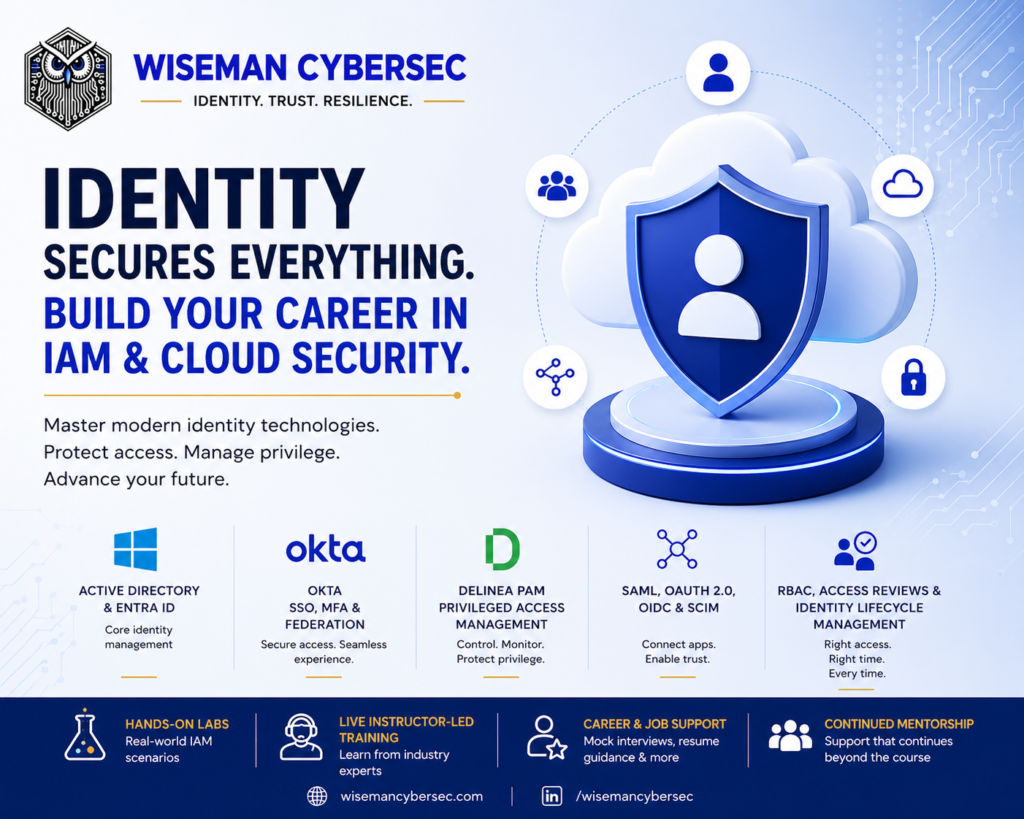
- Active Directory & Microsoft Entra ID
- Okta — SSO, MFA & Federation
- Delinea PAM
- AD/LDAP & Hybrid Identity
- SAML, OAuth 2.0, OIDC & SCIM
- RBAC, Access Reviews & Identity Lifecycle Management
The focus is not simply on learning a list of technologies. Learners work through hands-on labs, guided configurations and practical scenarios designed to connect IAM concepts with the type of problems organizations actually face.
Training Is Only One Part of Building a Career
A common problem in cybersecurity education is that people complete training but still do not know how to approach the job market. Technical knowledge matters, but candidates also need to know what roles to target, how to explain projects and labs, how to handle scenario-based interviews and how to present their skills effectively.
That is why the Wiseman CyberSec approach extends beyond classroom training with mentorship, practical exercises, mock interviews, résumé and LinkedIn guidance, interview preparation and continued career/job support.
Don’t just learn IAM. Learn how to build a career around it.
Who Should Consider IAM?
IAM can be particularly relevant for professionals coming from Active Directory administration, system administration, IT support, cloud administration, networking, SOC operations, cybersecurity, application support, GRC and infrastructure engineering.
You do not necessarily need to begin your cybersecurity career as a penetration tester or SOC analyst. Identity Security is another major route into cybersecurity — and for many professionals with infrastructure, Microsoft or cloud backgrounds, it may actually be a more natural transition.
The Bigger Picture: Identity Security and Cloud Security Are Converging
Cloud adoption has changed cybersecurity architecture. Applications are distributed. Employees are distributed. Infrastructure is distributed. Data is distributed. Identity is often the common control connecting everything together.
Before an organization grants access, it needs confidence in who the identity is, how it authenticated, what privileges it has, what resource it wants to access and whether that access should be trusted.
As cloud adoption continues, professionals capable of designing and operating these controls will remain an important part of enterprise cybersecurity teams.
Final Thought
A strong IAM career can grow from directory administration into Cloud IAM, PAM, Identity Governance, Zero Trust and eventually Identity Security Architecture.
IAM is not just another cybersecurity toolset. It can become an entire career.