Cybersecurity professionals eventually reach a point where technical skills alone are not enough.
You may understand networks, cloud security, IAM, incident response, vulnerability management, or security operations—but senior cybersecurity roles require something broader: the ability to understand how security works across an entire organization.
That is where the CISSP certification becomes highly relevant.
The Certified Information Systems Security Professional (CISSP) certification from ISC2 is one of the most recognized cybersecurity credentials for experienced professionals. Rather than focusing on a single technology, CISSP covers security architecture, risk management, network security, IAM, security operations, software security, assessment, and asset protection.
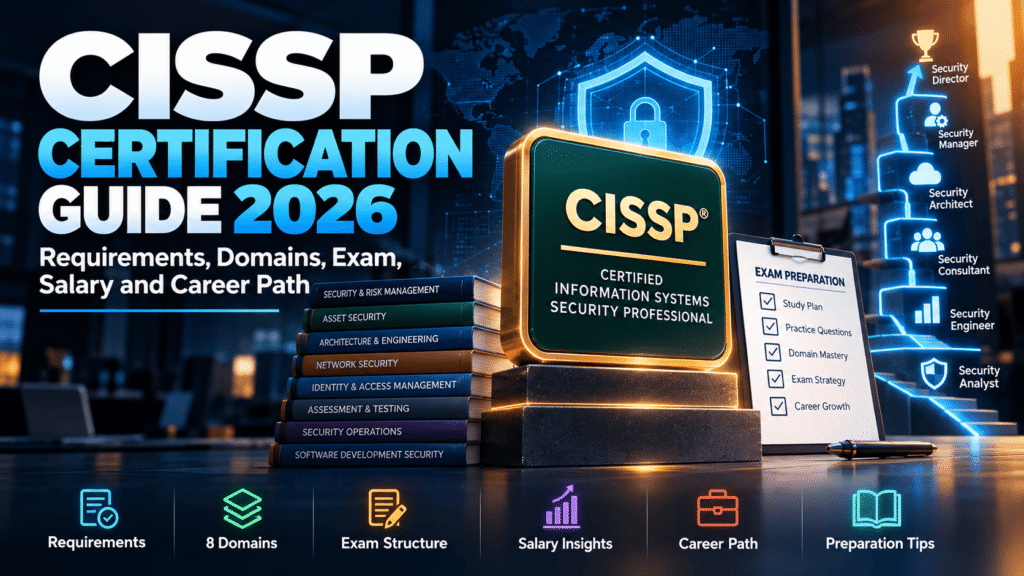
This guide explains what CISSP is, its eight domains, experience requirements, exam structure, difficulty, preparation strategy, career opportunities, and whether pursuing CISSP is worth it in 2026.
What Is CISSP?
CISSP stands for Certified Information Systems Security Professional.
It is a cybersecurity certification offered by ISC2 and is designed primarily for experienced security professionals who need broad knowledge across multiple areas of information security.
CISSP is particularly relevant for professionals moving toward roles such as:
- Security Architect
- Cybersecurity Manager
- Security Consultant
- Security Engineer
- Information Security Manager
- Security Lead
- Security Director
- Senior Security Analyst
- Cloud Security Architect
- Security Program Manager
Unlike certifications centered around one product or technology, CISSP is vendor-neutral.
The knowledge learned while preparing for CISSP can therefore be applied across different organizations, technologies, cloud environments, and security architectures.
Why Is CISSP Important?
Cybersecurity becomes increasingly interconnected as professionals move into senior positions.
An IAM decision can affect compliance.
A cloud architecture decision can create network-security risks.
A vulnerability-management decision can affect business continuity.
A new application can introduce privacy, identity, software-security, and data-protection concerns simultaneously.
Senior security professionals therefore need to understand the bigger picture.
CISSP develops this broader perspective.
Instead of asking only:
“How do I configure this security control?”
CISSP encourages professionals to consider:
“Why is this control necessary, what risk does it address, how should it be designed, and how does it support the organization’s security objectives?”
This shift in thinking is one of the reasons CISSP is commonly associated with experienced and senior cybersecurity roles.
Who Should Consider CISSP?
CISSP is generally most appropriate for professionals who already have cybersecurity or related IT experience.
It can be particularly useful for:
Security Engineers
Professionals who want to move from implementing individual controls toward designing complete security solutions.
SOC Professionals
Experienced SOC analysts and security operations professionals looking to progress into senior, architecture, consulting, or management positions.
IAM Professionals
Identity professionals who want broader knowledge of risk, network security, architecture, operations, and governance.
Network Security Professionals
Engineers working with firewalls, VPNs, segmentation, secure network architecture, and related technologies.
Cloud Security Professionals
Professionals responsible for securing cloud infrastructure, identities, applications, workloads, and data.
Security Consultants
Consultants frequently need to understand multiple security domains instead of specializing in only one technology.
Security Managers
Managers responsible for security programs, policies, teams, risk, compliance, and security operations can benefit significantly from CISSP’s broad curriculum.
IT Professionals Moving into Cybersecurity
Experienced infrastructure, networking, systems, cloud, or IT professionals may also use CISSP preparation to build a broader understanding of cybersecurity.
CISSP Experience Requirements
One of the major differences between CISSP and many entry-level cybersecurity certifications is its professional experience requirement.
To earn the CISSP certification, candidates generally need five years of cumulative paid work experience in two or more of the eight CISSP domains.
A relevant four-year degree or another credential recognized by ISC2 may satisfy up to one year of the required experience.
Candidates should always verify current eligibility requirements directly with ISC2 before applying because certification policies can change.
Can You Take CISSP Without Five Years of Experience?
Yes.
A candidate can pass the CISSP examination even without having the full required professional experience.
If you pass the examination but do not yet meet the experience requirement, you may become an Associate of ISC2 while gaining the required experience.
This creates an important distinction:
Passing the CISSP exam and holding the CISSP certification are not necessarily the same milestone.
Candidates must satisfy ISC2’s complete certification requirements before using the CISSP designation.
The 8 CISSP Domains
The CISSP Common Body of Knowledge is organized into eight domains.
These domains collectively cover a broad range of cybersecurity concepts.
Domain 1: Security and Risk Management
This domain establishes many of the governance and risk concepts used throughout CISSP.
Topics include:
- Confidentiality, Integrity and Availability
- Security governance
- Security policies
- Risk management
- Compliance
- Legal and regulatory requirements
- Professional ethics
- Business continuity
- Security awareness
- Threat modeling concepts
- Supply-chain risk
This domain is particularly important because CISSP questions often require candidates to think from a risk and business perspective, rather than choosing the most technically aggressive solution.
Domain 2: Asset Security
Asset Security focuses on protecting information throughout its lifecycle.
Topics include:
- Information classification
- Data ownership
- Data handling
- Data retention
- Data destruction
- Privacy
- Data security controls
- Asset management
Organizations cannot protect information properly without first understanding what information they have and how sensitive it is.
For example, an organization might classify information as:
Public → Internal → Confidential → Restricted
Different classifications can then receive different security controls.
Domain 3: Security Architecture and Engineering
This is one of the most technically broad CISSP domains.
It covers principles used when designing secure systems and architectures.
Topics can include:
- Security models
- Cryptography
- Secure architecture
- Hardware security
- Trusted computing
- Physical security
- System vulnerabilities
- Cloud architecture
- Industrial systems
- IoT security
Professionals studying this domain learn not simply how security technologies operate but how they fit into larger security architectures.
Domain 4: Communication and Network Security
Network security remains a fundamental cybersecurity skill.
This domain focuses on designing and securing communication systems and networks.
Topics include:
- OSI and TCP/IP concepts
- Network protocols
- Network architecture
- Firewalls
- VPNs
- Secure communication
- Network segmentation
- Wireless security
- Network attacks
- Secure network design
A CISSP candidate should understand how systems communicate and how attackers can exploit weaknesses in those communications.
Domain 5: Identity and Access Management
Identity has become one of the most important components of modern cybersecurity.
This CISSP domain covers concepts such as:
- Identification
- Authentication
- Authorization
- Federation
- Single Sign-On
- Multi-Factor Authentication
- Access control models
- Identity lifecycle
- Provisioning and deprovisioning
- Privileged access
- Access reviews
Professionals working with technologies such as Microsoft Entra ID, Active Directory, Okta, CyberArk, SailPoint, Saviynt, and other identity platforms will recognize many of these concepts.
However, CISSP approaches IAM from an architectural and security perspective rather than teaching configuration for a particular vendor.
Domain 6: Security Assessment and Testing
Security controls cannot simply be implemented and forgotten.
Organizations must continuously evaluate whether those controls actually work.
This domain covers:
- Security assessments
- Vulnerability assessments
- Penetration testing concepts
- Security audits
- Control testing
- Log reviews
- Testing strategies
- Reporting
- Security metrics
The goal is to determine whether security controls are functioning as intended and whether risks remain within acceptable levels.
Domain 7: Security Operations
Security Operations is one of the largest practical areas of cybersecurity.
It includes:
- Incident management
- Logging and monitoring
- Investigations
- Disaster recovery
- Business continuity
- Change management
- Patch management
- Vulnerability management
- Backup strategies
- Physical security
- Resource protection
Professionals working in SOC, DFIR, vulnerability management, infrastructure security, and operational security will find many familiar concepts here.
Domain 8: Software Development Security
Applications are a major attack surface.
The final CISSP domain focuses on integrating security throughout software development.
Topics include:
- Secure Software Development Lifecycle
- Application security
- Secure coding concepts
- Software vulnerabilities
- Security testing
- Change management
- DevSecOps concepts
- Third-party software
- Software risk
You do not need to become a professional developer to understand this domain.
Instead, CISSP candidates need to understand how security should be incorporated into software development and application architecture.
CISSP Domains at a Glance
| Domain | Main Focus |
| Security and Risk Management | Governance, risk, policy and compliance |
| Asset Security | Data classification and protection |
| Security Architecture and Engineering | Secure systems and architecture |
| Communication and Network Security | Networks and secure communications |
| Identity and Access Management | Authentication, authorization and identity |
| Security Assessment and Testing | Testing security controls |
| Security Operations | Incident response and operational security |
| Software Development Security | Secure software lifecycle |
The important point is that these domains should not be studied as completely independent subjects.
Real cybersecurity problems frequently involve several domains simultaneously.
What Is the CISSP Exam Like?
CISSP is not simply a memorization exam.
Candidates need to understand concepts and apply them to scenarios.
Questions may require you to determine:
- What should be done FIRST?
- What is the BEST solution?
- Which control MOST effectively reduces risk?
- Who should be responsible for a particular decision?
- Which approach best supports business requirements?
Several answers may appear technically possible.
The challenge is identifying the answer that best reflects security principles, risk management, governance, and business requirements.
This is why candidates with strong technical experience can still find CISSP challenging.
The CISSP Mindset
One of the biggest changes candidates need to make is moving from an engineer mindset to a broader security advisor mindset.
Imagine discovering a vulnerability.
A purely technical response might be:
Patch the vulnerable system immediately.
But a CISSP-style decision may require additional questions:
- What business process depends on the system?
- Has the risk been assessed?
- Could immediate patching cause an outage?
- Is change approval required?
- Are compensating controls available?
- Who owns the risk?
- What is the organization’s incident or change-management process?
CISSP teaches you to consider the entire context before making a security decision.
A useful principle during preparation is:
Understand the business requirement → assess the risk → follow governance → choose the appropriate security control.
Is CISSP Difficult?
CISSP can be challenging because of its breadth.
A candidate may be highly experienced in one domain but relatively unfamiliar with several others.
For example:
An IAM engineer may understand authentication and authorization deeply but have limited experience with software development security.
A SOC analyst may understand incident response and monitoring but need more work on governance and architecture.
A network engineer may be strong in communication security but less familiar with asset classification and risk management.
The challenge is therefore not necessarily extreme depth in every topic.
It is developing sufficient understanding across all eight domains and learning how the concepts interact.
Common CISSP Preparation Mistakes
Memorizing Without Understanding
Memorizing definitions can help, but scenario-based questions require conceptual understanding.
Ask yourself:
Why does this control exist?
What risk does it address?
When would it be appropriate?
Studying Only Your Strongest Domains
Candidates naturally enjoy studying areas they already understand.
That can create blind spots.
Your study plan should identify weak domains early and allocate additional time to them.
Thinking Only Like an Engineer
CISSP often evaluates decisions from a risk, governance, and management perspective.
The technically strongest solution is not automatically the best organizational decision.
Taking Practice Questions Too Early
Practice questions are most valuable after you understand the underlying concepts.
Otherwise, candidates may simply memorize answers without understanding the reasoning.
Using Too Many Resources
Using ten different books, five courses, and hundreds of videos can create unnecessary confusion.
A better strategy is to choose:
- One structured training source
- One primary study guide
- Official ISC2 material where appropriate
- Practice questions
- Your own revision notes
Consistency is more useful than collecting endless resources.
How to Prepare for CISSP
A structured preparation strategy can make the syllabus much easier to manage.
Step 1: Understand the Exam Structure
Before studying deeply, understand:
- The eight domains
- The current exam format
- Eligibility requirements
- Question style
- Current ISC2 exam policies
Always check ISC2’s official information because exam details can change.
Step 2: Assess Your Current Knowledge
Rate yourself across all eight domains.
For example:
| Domain | Current Knowledge |
| Security & Risk | Medium |
| Asset Security | Low |
| Architecture | Medium |
| Network Security | High |
| IAM | High |
| Assessment | Medium |
| Operations | High |
| Software Security | Low |
This immediately shows where your preparation should focus.
Step 3: Learn Concepts Before Memorizing
Instead of memorizing:
MFA = Multi-Factor Authentication
understand:
- What authentication factors are
- Why MFA reduces certain risks
- Where MFA can fail
- How authentication differs from authorization
- How federation works
- How SSO relates to identity
- How access should be governed
Understanding relationships makes information easier to retain.
Step 4: Connect Domains Together
Suppose an organization is deploying a new cloud application.
You can examine it through multiple CISSP domains.
Risk Management:
What risks does the application introduce?
Asset Security:
What data will it process?
Architecture:
How should the system be secured?
Network Security:
How will systems communicate?
IAM:
Who should have access?
Assessment:
How will controls be tested?
Operations:
How will incidents be detected and handled?
Software Security:
How will application vulnerabilities be managed?
Thinking this way develops the broader perspective CISSP expects.
Step 5: Practice Scenario-Based Questions
Once your fundamentals are strong, begin practicing scenario questions.
Do not simply check whether your answer was correct.
Ask:
Why is this answer correct?
and:
Why are the other answers less appropriate?
That reasoning process is more valuable than the score itself.
Step 6: Build a Revision Strategy
As the exam approaches, focus on consolidating information.
Useful revision material can include:
- Domain summaries
- Flashcards
- Architecture diagrams
- Risk-management concepts
- Cryptography fundamentals
- Network protocols
- IAM models
- Incident-response processes
- Business continuity concepts
- Secure development principles
Your final revision should reinforce concepts rather than introduce large amounts of completely new material.
How Long Does CISSP Preparation Take?
There is no universal preparation period.
The amount of time required depends heavily on:
- Existing cybersecurity experience
- Familiarity with the eight domains
- Study hours available each week
- Learning style
- Previous certifications
- Exam experience
An experienced security professional may need significantly less preparation than someone transitioning from a narrow technical specialization.
Instead of asking:
“Can I pass CISSP in 30 or 60 days?”
a better question is:
“Can I confidently understand and apply concepts across all eight domains?”
CISSP Career Opportunities
CISSP can support progression toward a variety of senior cybersecurity positions.
Common career paths include:
Security Architect
Designing security architecture across networks, applications, cloud environments, identities, and enterprise systems.
Cybersecurity Consultant
Advising organizations on risk, security architecture, governance, controls, and security strategy.
Information Security Manager
Managing security programs, teams, controls, policies, and organizational risk.
Security Engineering Lead
Leading security engineering teams and designing enterprise security solutions.
Cloud Security Architect
Designing security controls across cloud infrastructure, applications, identities, and workloads.
IAM Architect
Designing enterprise identity architectures involving authentication, authorization, federation, governance, and privileged access.
Security Director
Managing broader cybersecurity strategy, operations, risk, and organizational security programs.
CISSP does not automatically qualify someone for these positions, but it can complement the professional experience required for them.
CISSP Salary: Does CISSP Increase Your Salary?
CISSP is frequently associated with experienced cybersecurity roles, which can offer strong compensation.
However, there is no single “CISSP salary.”
Compensation depends on factors such as:
- Country
- City
- Experience
- Current role
- Technical specialization
- Management responsibility
- Industry
- Employer
- Security clearance requirements
- Additional certifications
A professional with CISSP plus strong cloud, IAM, application security, architecture, or security-engineering experience may have a very different salary from someone who has recently passed the exam.
The certification should therefore be viewed as a career accelerator and knowledge credential, rather than a guaranteed salary increase.
CISSP vs Technical Certifications
CISSP serves a different purpose from deeply technical certifications.
A technical certification may teach you:
How to configure or attack a particular technology.
CISSP focuses more broadly on:
How security should be designed, governed, assessed, and operated across an organization.
The two approaches complement each other.
For example:
CISSP + Cloud Security Skills
can support cloud security architecture roles.
CISSP + IAM Expertise
can support IAM architecture and identity-security leadership roles.
CISSP + Penetration Testing
can support broader security consulting roles.
CISSP + SOC/DFIR Experience
can support security operations leadership.
The strongest cybersecurity professionals often combine broad security knowledge with deep specialization in one or more areas.
CISSP vs CISM
CISSP and CISM are frequently compared, but they are not identical.
CISSP covers a broad range of security topics including:
- Architecture
- Networks
- IAM
- Security operations
- Risk
- Software security
- Asset protection
CISM places stronger emphasis on areas such as:
- Information security governance
- Risk management
- Security program development
- Security program management
- Incident management
Professionals interested in broad security architecture and technical-management knowledge may find CISSP particularly relevant.
Professionals focused heavily on security governance and program management may also consider CISM.
Some experienced professionals eventually earn both.
CISSP and Leadership
One misconception is that CISSP is only for managers.
That is not accurate.
CISSP is relevant to both senior technical professionals and security leaders.
A Security Architect may need to understand governance.
A Security Manager needs to understand technical risk.
A consultant needs both.
The certification sits at the intersection of:
Technology + Risk + Architecture + Governance + Operations
That combination is what makes CISSP valuable across many senior cybersecurity positions.
Is CISSP Worth It in 2026?
For the right professional, CISSP can still be a valuable certification.
It may be worth considering if you:
- Already work in cybersecurity or IT
- Want to move into senior cybersecurity positions
- Want broader knowledge beyond your specialization
- Want to move toward architecture
- Want to enter cybersecurity consulting
- Want to progress into security leadership
- Work across multiple security domains
- Need a widely recognized vendor-neutral security credential
However, CISSP should not replace practical experience.
The strongest profile is not:
CISSP without practical skills.
It is:
CISSP + practical cybersecurity experience + specialization + communication skills.
Building a Career Beyond CISSP
Passing CISSP should not be the final destination.
Cybersecurity professionals should continue developing practical expertise.
Depending on your career direction, you might deepen your knowledge in:
Identity Security
Microsoft Entra ID, Active Directory, Okta, IGA, PAM, federation, SAML, OAuth and OpenID Connect.
Cloud Security
AWS, Azure, Google Cloud, cloud IAM, workload security and cloud architecture.
Security Operations
SIEM, EDR, XDR, threat detection, incident response and digital forensics.
Governance, Risk and Compliance
ISO 27001, risk management, auditing, privacy and regulatory compliance.
Application Security
Secure SDLC, API security, threat modeling, penetration testing and DevSecOps.
PKI and Cryptography
Certificate Authorities, certificate lifecycle management, AD CS, HSMs and machine identities.
Your CISSP knowledge then becomes the foundation connecting these specialized skills.
Frequently Asked Questions About CISSP
What does CISSP stand for?
CISSP stands for Certified Information Systems Security Professional.
Who provides the CISSP certification?
CISSP is offered by ISC2.
How many domains are in CISSP?
The CISSP Common Body of Knowledge contains eight domains covering areas including risk management, asset security, architecture, networks, IAM, security testing, operations, and software security.
Is CISSP for beginners?
CISSP is primarily designed for experienced professionals and has professional experience requirements for certification.
Beginners may study CISSP concepts, but they should also focus heavily on building practical cybersecurity fundamentals and experience.
Can I take the CISSP exam without five years of experience?
Candidates can take and pass the examination before satisfying the complete experience requirement. Those who pass but do not yet meet the experience requirement may be eligible for Associate of ISC2 status while gaining the required experience.
Is CISSP technical or managerial?
CISSP includes both technical and management-oriented security concepts.
It covers technical areas such as networks, cryptography, IAM, architecture and software security while also covering governance, risk and security management.
Is CISSP difficult?
CISSP can be challenging because candidates must understand a broad range of security domains and apply that knowledge to scenario-based questions.
Does CISSP guarantee a cybersecurity job?
No certification can guarantee employment.
CISSP is most valuable when combined with relevant experience, practical skills, projects, communication abilities, and strong understanding of cybersecurity fundamentals.
Is CISSP useful for security architects?
Yes. Security architecture is one of the career areas where the broad security knowledge covered by CISSP can be particularly useful.
Should I choose CISSP or CISM?
The answer depends on your career direction. CISSP provides broad coverage across technical security, architecture, operations, risk and governance, while CISM is more concentrated on information-security management and governance.
Final Thoughts
CISSP is not about memorizing eight separate cybersecurity subjects.
Its real value is learning to see security as an interconnected system.
A security professional needs to understand how:
Business requirements influence risk.
Risk influences security architecture.
Architecture determines security controls.
Identity determines access.
Monitoring detects failures and attacks.
Incident response limits damage.
Governance ensures the entire process remains accountable.
That broader perspective becomes increasingly important as cybersecurity professionals move from individual technical tasks into architecture, consulting, leadership, and security decision-making.
If your goal is simply to add another certification to your résumé, CISSP preparation can become a memorization exercise.
But if your goal is to understand how cybersecurity works across an enterprise, CISSP can provide a strong framework for developing that knowledge.
At Wiseman CyberSec, our CISSP training focuses on understanding the concepts behind the eight domains, developing the right approach to scenario-based questions, and connecting certification knowledge with practical cybersecurity experience.
The objective is not simply to prepare you for an exam.It is to help you think like a cybersecurity professional capable of making security decisions across the enterprise.