How Third-Party Vendor Breaches Become Enterprise Security Crises
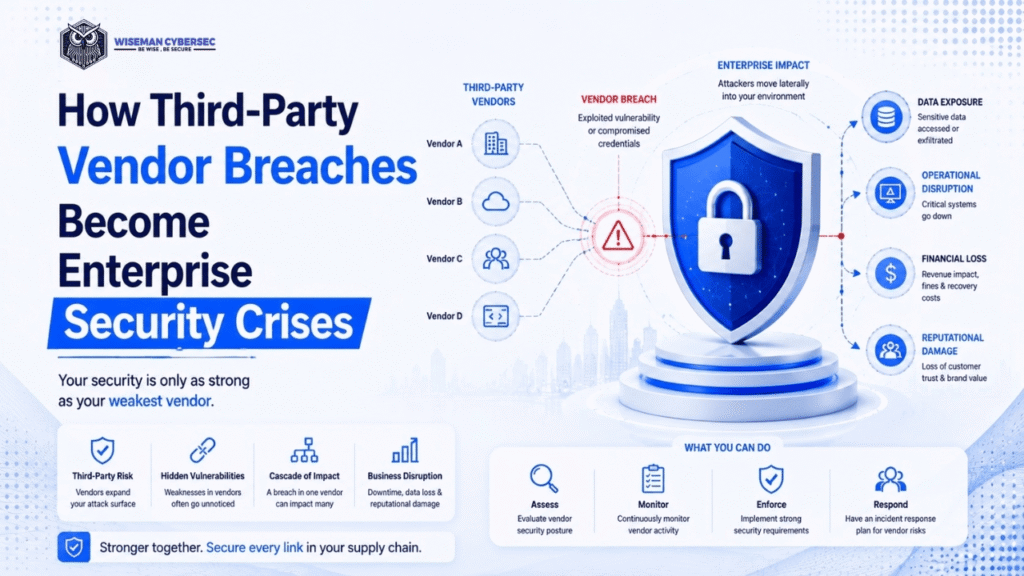
Introduction: In today’s interconnected digital ecosystem, cybersecurity extends far beyond an organization’s own network. Businesses increasingly rely on cloud platforms, SaaS applications, managed service providers (MSPs), consultants, payroll vendors, IT outsourcing firms, and numerous third-party partners to support critical operations. While these partnerships drive innovation and efficiency, they also introduce significant security risks. Every external vendor with access to your systems, applications, or sensitive data becomes part of your organization’s extended attack surface. If that vendor is compromised, the consequences can quickly escalate into a full-scale enterprise security crisis. Recent supply chain attacks have demonstrated that cybercriminals often target trusted third parties instead of attacking organizations directly. A single vulnerable supplier can become the gateway to data breaches, ransomware attacks, operational disruptions, regulatory penalties, and lasting reputational damage.Understanding and managing third-party risk is no longer optional—it’s a fundamental component of modern cybersecurity. Understanding Third-Party Risk: Third-party risk refers to the potential cybersecurity, operational, financial, and compliance risks introduced by external organizations that have access to your business assets. These vendors may include: Many organizations invest heavily in securing their own infrastructure while overlooking the security posture of their vendors. Unfortunately, attackers understand this weakness. A small supplier with privileged access can often become the easiest route into a much larger enterprise. This is why Third-Party Risk Management (TPRM) has evolved from a procurement requirement into a strategic cybersecurity function. How Vendor Breaches Become Enterprise Security Crises: A third-party breach becomes an enterprise-wide incident when attackers leverage the trust established between a vendor and the organization. Common attack vectors include: Once attackers gain access through a trusted vendor, they frequently: Because the traffic originates from trusted partners, malicious activity often goes undetected for extended periods, increasing the overall impact of the attack. Common Attack Paths: Third-party compromises generally follow predictable patterns. 1. Credential Theft: Attackers steal vendor usernames and passwords through phishing, malware, or credential leaks and use them to access customer environments. 2. Software Supply Chain Attacks: Cybercriminals compromise a vendor’s software development or update process, allowing malicious code to be distributed to thousands of customers simultaneously. 3. Remote Access Exploitation: Many IT vendors require administrative access to customer systems. Poorly secured remote access tools can become attractive entry points for attackers. 4. API Abuse: Insecure APIs between vendors and organizations may expose sensitive information or provide unauthorized system access. 5. Shared Infrastructure: Organizations that rely on shared cloud environments or integrated platforms may experience cascading compromise when a provider is breached. Business Impact of Third-Party Breaches: The consequences extend far beyond technical recovery. Data Exposure: Sensitive customer information, financial records, intellectual property, and confidential business data may be compromised. This often triggers: Operational Disruption: Critical business operations can come to a halt when vendors providing essential services become unavailable. Examples include: Financial Losses: Organizations frequently incur significant expenses, including: Reputational Damage: Customers rarely distinguish whether a breach originated internally or through a vendor. Loss of trust can result in: Why Traditional Vendor Assessments Fall Short: Many organizations still rely on annual questionnaires and compliance checklists to assess vendor security. While useful, these methods provide only a snapshot in time. Cyber threats evolve daily. A vendor that appeared secure during onboarding may experience a breach weeks later. Traditional assessments often fail because they: Effective Third-Party Risk Management requires ongoing visibility—not just periodic reviews. What Strong Vendor Security Looks Like: A mature vendor security program begins before a contract is signed. Organizations should: Security expectations should also be embedded into contracts, including: Vendor security should remain a continuous process throughout the business relationship. Practical Controls That Reduce Third-Party Risk: Organizations can significantly reduce exposure by implementing layered security controls. Recommended best practices include: Organizations should also maintain a complete inventory of vendors and identify which ones have access to critical systems or sensitive information. Evidence-based validation—such as independent security audits, penetration testing reports, and vulnerability management practices—is far more reliable than relying solely on vendor questionnaires. Governance Is the Key to Success: Third-party risk cannot be managed by cybersecurity teams alone. An effective TPRM program requires collaboration across multiple departments. Security Teams: Procurement: Legal Teams: Business Owners: Shared ownership reduces blind spots and enables faster decision-making during security incidents. Building a Mature Third-Party Risk Management Program: A comprehensive TPRM framework typically includes: Modern organizations increasingly use automation and continuous monitoring platforms to prioritize high-risk vendors and reduce assessment fatigue. The objective is not to eliminate every risk but to identify, prioritize, and effectively manage the risks that matter most. Final Thoughts: Third-party vendor breaches have become one of the most significant cybersecurity threats facing modern organizations. Attackers understand that trusted relationships often provide easier access than attacking well-defended enterprises directly. Without continuous oversight, strong governance, and enforceable security controls, a single vendor compromise can rapidly evolve into an enterprise-wide security crisis. Organizations that proactively invest in Third-Party Risk Management are better positioned to protect sensitive data, maintain business continuity, satisfy regulatory requirements, and preserve customer trust. In an era of increasingly interconnected digital ecosystems, cybersecurity is only as strong as the weakest link in your supply chain. Strengthening vendor security today is essential to protecting your organization tomorrow. – Wiseman CyberSec Secure Your Vendor Ecosystem Before Attackers Do– Third-party vendors shouldn’t become your biggest cybersecurity risk. Strengthen your supply chain security with expert-led Third-Party Risk Management, Vendor Risk Assessments, and Cybersecurity Training from Wiseman CyberSec.
SOC Analyst vs DFIR Analyst vs Threat Hunter: Understanding the Real Difference
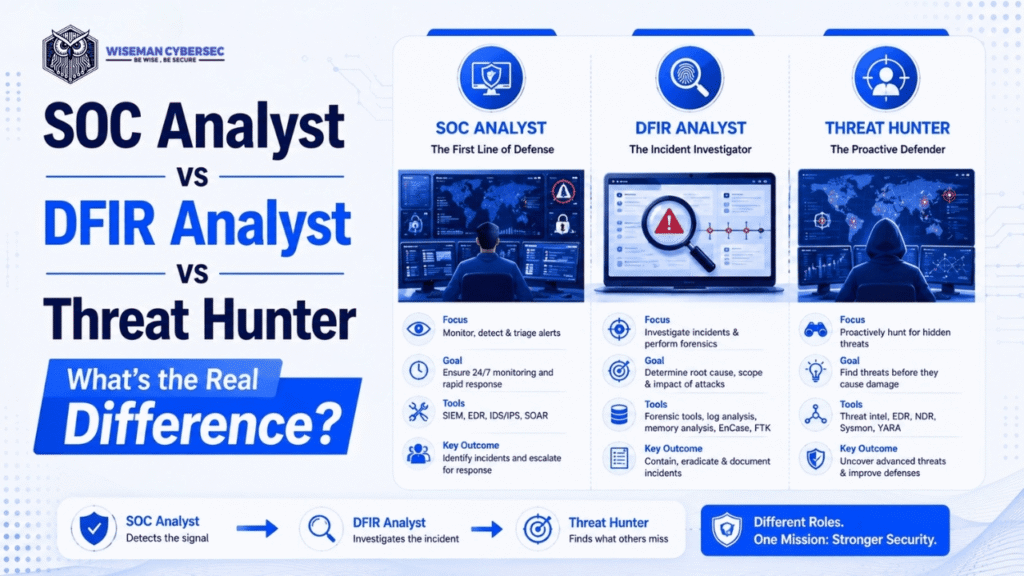
Introduction: As cyber threats become more sophisticated, organizations need specialized cybersecurity professionals to protect their environments at every stage of an attack. While the terms SOC Analyst, DFIR Analyst, and Threat Hunter are often used together, each role serves a distinct purpose within a mature Security Operations Center (SOC).Think of cybersecurity as a continuous defense cycle. One professional monitors for suspicious activity, another investigates and responds to confirmed incidents, while a third proactively searches for threats that traditional security tools may have missed.Although these roles work closely together, understanding their responsibilities, skill sets, and objectives is essential for organizations building security teams and for professionals planning a career in cybersecurity. The Cybersecurity Defense Lifecycle: A successful Security Operations Center follows a layered approach to cyber defense: Together, they create a comprehensive security strategy that helps organizations detect, respond to, and prevent cyberattacks. SOC Analyst – The First Line of Defense: A Security Operations Center (SOC) Analyst is responsible for continuously monitoring an organization’s network, systems, endpoints, and security tools for signs of malicious activity.Their primary objective is to identify, validate, and triage security alerts before they escalate into major incidents. Primary Responsibilities: Common Tools: SOC Analysts typically work with: Key Skills: Goal: Identify threats as quickly as possible and ensure rapid escalation to minimize business impact. DFIR Analyst – The Incident Investigator: Digital Forensics and Incident Response (DFIR) Analysts take over once a security incident has been confirmed. Rather than focusing on detection, they investigate exactly how the attack occurred, what systems were affected, how attackers gained access, and what evidence can be preserved. Their work combines technical investigation with structured incident response. Primary Responsibilities: Common Tools: DFIR professionals commonly use: Key Skills: Goal: Contain the incident, eradicate the threat, recover affected systems, and prevent similar attacks in the future. Threat Hunter – The Proactive Defender: Unlike SOC Analysts who respond to alerts, Threat Hunters actively search for threats that have not yet triggered security controls. Threat Hunting is hypothesis-driven and intelligence-led. Instead of waiting for alerts, Threat Hunters assume attackers may already be inside the environment and proactively look for indicators of compromise. This role requires strong analytical thinking and deep knowledge of attacker techniques. Primary Responsibilities: Common Tools: Threat Hunters frequently use: Key Skills: Goal: Discover threats before they become active security incidents and continuously strengthen the organization’s defensive posture. Comparing the Three Roles: SOC Analyst DFIR Analyst Threat Hunter How These Roles Work Together: These roles are not competitors—they complement each other as part of a unified cybersecurity defense strategy. A typical workflow looks like this: This collaborative approach enables organizations to respond faster, reduce attacker dwell time, and continuously strengthen their overall security posture. Which Career Path Should You Choose? Choosing between these roles depends on your interests and career goals. Choose SOC Analyst if you enjoy: Choose DFIR Analyst if you enjoy: Choose Threat Hunter if you enjoy: Many cybersecurity professionals begin as SOC Analysts before progressing into DFIR, Threat Hunting, Detection Engineering, or Security Architecture roles. Final Thoughts: Cybersecurity is no longer about a single role protecting an organization. Modern defense requires a coordinated team where each specialist contributes at a different stage of the attack lifecycle. SOC Analysts detect the signals, DFIR Analysts investigate and contain incidents, and Threat Hunters proactively uncover threats that traditional security controls may miss. Together, these professionals help organizations reduce risk, respond effectively to incidents, and build resilient security operations. Whether you’re starting your cybersecurity journey or expanding your Security Operations Center, understanding these distinct roles is essential for building a stronger, more proactive cyber defense strategy. – Wiseman CyberSec Advance Your Career in Cybersecurity Master the skills required for roles like SOC Analyst, DFIR Analyst, Threat Hunter, Security Analyst, and Incident Responder with Wiseman CyberSec’s hands-on cybersecurity training programs. Explore Our Cybersecurity & AI Security Courses and take the next step toward a successful career in cyber defense.
5 Common ISO 27001 Audit Mistakes Organizations Still Make
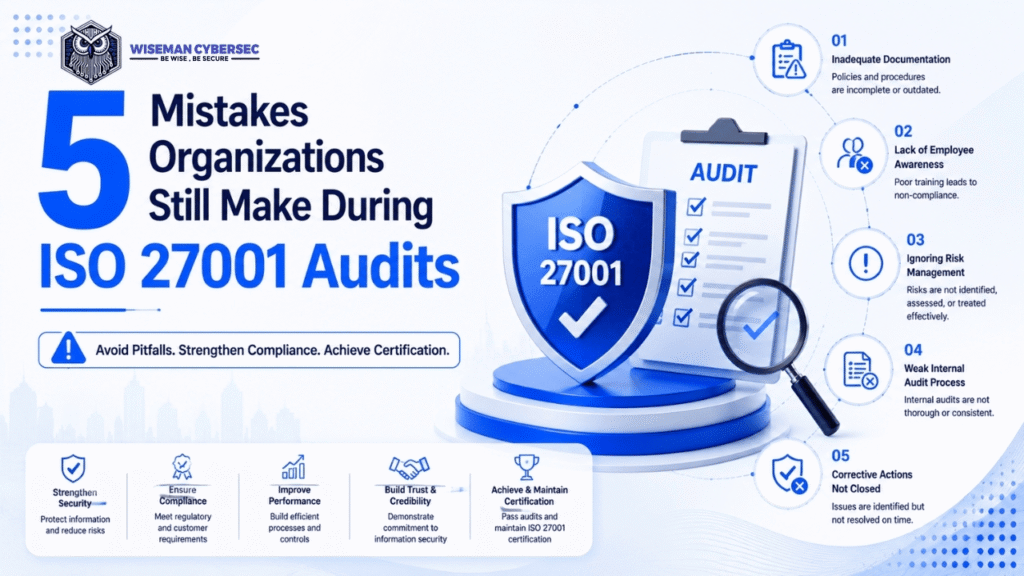
ISO 27001 certification is one of the most effective ways to demonstrate a strong information security management system. It helps organizations protect sensitive data, build customer trust, and show that security is managed through a structured and repeatable process. However, many organizations still struggle during audits because of avoidable mistakes that weaken compliance and create unnecessary findings. The good news is that most ISO 27001 audit issues are preventable. With the right documentation, employee awareness, risk management, internal audit discipline, and corrective action process, organizations can significantly improve their audit readiness and certification success. Why ISO 27001 audits matter: An ISO 27001 audit is not just a formal review of documents. It evaluates whether your organization’s information security management system is working in practice, not just on paper. Auditors want to see evidence that policies are implemented, risks are managed, employees are aware of their responsibilities, and corrective actions are tracked properly. For leadership, a successful audit reflects maturity, accountability, and resilience. For teams, it creates clarity around responsibilities and helps build a culture of security. That is why audit preparation should be treated as an ongoing business activity rather than a last-minute project. 1. Inadequate documentation: One of the most common reasons organizations struggle during an ISO 27001 audit is poor documentation. Policies may be incomplete, outdated, or not aligned with actual business processes. In some cases, documents exist only to satisfy the standard, but they are not actively used or reviewed. Auditors look for consistency between written policies and real-world practices. If the documentation says one thing and the organization does another, that inconsistency can lead to nonconformities. Strong documentation should be current, approved, version-controlled, and easy for relevant staff to access. How to avoid it: 2. Lack of employee awareness: Even the best policies fail if employees do not understand them. A common audit issue is weak security awareness across the workforce, especially when people cannot explain basic responsibilities such as incident reporting, password hygiene, access control, or data handling practices. ISO 27001 expects organizations to show that security awareness is part of daily operations. Training records alone are not enough if employees cannot apply what they learned. Auditors often ask staff how they would respond to phishing emails, suspicious activity, or unauthorized access attempts. How to avoid it: 3. Ignoring risk management: Risk management is the foundation of ISO 27001, yet many organizations treat it like a one-time compliance exercise. They complete a risk assessment during implementation but fail to update it when systems, vendors, regulations, or business processes change. This creates a disconnect between the ISMS and the actual risk environment. Auditors expect risk assessment and treatment to be active, not static. Risks should be identified, evaluated, assigned, treated, and reviewed on a regular basis. If the risk register is outdated, it suggests that the organization is not managing information security in a structured way. How to avoid it: 4. Weak internal audit process: Many organizations treat internal audits as a formality before the certification audit. That approach is risky because internal audits are meant to identify weaknesses early and help the organization improve before external auditors arrive. A weak internal audit process often means gaps are discovered too late or not at all. A good internal audit should be independent, risk-based, and thorough. It should cover applicable clauses, controls, and operational evidence. If internal audits are rushed or performed without proper expertise, the organization loses one of its most valuable tools for maintaining audit readiness. How to avoid it: 5. Corrective actions not closed: Another major audit mistake is failing to close corrective actions properly. Organizations may identify a nonconformity but then delay root cause analysis, correction, or follow-up. This creates repeat issues and weakens confidence in the management system. ISO 27001 auditors expect a complete corrective action cycle: identify the issue, determine the root cause, implement a fix, verify effectiveness, and document closure. If this process is inconsistent, the organization may appear reactive rather than mature and controlled. How to avoid it: What auditors look for : Auditors are not only checking whether you have documents in place. They are looking for evidence of discipline, consistency, and continuous improvement. They want to see that leadership is involved, employees understand their roles, risks are actively managed, and corrective actions are tracked effectively. A well-prepared organization usually demonstrates: How to improve audit readiness: The best way to prepare for an ISO 27001 audit is to make readiness part of everyday operations. Organizations that wait until the audit date is near often struggle with missing evidence, untrained staff, and unresolved actions. In contrast, organizations that build regular reviews into their ISMS are far more likely to succeed. A practical preparation cycle includes reviewing documentation, checking risk assessments, testing staff awareness, running internal audits, and closing any open findings. This creates a stronger system and reduces stress when the external audit begins. Final thoughts: ISO 27001 audits do not have to be stressful. Most problems come from preventable weaknesses rather than complex technical failures. By improving documentation, awareness, risk management, internal audits, and corrective action closure, organizations can build a more reliable and audit-ready ISMS. If your goal is certification, focus on consistency over speed and evidence over assumptions. A well-managed ISMS not only helps you pass the audit but also strengthens your long-term security posture. – Wiseman CyberSec Ready to simplify your ISO 27001 audit journey? Avoid common audit pitfalls with expert guidance from WisemanCyberSec. Whether you’re preparing for certification, conducting internal audits, or strengthening your ISMS, our cybersecurity professionals can help you achieve compliance with confidence. Contact WisemanCyberSec today to schedule an ISO 27001 consultation and assess your audit readiness.
Why Cybersecurity Is No Longer Just Technical: A Business Imperative for Every Organization
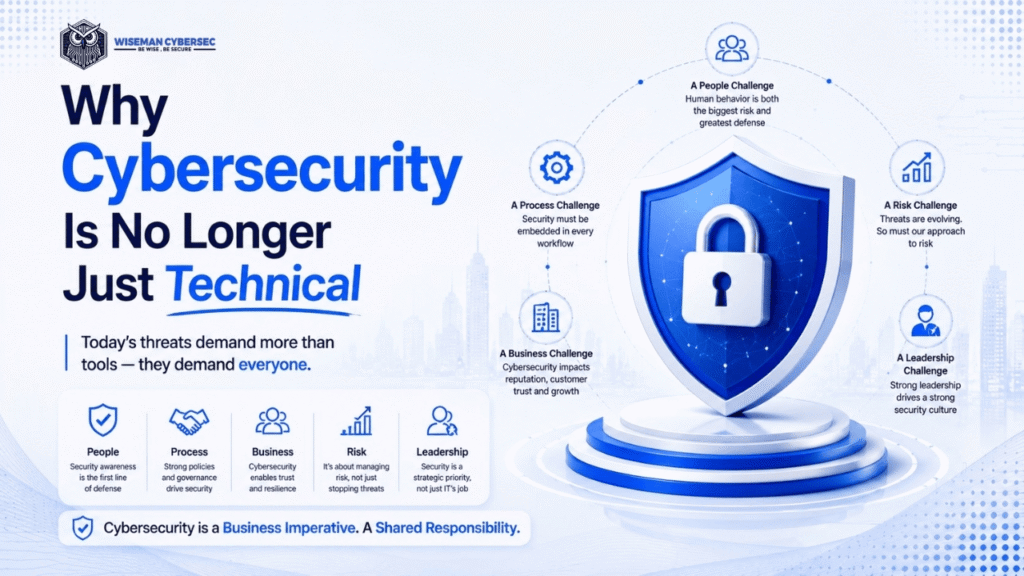
For many years, cybersecurity was treated as a narrow technical discipline owned by the IT department. Firewalls, antivirus tools, patching, and network defenses were seen as the primary answer to security threats. That approach is no longer enough. Today’s threat landscape is more complex, more human-driven, and more business-critical than ever before. Cybersecurity now affects reputation, customer trust, compliance, operations, revenue, and long-term resilience. The central message of this post is clear: cybersecurity must be embedded across the entire organization. It is not just about protecting systems; it is about protecting the business itself. When security is viewed only as a technical issue, organizations tend to react late, overlook human behavior, and create gaps between policy and practice. A modern security program must connect technology with governance, culture, leadership, and business strategy. The shift from technical to strategic: Cyber threats have evolved far beyond basic malware or unauthorized access attempts. Attackers now exploit people through phishing, social engineering, credential theft, business email compromise, and insider misuse. They target business processes, third-party relationships, cloud environments, and supply chains. This means that defending an organization requires more than technical controls alone. Security leaders must now think strategically. Cybersecurity decisions affect hiring, training, procurement, vendor selection, remote work policies, customer experience, and crisis management. In other words, security is not a separate layer added at the end; it is part of how the business operates from the beginning. The people challenge: Human behavior remains one of the biggest security risks. Employees can accidentally click malicious links, reuse weak passwords, mishandle sensitive data, or bypass procedures under pressure. At the same time, people are also the organization’s first and strongest line of defense when they are trained, informed, and empowered. This is why awareness programs alone are not enough. Organizations need a security culture where employees understand why controls exist and how their actions affect the company. That includes role-based training, leadership messaging, clear reporting channels, and practical guidance for everyday decisions. When people become part of the defense strategy, the organization becomes significantly harder to attack. The process challenge: Even the best security tools fail when processes are weak or ignored. Security must be embedded into workflows, not layered on as an afterthought. That means secure onboarding and offboarding, access reviews, change management, incident response procedures, backup testing, vendor risk checks, and documented approval paths. Strong processes create consistency. They reduce reliance on individual memory and ensure that security decisions are repeatable and measurable. In frameworks such as ISO 27001, this process-driven approach is essential because it ties security to governance, accountability, and continuous improvement. The goal is not just to prevent incidents, but to build an organization that can respond, recover, and adapt. The business challenge: Cybersecurity has direct business impact. A security incident can disrupt operations, delay services, damage client confidence, trigger legal exposure, and affect revenue. For customer-facing organizations, one breach can quickly become a reputation crisis. For regulated industries, the consequences may include fines, audits, and contractual loss. This is why business leaders must treat cybersecurity as a core business function. It is not merely a cost center or a technical overhead. It protects trust, preserves continuity, and supports growth. If the business depends on digital systems, customer data, and connected operations, then security is inseparable from business performance. The risk challenge: Risk is not static. Threats evolve, attackers adapt, and business environments change constantly. Remote work, cloud adoption, AI-enabled attacks, third-party dependencies, and shadow IT have expanded the attack surface. Security programs must therefore shift from a one-time control mindset to an ongoing risk management approach. A risk-based security strategy helps organizations prioritize what matters most. Not every asset carries the same level of exposure, and not every threat has the same business impact. Mature organizations assess likelihood and impact, apply controls where they matter most, and continuously review priorities as conditions change. This is what makes cybersecurity sustainable instead of reactive. The leadership challenge: Leadership determines whether cybersecurity becomes a real organizational priority or remains a technical checkbox. Strong leaders set the tone, allocate resources, demand accountability, and create a culture where security is taken seriously. Without leadership support, security teams often struggle to get buy-in for policy enforcement, training, investments, and process changes. Leaders do not need to be technical experts to support cybersecurity effectively. They do need to ask the right questions, understand business risk, and treat security as part of corporate governance. When executives visibly support security, teams across the organization are more likely to follow. That top-down commitment is often what separates mature organizations from vulnerable ones. Why shared responsibility matters: The post correctly frames cybersecurity as a shared responsibility. IT teams, security professionals, executives, managers, employees, vendors, and even customers all play a role in protecting the organization. No single team can stop every threat alone. Shared responsibility means that everyone has a part to play. Employees must follow secure practices, managers must enforce policies, executives must sponsor the program, and security teams must design practical controls that support business goals. When responsibility is distributed clearly, security becomes more resilient and far more effective. Building a modern security culture: A strong cybersecurity culture does not happen by chance. It is built through consistent communication, leadership commitment, process discipline, and ongoing education. Organizations should make security visible, understandable, and relevant to daily work. Practical steps include: These practices help move security from theory into daily behavior. Over time, they create an environment where secure choices become normal choices. Conclusion: Cybersecurity is no longer just a technical function because modern threats do not stay within technical boundaries. They affect people, processes, business operations, leadership decisions, and organizational risk. The most resilient organizations are the ones that treat security as a business imperative and a shared responsibility. – Wiseman CyberSec Ready to build a cybersecurity culture that protects your business? Explore Wiseman CyberSec’s cybersecurity, risk management, and governance training programs to empower your teams, strengthen resilience, and stay ahead of evolving threats.
AI-Operated Cyberattacks Are Here: What Security Teams Need to Learn from the Latest Claude AI Abuse Case
Artificial Intelligence is changing cybersecurity faster than many organizations expected. For defenders, AI is helping with faster alert triage, threat intelligence analysis, malware investigation, phishing detection, and security automation. But the same technology is now being adopted by attackers to increase speed, scale, and efficiency. A recent report highlighted that Chinese state-sponsored threat actors allegedly used Anthropic’s Claude AI to support a highly automated cyber-espionage campaign targeting around 30 global organizations, including technology companies, financial institutions, chemical manufacturers, and government agencies. The activity reportedly took place in mid-September 2025 and involved the misuse of Claude Code and related tooling to automate large parts of the attack lifecycle. This incident is important because it shows a shift from AI-assisted hacking to AI-operated hacking. From AI as an Assistant to AI as an Attack Operator: Until now, most AI misuse in cybercrime was seen in areas such as phishing email generation, basic script writing, social engineering content, or malware modification attempts. This case is different. According to the report, the attackers did not simply use AI to ask for advice. They allegedly used AI’s agentic capabilities to perform tactical cyber operations across multiple stages of the attack chain. The AI was reportedly used for: • Reconnaissance and attack surface mapping• Vulnerability discovery• Payload generation and validation• Exploitation support• Credential harvesting• Lateral movement assistance• Data analysis• Exfiltration-related decision support• Attack documentation This means AI was not just helping write commands. It was being used to break down complex cyber operations into smaller tasks and execute them at speed. Why This Matters for Security Leaders: The biggest concern here is scale. In a traditional cyberattack, multiple skilled operators may be needed to perform reconnaissance, identify vulnerabilities, write payloads, validate access, analyze stolen data, and document findings. With agentic AI, one operator may be able to manage a much larger volume of activity. That changes the economics of cyberattacks. Attackers can move faster.They can test more targets.They can automate repetitive tasks.They can reduce dependency on large technical teams.They can potentially scale campaigns that earlier required more time, skill, and manpower. For organizations, this means the window to detect and respond may become much shorter. The Human Role Has Not Disappeared: One important point is that the campaign was not fully independent. Human operators were still involved in key decisions, such as selecting targets, approving escalation from reconnaissance to exploitation, deciding when to use harvested credentials, and determining what data should be retained or exfiltrated. This tells us something important. AI is not replacing attackers completely. It is increasing their operational capacity The attacker still provides strategy.The AI accelerates execution. That combination is what makes this threat serious. AI Still Makes Mistakes: The report also highlighted a major limitation: AI hallucination. In some cases, the AI reportedly generated fake credentials or incorrectly treated publicly available information as sensitive findings. This shows that AI-operated attacks are not perfect. They still require human validation. But even with these limitations, the ability to automate 70–90% of tactical work can still create a major advantage for threat actors. For defenders, this is a warning. We should not underestimate AI-enabled attackers just because AI makes mistakes. Even imperfect automation can create pressure on security teams. Identity Security And Zero Trust: Identity security is a foundational part of Zero Trust. The Zero Trust model assumes that no user, device, or network should be trusted automatically. Every access request must be evaluated before it is approved. This is only possible when identity is at the center of the architecture. Identity provides the data and controls needed to verify users, enforce policy, and make access decisions based on real-time risk. In a Zero Trust model, identity is not a one-time login step. It is a continuous trust mechanism that supports secure access throughout the session. This is one reason why identity security is becoming more important than traditional perimeter controls. What This Means for SOC and Blue Teams: Security Operations Centers must prepare for a future where attackers operate faster and with more automation. Traditional alert monitoring will not be enough. SOC teams need stronger capability in: The focus should move from simply collecting alerts to understanding attacker behavior. If attackers are using AI to speed up reconnaissance and exploitation, defenders must improve visibility, response speed, and contextual analysis. Identity Security Becomes Even More Critical: A major part of modern attacks involves credential theft, privilege escalation, and lateral movement. When AI is used to automate post-exploitation tasks, weak identity controls become even more dangerous. Organizations should focus on: Identity is now one of the most important security control points. The New Skill Requirement: AI-Aware Cybersecurity Professionals: Cybersecurity professionals must now understand both sides of AI. They need to know how AI can help defenders, but also how attackers may abuse it. This includes understanding: The next generation of SOC analysts, threat hunters, incident responders, and security leaders must be trained for this new reality. Wiseman CyberSec Perspective: At Wiseman CyberSec, we believe this incident is a clear signal that cybersecurity training and security operations must evolve. The industry cannot rely only on traditional tool-based learning. Security professionals need hands-on exposure to real-world attack scenarios, practical detection logic, open-source security tools, adversary behavior, AI-assisted investigation, and modern incident response workflows. AI will not remove the need for cybersecurity professionals. But it will raise the standard. The professionals who understand AI-driven threats, attacker tradecraft, and defensive automation will be far better prepared for the future. Final Takeaway: AI-operated cyberattacks are no longer a future risk. They are already becoming part of the threat landscape. For organizations, the message is clear: The attackers are evolving. Security teams must evolve faster. – Wiseman CyberSec Stay Ahead of AI-Driven Threats- Cyberattacks are evolving faster than ever. Build practical cybersecurity skills in SOC operations, threat hunting, incident response, and modern defensive strategies.
Why Organizations Are Prioritizing Identity Security Over Traditional Perimeter Security
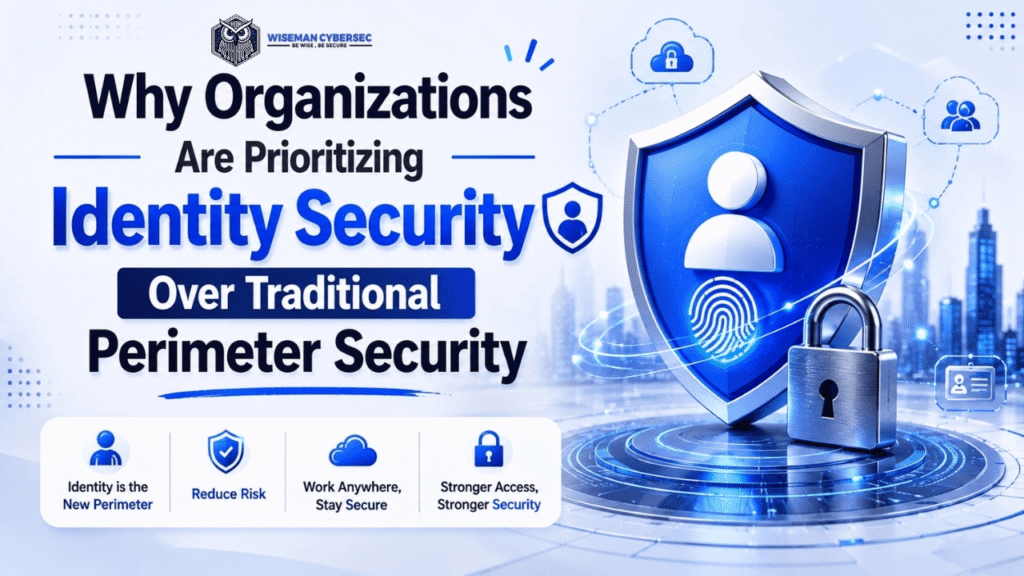
Organizations are shifting away from traditional perimeter-based security because the perimeter itself has changed. With cloud adoption, remote work, SaaS applications, mobile devices, and distributed teams, security can no longer depend on a fixed network boundary. Identity security has become the new control point because access now matters more than location. Instead of asking whether a user is inside the network, organizations are asking who the user is, what device they are using, what risk they pose, and whether they should be trusted at all. The Problem With Traditional Perimeter Security: Traditional perimeter security was built around a simple idea: keep threats outside the network and trust what is inside. Firewalls, VPNs, and network segmentation were effective when employees worked in offices and most applications stayed on-premises. That model is much less effective today. Users connect from home, coffee shops, airports, and personal devices. Applications run in cloud environments. Data moves across multiple platforms and third-party services. In this environment, the perimeter is no longer a clear line, which makes perimeter-only security too weak for modern risk. Attackers also know this. Rather than trying to break through a firewall, they often target identities directly through phishing, credential theft, password spraying, MFA fatigue attacks, token abuse, and privilege escalation. Once identity is compromised, the attacker may appear legitimate and bypass traditional boundary defenses. Why Identity Has Become The New Perimeter: Identity is now the most important security control because it governs access to systems, applications, and data. If an organization can verify identity accurately and enforce access policies intelligently, it can reduce risk across the entire environment. This shift reflects a broader security principle: trust should not be based on network location alone. Instead, trust should be determined through identity, device posture, user behavior, application sensitivity, and contextual risk signals. In practice, this means the user’s identity becomes the gateway to everything else. Whether a person is trying to access email, financial records, customer data, or cloud resources, identity controls determine whether that access is allowed, limited, or blocked. How Identity Security Reduces Risk: Identity security reduces risk by ensuring that access is tightly controlled and continuously validated. This includes strong authentication, least privilege access, conditional access policies, privileged access management, and identity governance. When done properly, these controls prevent unauthorized access, limit lateral movement, and reduce the impact of compromised accounts. Even if an attacker obtains a password, additional controls such as multifactor authentication, risk-based policies, and device compliance checks can stop the breach from progressing. Identity security also helps organizations respond faster. If a suspicious sign-in is detected, access can be challenged, limited, or revoked immediately. That kind of control is much harder to achieve with perimeter defenses alone. Supporting Modern Work Styles: One of the biggest reasons organizations are prioritizing identity security is that people work from everywhere now. Employees, contractors, partners, and vendors all need access to corporate systems, often outside the traditional office network. Identity-based security makes this possible without sacrificing control. Users can access what they need from anywhere, while the organization still enforces authentication, authorization, and policy-based restrictions. This creates a better balance between security and productivity. It also supports a better user experience. Single sign-on, passwordless authentication, and adaptive access policies make it easier for users to work securely without repeatedly logging in or dealing with unnecessary friction. Identity Security And Zero Trust: Identity security is a foundational part of Zero Trust. The Zero Trust model assumes that no user, device, or network should be trusted automatically. Every access request must be evaluated before it is approved. This is only possible when identity is at the center of the architecture. Identity provides the data and controls needed to verify users, enforce policy, and make access decisions based on real-time risk. In a Zero Trust model, identity is not a one-time login step. It is a continuous trust mechanism that supports secure access throughout the session. This is one reason why identity security is becoming more important than traditional perimeter controls. The Role Of Strong Access Controls: A major advantage of identity security is stronger access control. Organizations can assign permissions based on role, responsibility, and context instead of giving broad access to entire network segments. This reduces unnecessary exposure and helps enforce the principle of least privilege. Users get access only to what they need, when they need it, and in the way they need it. That significantly lowers the chance of misuse or accidental overexposure. Strong access controls are especially important for privileged accounts, sensitive data repositories, administrative consoles, and cloud platforms. These are the areas attackers often target first after gaining entry. Business Benefits Beyond Security: Identity security is not only about reducing attacks. It also supports business agility, compliance, and digital transformation. Organizations can onboard users faster, manage access more efficiently, and maintain better oversight of who has access to what. This is particularly valuable in large enterprises where manual access management can become slow and error-prone. Identity governance helps automate approvals, reviews, and lifecycle changes, which improves both security and operational efficiency. It also helps organizations demonstrate compliance. Many frameworks and audits expect clear evidence of authentication controls, access reviews, and privileged access oversight. Identity security provides the structure needed to meet those expectations. Why The Shift Will Continue: The move from perimeter security to identity security is not a temporary trend. It is a response to how business and technology actually work now. As cloud environments expand, AI-driven attacks increase, and organizations continue to operate in distributed models, identity will remain the most practical place to enforce security. Perimeter tools will still matter, but they are no longer enough on their own. The future of cybersecurity will be built around identity, context, and continuous verification. Organizations that invest in identity security today will be better prepared for that future. Final Thoughts: Organizations are prioritizing identity security over traditional perimeter security because the environment has changed, the threats have changed, and the way people work has changed. Identity
How Modern DFIR Teams Investigate Enterprise Cyber Attacks
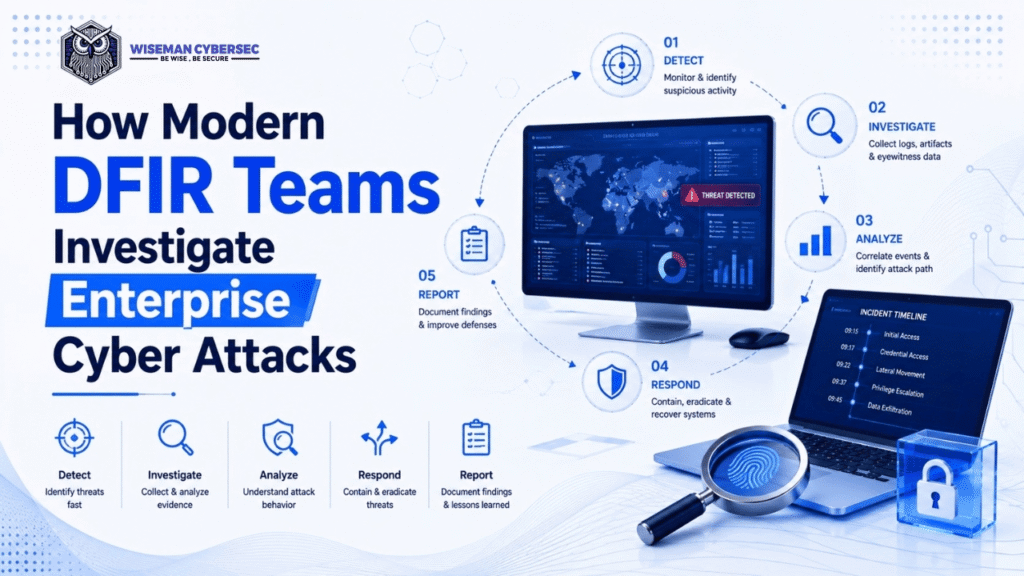
Modern digital forensics and incident response, or DFIR, teams are the backbone of enterprise cyber defense when an attack is detected. Their job is not only to identify what happened, but also to understand how it happened, how far it spread, what data or systems were affected, and what the organization must do next to recover safely. In today’s threat landscape, attacks are faster, more complex, and more distributed than ever before. That means DFIR teams must work through a structured process that combines technical analysis, evidence preservation, containment, communication, and recovery. Why DFIR Matters In Modern Enterprises: Enterprises no longer face only isolated malware incidents. They deal with phishing, credential theft, ransomware, insider misuse, supply chain compromise, cloud intrusion, and advanced persistent threats. In many cases, the attacker moves through multiple systems before the organization even realizes there is a problem. DFIR teams help organizations respond with clarity instead of panic. They provide the technical truth behind the incident, which is essential for decision-making, legal review, executive communication, and post-incident improvement. A strong DFIR capability also reduces downtime. The faster a team can identify the attack path and contain the threat, the lower the operational and financial impact tends to be. The Five Core DFIR Stages The banner highlights a five-step process: detect, investigate, analyze, respond, and report. This sequence reflects how structured incident response works in real enterprises. Good detection is about more than seeing an alert. It requires understanding what “normal” looks like across users, devices, applications, and network flows so that unusual activity stands out quickly. The faster an organization detects a threat, the more options it has for limiting damage. Investigation answers the “what happened?” question. Teams try to determine how the attacker gained access, which accounts were used, what systems were touched, and whether the adversary still has a foothold in the environment. This is where DFIR becomes especially valuable. A single alert may not reveal much on its own, but when logs, authentication events, process activity, and network connections are combined, a clear picture of the intrusion can emerge. Effective response depends on good analysis. If the team responds too early without enough evidence, it may miss hidden persistence. If it responds too late, the attacker may expand access or exfiltrate more data. This report is not just for technical staff. It is often used by executives, legal teams, compliance teams, insurers, auditors, and sometimes regulators or law enforcement. A strong report helps the organization learn from the incident and strengthen its defenses. What DFIR Teams Look For: A professional DFIR investigation usually focuses on several core questions. How did the attacker enter? What systems were affected? Was data stolen? Are there signs of persistence? Has the attacker been fully removed? To answer these questions, teams look at endpoint processes, event logs, authentication records, suspicious scripts, registry changes, scheduled tasks, lateral movement indicators, and exfiltration paths. They also preserve evidence carefully so that the investigation remains defensible and accurate. This evidence-based approach is critical because assumptions can be dangerous. In a serious incident, what looks like a simple malware infection may actually be part of a larger intrusion campaign. The Importance Of Speed And Accuracy: DFIR teams must balance urgency with precision. Enterprises need fast answers, but they also need accurate ones. A rushed conclusion can lead to the wrong containment action, while a slow response can allow the threat to spread further. That is why mature DFIR teams work in parallel. While one group handles containment, another collects evidence, another analyzes attack behavior, and another prepares communication for leadership. This coordinated approach improves both speed and quality. DFIR In Cloud And Hybrid Environments: Modern enterprise attacks rarely stay inside one environment. They often involve cloud accounts, SaaS applications, remote endpoints, identity providers, and on-premises systems all at once. This makes DFIR more challenging and more important. In cloud and hybrid environments, investigators must look across multiple layers of telemetry. Identity logs, API activity, configuration changes, mailbox access, cloud workload alerts, and endpoint alerts may all be part of the same attack chain. A modern DFIR team must be comfortable working across all of these data sources. Why Reporting Matters After Containment: Once the incident is contained and systems begin to recover, reporting becomes essential. The final report captures what happened, what was done, what evidence was found, and how the organization can improve. This report often leads to policy changes, technical hardening, training updates, and control improvements. In that sense, DFIR is not only about incident handling; it is also about organizational learning and resilience. What Makes A Strong DFIR Team: A strong DFIR team combines technical depth, discipline, and clear communication. Members must know how to work with evidence, understand attack behavior, communicate with stakeholders, and operate under pressure. They also need strong collaboration with SOC, IT, cloud, legal, HR, compliance, and executive leadership. Cyber incidents are rarely isolated technical events, so the response must be cross-functional and coordinated. Final Thoughts: Modern DFIR teams are essential because enterprise cyberattacks are no longer simple or contained. They are fast-moving, multi-stage, and often designed to evade detection for as long as possible. A strong DFIR process helps organizations detect threats early, investigate them thoroughly, analyze the full attack path, respond effectively, and report findings that improve future defenses. The real value of DFIR is not just in solving incidents. It is in helping organizations recover with confidence and become harder to attack the next time. Ready to strengthen your incident response capabilities? Connect with Wiseman Cybersec for expert DFIR, Threat Hunting, and Managed Security Services..
Top Microsoft Entra ID Interview Questions and Answers for 2026
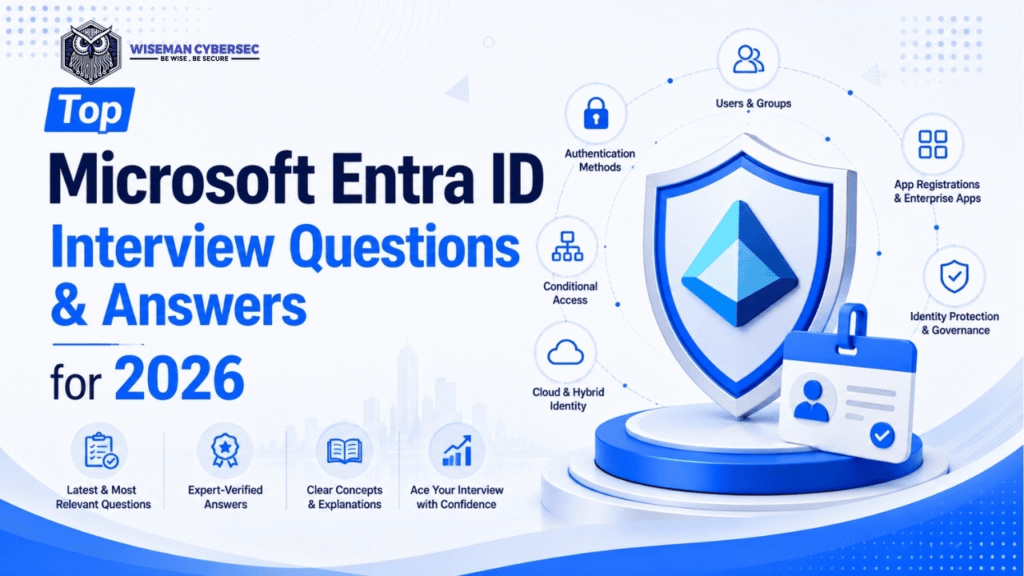
Microsoft Entra ID has become one of the most important identity platforms in modern enterprises, especially as organisations continue shifting toward cloud, hybrid work, Zero Trust, and stronger access governance. For professionals preparing for IAM, cloud security, or identity-focused interviews in 2026, understanding Microsoft Entra ID at both conceptual and practical levels is essential. This article provides an in-depth explanation of the most important interview questions, the ideas behind them, and the kind of answers interviewers typically expect. It is designed not just to help you memories definitions, but to help you explain Entra ID confidently in real-world scenarios. Why Microsoft Entra ID Matters: Microsoft Entra ID, formerly known as Azure Active Directory, is Microsoft’s cloud-based identity and access management solution. It helps organizations manage authentication, authorization, users, groups, applications, and secure access across cloud and hybrid environments. Its importance has increased because identity is now the control plane of security. Instead of relying only on network boundaries, organizations are using identity as the foundation for access decisions, risk detection, and policy enforcement. For interviews, this means candidates should be able to explain not just what Entra ID is, but also why it matters in Zero Trust architectures, cloud adoption strategies, and identity governance programs. Core Concepts To Understand: Before answering interview questions, it is important to understand the main building blocks of Entra ID. These include users and groups, authentication methods, app registrations, enterprise applications, conditional access, identity protection, and cloud or hybrid identity. Interviewers often expect candidates to connect these concepts rather than describe them in isolation. For example, app registrations are related to application identity, enterprise applications relate to service access and permissions, and conditional access controls how users are allowed to authenticate under specific conditions. A strong candidate should also understand how Entra ID integrates with Microsoft 365, Azure, SaaS apps, and on-premises Active Directory environments. That integration story is often where practical interview questions come from. Common Interview Questions: A good answer should also mention that it supports single sign-on, multifactor authentication, conditional access, identity governance, and hybrid identity scenarios. A strong answer should mention that AD is best suited for traditional internal network environments, while Entra ID is built for cloud apps, remote access, and modern authentication. In hybrid organizations, both often work together. Interviewers usually want to hear that it is not just a login check, but a dynamic decision-making layer. It is a key part of Zero Trust because it helps organizations enforce access only when the right conditions are met. A practical answer should explain that app registration is more about configuration and identity definition, while an enterprise application is more about how the app is actually used inside the organization. A strong interview answer should mention user risk, sign-in risk, risk-based policies, and the idea that the system can help enforce remediation actions such as requiring password reset or step-up authentication. Authentication And Access Topics: Authentication methods are a major interview area because they are central to secure identity design. Candidates should be familiar with passwords, multifactor authentication, password less options, and modern authentication protocols. Interviewers may also ask about single sign-on, federation, and hybrid authentication. The goal is to understand whether the candidate knows how identity flows work in real enterprise environments, not just in theory. You should be able to explain why stronger authentication is critical in 2026, especially in environments where phishing, token theft, and credential compromise remain major threats. Users, Groups, And Governance: Users and groups are basic identity objects in Entra ID, but interviewers often ask deeper questions about how they are used in access management. Groups help simplify access assignment, enforce policies, and manage large environments more efficiently. Identity governance is also an important topic. This includes access reviews, entitlement management, privileged identity management, and lifecycle control. These features help organizations ensure that access remains appropriate over time. A good answer should show that you understand governance as an ongoing process, not a one-time setup. Access must be reviewed, adjusted, and removed when business needs change. Cloud And Hybrid Identity: Many enterprise environments are hybrid, which means identity exists both on-premises and in the cloud. Microsoft Entra ID supports this through synchronization and federation capabilities, allowing users to access cloud services with consistent identity management. Interviewers may ask how Entra ID supports hybrid identity or how it integrates with on-prem AD. The key is to explain that hybrid identity helps organizations move gradually to the cloud while preserving existing directories, policies, and user accounts. This is especially important for large organizations that cannot migrate everything at once. A strong candidate should be able to explain both the benefits and the operational challenges of hybrid identity models. How To Answer Better In Interviews: The best interview answers are not just definitions. They include context, use cases, and real-world relevance. For example, instead of saying “Conditional Access is a policy,” explain how it helps block risky sign-ins, enforce MFA, and protect sensitive applications. It also helps to speak in business terms. Interviewers appreciate candidates who can explain how Entra ID reduces risk, improves productivity, supports compliance, and strengthens Zero Trust. If possible, connect your answers to common enterprise scenarios such as remote workers, SaaS access, privileged access control, or hybrid migrations. That makes your response more practical and memorable. What Employers Look For: In 2026, employers are looking for IAM professionals who understand both platform functionality and security design. They want candidates who can manage identity systems, troubleshoot access issues, and design secure policies. They also value people who understand governance, cloud security, conditional access, and identity lifecycle management. Knowing the terminology is useful, but being able to apply it is what really stands out. If you are preparing for an interview, focus on explaining how Entra ID fits into broader security architecture rather than treating it as a standalone product. Final Thoughts: Microsoft Entra ID is one of the most relevant identity platforms for modern cybersecurity and IAM roles. As organizations continue to strengthen
A Ransomware Attack Hits Production Systems: What Security Leadership Should Do First
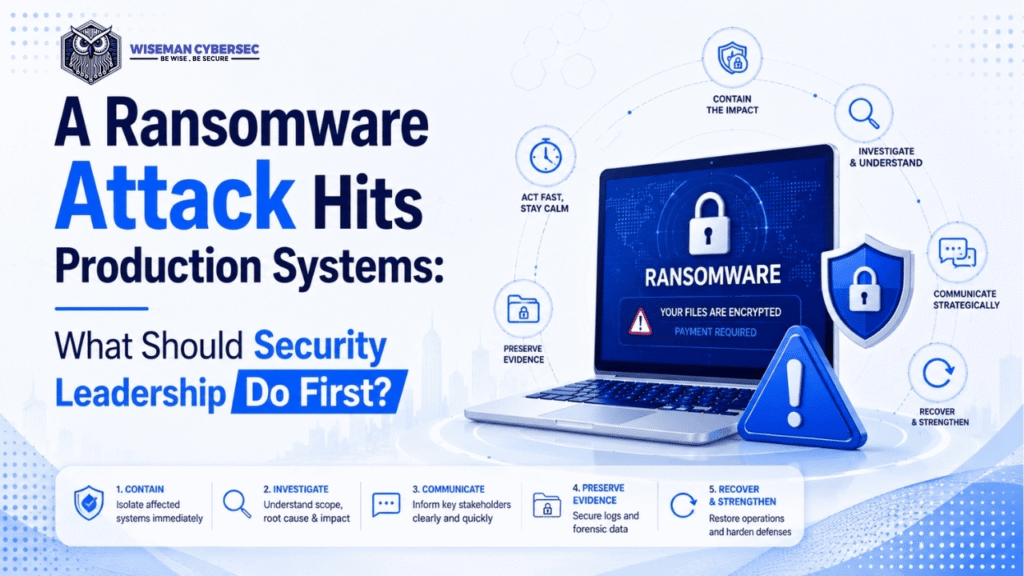
A ransomware attack on production systems is one of the most disruptive incidents an organization can face. It can freeze critical business operations, interrupt customer services, damage trust, and create immediate pressure on every part of the business. When production systems are affected, security leadership cannot afford confusion or delay. The first few hours after detection often determine how severe the impact becomes. A fast, structured response can limit spread, protect evidence, support recovery, and reduce long-term damage. That is why security leadership must know exactly what to do first when ransomware strikes. Why Production Systems Are So Critical: Production environments are the backbone of an organization. They power customer applications, internal business platforms, financial systems, databases, cloud workloads, and operational technology. If ransomware reaches these systems, the organization may lose access to the very services it depends on to function.This makes the incident more than a technical issue. It becomes a business continuity problem, a legal and compliance concern, and often a reputational crisis. In many cases, the cost of downtime can exceed the ransom demand itself. The First Priority: Containment: The most important first step is containment. Security leadership must act quickly to isolate affected systems and prevent the malware from spreading further. This may involve disconnecting infected machines from the network, disabling compromised accounts, stopping remote access sessions, and separating critical segments of the environment. Containment must be decisive, but it should also be thoughtful. Shutting down systems too aggressively or making unnecessary changes can destroy evidence that investigators will need later. The goal is to stop the attack while preserving the ability to understand what happened. A good containment decision balances speed with control. Security leaders should focus on limiting lateral movement, protecting backups, and preventing the attacker from reaching additional systems. Understanding The Scope Of The Incident: Once the spread is under control, the next step is to determine the full scope of the attack. Security teams need to understand which systems were impacted, how the attackers entered, what data may have been accessed or stolen, and whether any backup repositories were touched. This stage is critical because ransomware incidents are rarely simple. Some attacks only encrypt systems. Others also exfiltrate sensitive data, plant persistence mechanisms, or disable recovery options. Without a clear understanding of the scope, leadership may underestimate the risk or make recovery decisions too early. The investigation should also identify the attack vector. Was it a phishing email? A stolen credential? An exposed remote access service? An unpatched vulnerability? Knowing the entry point helps prevent the same thing from happening again. Clear Communication During Crisis: Ransomware incidents create uncertainty, and uncertainty spreads quickly. That is why security leadership must communicate clearly with executives, IT teams, legal counsel, business owners, and other key stakeholders. Everyone involved needs timely, factual information about what is known, what is not yet known, and what actions are being taken. Communication should be strategic. It should avoid speculation, but it should not be so cautious that it leaves people uninformed. In a crisis, silence creates more problems than honest, coordinated updates. If the incident has regulatory, contractual, or customer notification implications, leadership should also work with the appropriate internal teams to ensure the right external communication happens at the right time. Messaging should be consistent and aligned with the current facts. Preserving Evidence Matters: Even during a major attack, organizations must preserve logs, forensic data, and other evidence. This includes endpoint artifacts, server logs, authentication records, ransom notes, and any suspicious files or processes related to the incident. Preserving evidence is important for several reasons. It supports forensic investigation, helps confirm the scope of compromise, assists in legal and insurance matters, and may support law enforcement involvement. It also helps the organization learn from the event and strengthen defenses after recovery. In the pressure of a live incident, it is tempting to focus only on restoration. But if evidence is lost, the organization may never fully understand how the attacker got in or how deeply they moved through the environment. Recovery Must Be Careful: Recovery should begin only after the environment is sufficiently understood and trusted. This often means restoring systems from known-clean backups, rebuilding infected machines, resetting credentials, and validating that malicious access has been removed. Recovery is not just about getting systems back online. It is about restoring them safely. If the attacker still has a foothold, simply rebooting or re-enabling services can cause reinfection. That is why validation is so important. Organizations should also test restored systems before putting them back into production. This includes checking for persistence mechanisms, reviewing privileged accounts, confirming patch levels, and ensuring backups are clean. A rushed recovery may solve the immediate outage but create a second incident later. Strengthening Security After The Attack: A ransomware incident should always lead to a stronger security posture. Once the immediate crisis is over, leadership should review what failed, what worked, and what needs to change. This review should include backup strategy, identity controls, patch management, monitoring, segmentation, and incident response readiness. Many ransomware attacks succeed because of a combination of small weaknesses rather than one major failure. Weak passwords, excessive privileges, delayed patching, poor network separation, and lack of backup protection can all contribute to a serious incident. Fixing only one issue is not enough. Organizations should also use the event to improve training and preparedness. Regular tabletop exercises, crisis communication planning, and ransomware recovery drills can make future responses much more effective. The more prepared the team is, the less likely panic will take over during the next incident. What Security Leadership Should Remember: In a ransomware event, security leadership must stay focused on five priorities: contain, investigate, communicate, preserve evidence, and recover securely. These steps create a disciplined response that protects both the business and the investigation. The goal is not just to remove the ransomware. The goal is to restore operations safely, reduce business impact, and make the organization more resilient against the next attack. A calm, well-led
Cyber Security Full Course – Beginner to Advanced