Modern digital forensics and incident response, or DFIR, teams are the backbone of enterprise cyber defense when an attack is detected. Their job is not only to identify what happened, but also to understand how it happened, how far it spread, what data or systems were affected, and what the organization must do next to recover safely.
In today’s threat landscape, attacks are faster, more complex, and more distributed than ever before. That means DFIR teams must work through a structured process that combines technical analysis, evidence preservation, containment, communication, and recovery.
Why DFIR Matters In Modern Enterprises:
Enterprises no longer face only isolated malware incidents. They deal with phishing, credential theft, ransomware, insider misuse, supply chain compromise, cloud intrusion, and advanced persistent threats. In many cases, the attacker moves through multiple systems before the organization even realizes there is a problem.
DFIR teams help organizations respond with clarity instead of panic. They provide the technical truth behind the incident, which is essential for decision-making, legal review, executive communication, and post-incident improvement.
A strong DFIR capability also reduces downtime. The faster a team can identify the attack path and contain the threat, the lower the operational and financial impact tends to be.
The Five Core DFIR Stages
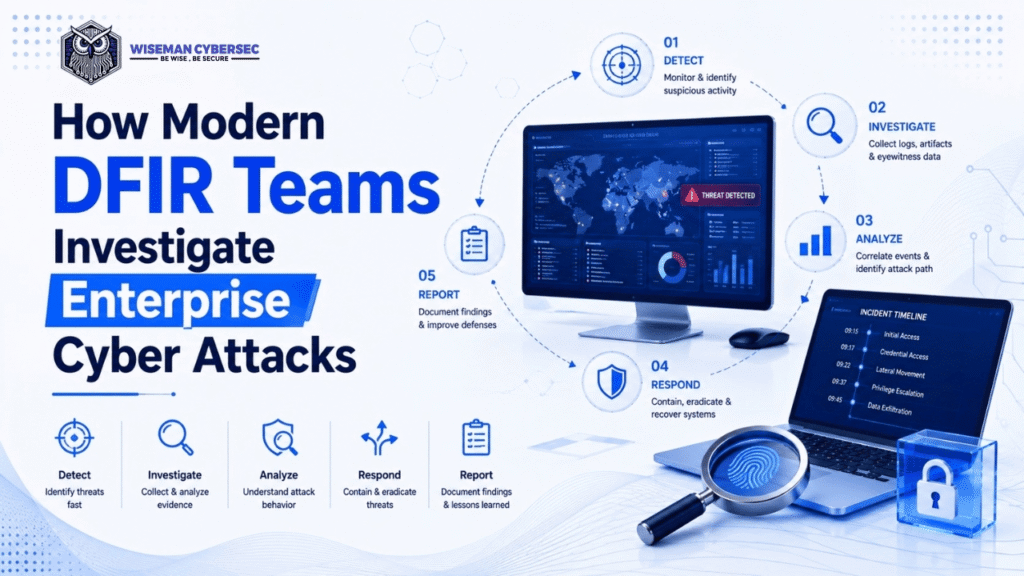
The banner highlights a five-step process: detect, investigate, analyze, respond, and report. This sequence reflects how structured incident response works in real enterprises.
- Detect
Detection is the starting point of DFIR. Teams monitor systems, logs, alerts, endpoints, and network activity to identify suspicious behavior as early as possible.
Good detection is about more than seeing an alert. It requires understanding what “normal” looks like across users, devices, applications, and network flows so that unusual activity stands out quickly. The faster an organization detects a threat, the more options it has for limiting damage.
- Investigate
Once suspicious activity is confirmed, the next step is investigation. DFIR teams collect logs, forensic artifacts, endpoint data, memory captures, file hashes, network telemetry, and eyewitness reports to understand what occurred.
Investigation answers the “what happened?” question. Teams try to determine how the attacker gained access, which accounts were used, what systems were touched, and whether the adversary still has a foothold in the environment.
- Analyze
Analysis turns raw evidence into an attack narrative. The team correlates events across systems to identify patterns, timelines, and the likely attack path.
This is where DFIR becomes especially valuable. A single alert may not reveal much on its own, but when logs, authentication events, process activity, and network connections are combined, a clear picture of the intrusion can emerge.
- Respond
Response is the stage where the organization takes action to stop the attack and restore control. This may include isolating hosts, disabling compromised accounts, blocking malicious traffic, removing malware, resetting credentials, and beginning system recovery.
Effective response depends on good analysis. If the team responds too early without enough evidence, it may miss hidden persistence. If it responds too late, the attacker may expand access or exfiltrate more data.
- Report
The final phase is reporting. DFIR teams document their findings, summarize the attack timeline, record the impact, and recommend improvements to security controls.
This report is not just for technical staff. It is often used by executives, legal teams, compliance teams, insurers, auditors, and sometimes regulators or law enforcement. A strong report helps the organization learn from the incident and strengthen its defenses.
What DFIR Teams Look For:
A professional DFIR investigation usually focuses on several core questions. How did the attacker enter? What systems were affected? Was data stolen? Are there signs of persistence? Has the attacker been fully removed?
To answer these questions, teams look at endpoint processes, event logs, authentication records, suspicious scripts, registry changes, scheduled tasks, lateral movement indicators, and exfiltration paths. They also preserve evidence carefully so that the investigation remains defensible and accurate.
This evidence-based approach is critical because assumptions can be dangerous. In a serious incident, what looks like a simple malware infection may actually be part of a larger intrusion campaign.
The Importance Of Speed And Accuracy:
DFIR teams must balance urgency with precision. Enterprises need fast answers, but they also need accurate ones. A rushed conclusion can lead to the wrong containment action, while a slow response can allow the threat to spread further.
That is why mature DFIR teams work in parallel. While one group handles containment, another collects evidence, another analyzes attack behavior, and another prepares communication for leadership. This coordinated approach improves both speed and quality.
DFIR In Cloud And Hybrid Environments:
Modern enterprise attacks rarely stay inside one environment. They often involve cloud accounts, SaaS applications, remote endpoints, identity providers, and on-premises systems all at once. This makes DFIR more challenging and more important.
In cloud and hybrid environments, investigators must look across multiple layers of telemetry. Identity logs, API activity, configuration changes, mailbox access, cloud workload alerts, and endpoint alerts may all be part of the same attack chain. A modern DFIR team must be comfortable working across all of these data sources.
Why Reporting Matters After Containment:
Once the incident is contained and systems begin to recover, reporting becomes essential. The final report captures what happened, what was done, what evidence was found, and how the organization can improve.
This report often leads to policy changes, technical hardening, training updates, and control improvements. In that sense, DFIR is not only about incident handling; it is also about organizational learning and resilience.
What Makes A Strong DFIR Team:
A strong DFIR team combines technical depth, discipline, and clear communication. Members must know how to work with evidence, understand attack behavior, communicate with stakeholders, and operate under pressure.
They also need strong collaboration with SOC, IT, cloud, legal, HR, compliance, and executive leadership. Cyber incidents are rarely isolated technical events, so the response must be cross-functional and coordinated.
Final Thoughts:
Modern DFIR teams are essential because enterprise cyberattacks are no longer simple or contained. They are fast-moving, multi-stage, and often designed to evade detection for as long as possible. A strong DFIR process helps organizations detect threats early, investigate them thoroughly, analyze the full attack path, respond effectively, and report findings that improve future defenses.
The real value of DFIR is not just in solving incidents. It is in helping organizations recover with confidence and become harder to attack the next time.
Ready to strengthen your incident response capabilities?
Connect with Wiseman Cybersec for expert DFIR, Threat Hunting, and Managed Security Services..