SOC and Blue Team Training – Launch Your Cybersecurity Career
Duration: 30 Hours
Level: Beginner to Intermediate
Mode: Instructor-Led Live Online
Format: Hands on practical Training
Core Platform: Splunk, Wazuh and TheHive
Includes: Guided Lab Access, SOC Scenarios, Capstone Simulation, Practice Questions, Recordings and Certificate Simulations, Practical Scenarios, Practice Questions, Certificate
Upcoming Batch Details
|
Training Program
|
Start Date
|
Duration
|
Timing (IST)
|
Enroll URL
|
|---|---|---|---|---|
|
SOC Analyst
|
26th December
|
30 hours
|
7 PM - 10 PM
|
Course Overview
Wiseman CyberSec’s SOC Analyst Training is a live, instructor-led program designed to help beginners, graduates and IT professionals build the practical skills required for entry-level Security Operations Center roles.
The course begins with cybersecurity, networking and log fundamentals before moving into SIEM monitoring, alert triage, endpoint investigation, threat-intelligence enrichment, incident handling and professional reporting. Learners work with Splunk and Wazuh for security monitoring and use TheHive to document, assign, escalate and close investigation cases.
The training follows the day-to-day workflow of an L1 SOC analyst. Instead of learning tools in isolation, students investigate alerts, connect evidence across users, IP addresses, endpoints and logs, decide whether activity is suspicious, record their findings and escalate incidents with clear supporting evidence.
No previous SOC experience is required. The course is suitable for learners who want a structured, practical pathway into blue-team and security-monitoring roles.
Key Highlights
Live Instructor-Led Sessions
Capstone SOC Shift Simulation
Realistic Alert-Triage Exercises
Hands-on Splunk and Wazuh Labs
TheHive Case Management
LMS and Recorded Sessions
Beginner-to-Intermediate Progression
Career-Focused Support
Skills You’ll Learn
Understand SOC structure, analyst responsibilities, alert queues, shift workflow, priorities and escalation paths.
Understand TCP/IP, OSI, common ports, DNS, HTTP/HTTPS, ICMP, firewalls, IDS/IPS, segmentation and basic network evidence.
Read Windows Event Logs, Linux logs, firewall and web-server logs; identify important fields, timestamps, users, systems and actions.
Use Splunk and Wazuh to filter events, search by user/IP/time, review alerts, save searches and connect related evidence.
Validate alerts, identify false positives, assess business risk, use a triage checklist and decide when an issue must be escalated.
Create cases, add evidence and observables, manage investigation tasks, maintain notes, update status and prepare an L2 escalation.
Recognise phishing, brute-force activity, password spraying, suspicious logins, malware indicators, lateral movement, privilege escalation and data theft.
Review process execution, files, connections and parent-child process relationships to understand suspicious activity on endpoints.
Investigate IP addresses, domains and file hashes; record reputation findings and understand the limits of reputation results.
Understand alert-to-incident progression, containment options, evidence preservation, stakeholder communication and playbook use.
Understand volatile evidence, chain of custody, key artefacts, safe file checks and how to read a sandbox report without executing malware.
Build timelines, write concise analyst notes, prepare escalation messages and create technical and management-friendly incident summaries.
Why Choose WisemanCyberSec
WisemanCyberSec is committed to transforming beginners into job-ready SOC analysts. Our unique approach sets us apart:
Personalized Learning Experience
We keep our batch sizes limited to just 5–7 students to ensure highly interactive sessions, personalized mentorship, and proper one-to-one attention for every learner.
Flexible Redo & Retake Option
Missed a session due to work or personal commitments? No worries. Students can redo missed sessions with upcoming batches and continue learning without interruption.
LMS Access with Recorded Sessions
Get access to our dedicated LMS platform with recorded sessions, helping you revise concepts anytime and learn at your own pace whenever needed.
Continuous Post-Training Support
Our support continues even after training completion through dedicated community groups, regular communication, study resources, and continuous mentor guidance.
Join an Active Cybersecurity Community
Become part of a growing cybersecurity community with access to weekly discussions, masterclasses, expert sessions, podcasts, and networking opportunities beyond your domain.
Learn from Real Industry Experts
All our instructors have strong real-world industry experience and hands-on practical exposure, helping students learn actual tools, workflows, and business use cases.
Practical & Career-Focused Training
Our programs focus on practical implementation, real-world scenarios, and job-ready skills to help learners build confidence and grow their cybersecurity careers.
GET A FREE DEMO CLASS
Who Should Enroll
This SOC Analyst Training is ideal for:
Learners who want to begin a career in security operations, monitoring, alert investigation and incident handling.
Computer science, IT, engineering and cybersecurity learners who want practical exposure beyond academic theory.
Professionals who already troubleshoot users and systems and want to transition into cybersecurity operations.
Administrators who want to understand security logs, suspicious behaviour, SIEM monitoring and response workflows.
Learners interested in defensive security, threat detection, incident response and blue-team operations.
Professionals from other backgrounds who are ready to build cybersecurity fundamentals and practice structured SOC tasks.
Prerequisites for the SOC Analyst Training
No previous SOC or cybersecurity work experience is required. The course begins with the fundamentals and builds toward practical investigations.
Basic computer proficiency and confidence using a web browser.
Familiarity with Windows is helpful; basic Linux and networking knowledge is beneficial but not mandatory.
A laptop with at least 8 GB RAM; 16 GB RAM is recommended for smoother lab activity.
Approximately 60 GB of free storage, stable internet access and permission to install or access the required lab tools.
Curiosity, attention to detail and willingness to document findings clearly.
Course Curriculum
The revised 30-hour curriculum follows the operational workflow of an entry-level SOC analyst and combines foundational knowledge with guided investigation practice.
1. Introduction to SOC and Cybersecurity
Cybersecurity fundamentals, CIA triad, common threats, SOC types, blue-team and red-team responsibilities, L1/L2/L3 roles, a typical analyst shift and the purpose of common SOC tools.
2. Networking Basics for SOC Analysts
How data travels, OSI and TCP/IP, TCP versus UDP, ports and services, private/public IPs, DNS abuse, HTTP/HTTPS, ICMP, firewalls, IDS/IPS, segmentation, network diagrams and suspicious-traffic review.
3. Understanding Logs
System, security, network and application logs; Windows Event Logs and important security events; logon types; Linux, firewall and web-server logs; field-by-field log reading; timestamps and time zones.
4. SIEM Operations with Splunk and Wazuh
SIEM purpose and data flow, dashboards, time/user/IP filtering, alert fields, saved searches, basic detection logic, threshold alerts, noise reduction, alert states, true/false positives and linking related activity.
5. Alert Triage and TheHive Case Workflow
End-to-end L1 triage, severity and business risk, false-positive validation, escalation criteria, concise investigation notes, triage checklists, mixed-alert exercises, case creation and L2 escalation using TheHive.
6. Common Attacks and Their Indicators
Phishing, brute-force attacks, password spraying, malware indicators, abnormal account activity, lateral movement, privilege escalation, data theft and connecting events into an attack chain.
7. Endpoint Monitoring Basics
Endpoint telemetry, process execution, file creation, outbound connections, parent-child process analysis, persistence awareness, device lookup and distinguishing legitimate administrator activity from suspicious behaviour.
8. Threat Intelligence Basics
Threat intelligence, indicators of compromise, the Pyramid of Pain, IP/domain/hash reputation checks, limitations of clean results and documenting enrichment findings in an investigation.
9. Incident Response Basics
Alert versus incident, response stages, L1 and L2 responsibilities, containment options, evidence preservation, communication, incident summaries, common incident types and playbook-based response.
10. Digital Forensics Awareness for SOC Analysts
Why forensics matters, volatile evidence, chain of custody, important Windows/Linux artefacts, memory evidence and knowing when to escalate to a specialist DFIR team.
11. Malware Awareness for SOC Analysts
Malware types and delivery methods, behaviour after execution, safe sandbox concepts, basic file checks, reading an existing sandbox report and extracting useful indicators.
12. Capstone – Full SOC Shift Simulation
A phishing-to-endpoint-compromise scenario using email, login, network, endpoint and alert evidence. Learners prioritise alerts, investigate activity, enrich indicators, build a timeline, open and manage a case in TheHive, recommend containment, escalate and submit an incident report.
Labs, Tools, & Simulated SOC Environments
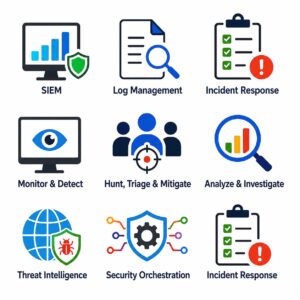
Learners practise in a guided lab environment containing security events, endpoint activity, alerts, indicators and investigation evidence. Exercises are designed to reproduce the decisions an L1 analyst makes during a normal SOC shift: search, validate, enrich, document, escalate and report.
Core Hands-on Platforms



Supporting Analyst Tools and Resources
Practical Lab Experience
Guided Log Searches
Search Windows, Linux, firewall, web and endpoint events by time, user, IP address, host and activity.
SIEM Alert Investigations
Review alert fields, validate evidence, distinguish true positives from false positives and connect related events.
TheHive Case Handling
Create cases, add observables, assign tasks, maintain investigation notes, record decisions and prepare escalation.
Threat-Intelligence Enrichment
Check suspicious indicators and document reputation, context, confidence and limitations.
Attack Recognition Exercises
Investigate phishing, brute force, password spray, suspicious logins, malware behaviour and endpoint activity.
Capstone SOC Shift
Complete a structured end-to-end incident investigation and submit an L2 escalation and final incident report.
Career Support
Build a successful SOC career with expert mentorship, practical guidance, interview preparation, and continuous post-training support.
Mentorship & Learning Guidance
Receive personalized feedback on your technical progress, learning priorities, and the next steps to develop a successful career as a SOC Analyst.
Resume, LinkedIn & Mock Interview Preparation
Learn how to present your SOC labs, SIEM experience, case handling, and investigation outcomes professionally. Practice common L1 SOC interview questions covering logs, networking, SIEM, alert triage, incidents, and scenario-based decision-making.
Portfolio & Career-Path Guidance
Organize investigation notes, timelines, triage sheets, and incident reports into a professional portfolio while understanding the responsibilities of L1 SOC Analyst, Junior Security Analyst, and other Blue Team roles.
Post-Training Community Support
Continue your learning journey through mentor guidance, doubt resolution, community discussions, study resources, and expert cybersecurity sessions.
Frequently Asked Questions
The program is designed for aspiring SOC analysts, recent graduates, IT support professionals, system and network administrators, career changers and security enthusiasts who want practical blue-team skills.
No. Basic computer proficiency is sufficient. Familiarity with Windows, Linux or networking is helpful, but the course begins with the fundamentals.
You will be able to review security alerts, search and interpret logs, perform first-level triage, enrich indicators, document findings, manage a case in TheHive, recommend containment and escalate incidents with supporting evidence.
The core hands-on platforms are Splunk, Wazuh and TheHive. Supporting exercises may use Wireshark, Windows Event Viewer, Sysmon, PowerShell, Linux logs, VirusTotal, AbuseIPDB, WHOIS/DNS tools, MITRE ATT&CK resources and sandbox-report platforms.
It is a beginner-to-intermediate program. It prepares learners for entry-level and L1 SOC workflows; advanced threat hunting, detection engineering, malware reverse engineering and full digital forensics require additional specialist training.
Training is delivered through live instructor-led online sessions, tool demonstrations, guided labs, mixed-alert triage exercises, case studies and a final SOC shift simulation. Recordings and notes are provided according to the batch policy.
The course builds practical SOC and SIEM foundations that can support later preparation for blue-team and security-analyst certifications. It should not be presented as official exam preparation unless a specific batch explicitly includes that service.
A laptop with at least 8 GB RAM is required; 16 GB is recommended. Learners should have approximately 60 GB free storage, stable internet and the ability to access or install the lab tools provided by the instructor.
Yes. Career-focused support may include resume and LinkedIn guidance, mock interviews, portfolio feedback, role guidance and continued community support, according to the current program policy.
Learners who complete the training and required practical activities receive a Wiseman CyberSec course-completion certificate, according to the attendance and assessment policy.
Become a Job-Ready L1 SOC Analyst
• Incident response playbooks, evidence awareness and professional escalation.
• End-to-end capstone simulation based on a phishing-led endpoint compromise.
• Resume, interview and learning-path guidance for SOC career preparation.