Identity has become one of the most important security boundaries in modern organizations. Employees access applications from different locations, contractors require temporary permissions, cloud workloads communicate through service identities, and administrators manage systems with highly privileged accounts.
Controlling all this access requires more than usernames and passwords.
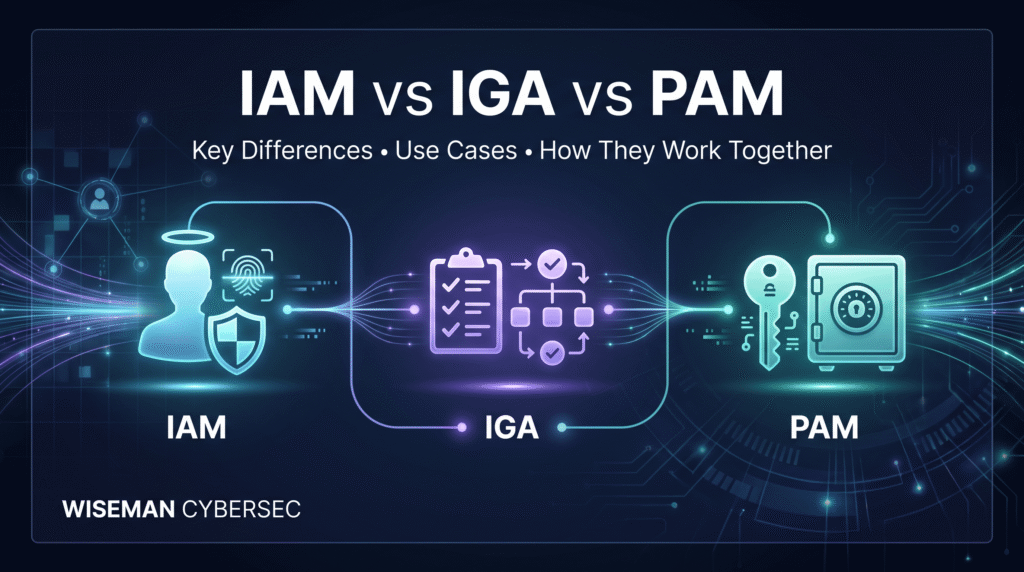
Three important concepts frequently appear in enterprise identity security discussions: Identity and Access Management (IAM), Identity Governance and Administration (IGA), and Privileged Access Management (PAM).
Although these terms are closely related, they solve different problems.
- IAM manages identities, authentication, and access to resources.
- IGA governs who should have access, why they need it, and whether that access remains appropriate.
- PAM protects, controls, and monitors privileged access to sensitive systems.
Understanding the differences between IAM, IGA, and PAM is essential for cybersecurity professionals, identity engineers, security architects, auditors, and organizations building a mature identity security program.
This guide explains their architecture, capabilities, practical use cases, and how they work together.
What Is Identity and Access Management (IAM)?
Identity and Access Management (IAM) is the collection of processes, policies, and technologies used to manage digital identities and control access to applications, systems, and data.
IAM helps organizations answer two fundamental questions:
- Who is requesting access?
- Is that identity permitted to access this resource?
For example, when an employee signs in to a corporate application using Microsoft Entra ID or Okta, IAM technologies may authenticate the employee, enforce multifactor authentication, and enable single sign-on.
Core Components of IAM
1. Identity Management
Organizations create and maintain digital identities for employees, contractors, partners, customers, and non-human entities.
An identity may contain attributes such as department, job title, manager, employment status, and assigned roles.
2. Authentication
Authentication verifies that an identity is who or what it claims to be.
Common authentication methods include passwords, passkeys, security keys, certificates, and multifactor authentication.
3. Authorization
Authorization determines what an authenticated identity is allowed to do.
For example, an employee may be authorized to view financial reports but not modify payroll information.
4. Single Sign-On (SSO)
SSO allows users to access multiple applications through a centralized authentication experience.
Common enterprise federation technologies include SAML 2.0 and OpenID Connect.
5. Access Policies
IAM platforms enforce policies based on factors such as identity, group membership, device posture, location, application sensitivity, and risk signals.
6. Identity Lifecycle Integration
IAM systems often integrate with HR platforms, directories, and applications to support account creation, updates, and deactivation.
Practical IAM Example
Consider an employee joining a company.
The employee receives a corporate identity, signs in using SSO, completes MFA, and accesses approved applications.
An IAM platform may coordinate these activities through integrations with the organization’s directory and applications.
However, an important question remains:
Who decided which applications the employee should receive, and who periodically verifies that those permissions are still appropriate?
That is where IGA becomes important.
What Is Identity Governance and Administration (IGA)?
Identity Governance and Administration (IGA) focuses on managing and governing access throughout the identity lifecycle.
IGA helps organizations answer questions such as:
- Who currently has access to each application?
- Why was that access granted?
- Who approved it?
- Does the employee still need it?
- Does the access violate a segregation-of-duties policy?
- Can the organization demonstrate appropriate access controls during an audit?
IGA combines identity administration with governance, oversight, and accountability.
Core Components of IGA
1. Joiner-Mover-Leaver Lifecycle Management
IGA platforms can automate identity lifecycle processes based on authoritative data, often from HR systems.
A joiner receives access appropriate to a new role. A mover has access adjusted when responsibilities change. A leaver has access removed when employment ends.
2. Access Requests and Approvals
Users may request additional application permissions through a self-service workflow.
Approval can depend on a manager, application owner, data owner, or designated risk reviewer.
3. Access Reviews and Certifications
Managers and application owners periodically review existing access.
They may approve continued access, revoke unnecessary permissions, or investigate exceptions.
4. Role Management
IGA supports the design and governance of business roles and technical entitlements.
For example, a Finance Analyst role may map to approved permissions across several business applications.
5. Segregation of Duties (SoD)
SoD policies identify combinations of permissions that could create unacceptable risk.
For example, the ability to create a supplier and independently approve payments to that supplier may represent a conflict.
6. Audit and Compliance Evidence
IGA platforms can maintain records of requests, approvals, reviews, policy violations, and remediation activities.
This supports internal control testing and compliance processes.
Practical IGA Example
An employee transfers from the finance department to the sales department.
Without effective governance, the employee may retain sensitive finance permissions while receiving new sales permissions.
This is commonly called access accumulation or privilege creep.
An IGA process can detect the job change, initiate access reassessment, remove unnecessary finance entitlements, and provision approved sales access.
IGA therefore addresses a problem that authentication alone cannot solve.
A user can successfully authenticate and still possess inappropriate permissions.
What Is Privileged Access Management (PAM)?
Privileged Access Management (PAM) is a security discipline focused on protecting identities, accounts, credentials, and sessions with elevated access.
Privileged access can allow someone—or something—to modify security configurations, manage infrastructure, access sensitive data, or disrupt critical services.
Examples include:
- Domain administrator accounts
- Root accounts on Linux servers
- Database administrator accounts
- Cloud infrastructure administrator roles
- Network device administrator credentials
- Emergency or break-glass accounts
- Privileged service accounts and automation identities
PAM helps organizations answer:
How can we securely grant, use, monitor, and revoke powerful access?
Core Components of PAM
1. Privileged Account Discovery
Organizations identify privileged accounts and credentials across servers, databases, cloud platforms, network devices, and applications.
2. Credential Vaulting
Privileged credentials can be stored in controlled vaults rather than shared through documents, scripts, or unsecured password stores.
3. Credential Rotation
Passwords and other managed secrets can be rotated according to policy or after use.
4. Privileged Session Management
PAM solutions may broker, monitor, and record privileged sessions.
Session monitoring supports investigations and accountability, subject to organizational policies and applicable privacy requirements.
5. Just-in-Time (JIT) Access
JIT access provides elevated permissions only when needed and for a limited period.
This reduces standing privilege.
6. Approval and Access Controls
Sensitive administrative access may require additional authentication, justification, ticket references, or explicit approval.
7. Least Privilege Enforcement
PAM programs seek to minimize the number of identities with powerful permissions and limit the scope of those permissions.
Practical PAM Example
A database administrator needs temporary access to a production database server to investigate a performance issue.
Instead of using a permanently assigned administrator password, the organization may require the administrator to:
- Authenticate using the enterprise identity provider.
- Request access to the production environment.
- Provide a business justification.
- Receive approval where required.
- Start a controlled privileged session.
- Have the session logged or recorded according to policy.
- Lose elevated access when the approved period ends.
PAM helps reduce the risks associated with shared credentials, excessive administrative permissions, and uncontrolled privileged sessions.
IAM vs IGA vs PAM: Comparison Table
| Area | IAM | IGA | PAM |
| Primary purpose | Manage identity and access | Govern access and identity lifecycle | Secure privileged access |
| Main question | Can this identity access the resource? | Should this identity have this access? | How should powerful access be controlled? |
| Main focus | Authentication, authorization, SSO, access policies | Provisioning, approvals, reviews, SoD, compliance | Privileged credentials, sessions, JIT access |
| Typical users | Employees, contractors, customers, workloads | Workforce identities and access owners | Administrators, operators, privileged services |
| Common controls | MFA, SSO, conditional access | Access certification, role governance, policy checks | Vaulting, rotation, session monitoring |
| Business value | Secure and efficient access | Appropriate and auditable access | Reduced privileged-access risk |
| Example technologies | Microsoft Entra ID, Okta | SailPoint, Saviynt | CyberArk, Delinea, BeyondTrust |
The boundaries are not absolute. Many vendors offer capabilities across multiple categories, and organizations may implement certain controls through more than one platform.
The key difference is the security objective, not simply the product name.
IAM vs IGA: What Is the Difference?
IAM and IGA both deal with identities and access, but they operate from different perspectives.
IAM primarily focuses on access enablement and enforcement.
IGA focuses on access decisions, lifecycle governance, and accountability.
Consider an employee requesting access to a financial reporting application.
An IGA workflow may determine whether the request is justified, identify the appropriate approver, and document the decision.
The IAM environment may then enforce access through directory groups, application assignments, or access policies.
At the next certification cycle, IGA may ask the application owner to confirm whether the employee still needs that permission.
IAM and IGA are therefore complementary.
IAM helps provide access securely. IGA helps ensure that access remains appropriate.
IAM vs PAM: What Is the Difference?
IAM manages access for a broad population of identities and applications.
PAM concentrates on access that carries elevated risk because of the power associated with the account, role, or session.
For example, IAM may authenticate a system administrator using SSO and MFA.
PAM may then control how that administrator obtains temporary root access to a production server.
An organization can have strong MFA and still face serious risk if administrators possess permanent, excessive permissions or share privileged credentials.
This is why IAM alone does not replace PAM.
IAM verifies and controls access. PAM adds specialized protection for high-impact privileges.
IGA vs PAM: What Is the Difference?
IGA and PAM overlap in privileged-access governance, but their primary responsibilities differ.
IGA may determine whether an administrator should be eligible for a privileged role.
PAM may control how that role is activated and used.
For example:
An infrastructure engineer requests eligibility for a production administrator role.
IGA manages the access request, approval, and periodic review.
PAM enforces time-limited activation, credential protection, and session controls when the engineer needs to perform administrative work.
IGA focuses on the appropriateness and governance of entitlement.
PAM focuses on the security of privileged access and its use.
Both are important.
How IAM, IGA, and PAM Work Together
A mature enterprise identity architecture connects all three disciplines.
Consider a new cloud engineer joining an organization.
Step 1: Identity Creation
The HR system records the new employee.
Identity lifecycle processes create or update the employee’s digital identity in the corporate directory and connected applications.
Step 2: Access Governance
IGA evaluates the employee’s department, role, and approved access requirements.
It may automatically assign standard entitlements and route sensitive requests for approval.
Step 3: Authentication and Application Access
IAM enables the employee to sign in through SSO, satisfy MFA requirements, and access authorized applications.
Step 4: Privileged Access Request
The engineer needs temporary administrative access to a production cloud environment.
The request may be evaluated against governance policies, approval requirements, and role eligibility.
Step 5: Privileged Access Enforcement
PAM or cloud-native privileged-access controls activate the required permissions for a limited period.
The activity may be logged, monitored, or recorded.
Step 6: Periodic Review
IGA periodically reassesses the engineer’s entitlements and privileged-role eligibility.
Unnecessary permissions are removed.
Step 7: Role Change or Departure
When the engineer transfers teams or leaves the organization, lifecycle processes update or revoke access across connected systems.
This illustrates the combined value of IAM, IGA, and PAM:
The right identity receives the right access, for the right reason, under the right controls, for no longer than necessary.
Why Organizations Need All Three
Organizations sometimes invest heavily in authentication technologies while overlooking governance and privileged-access controls.
This creates security gaps.
Risk 1: Strong Authentication but Excessive Access
An employee may use phishing-resistant MFA yet retain permissions from several previous job roles.
IAM can authenticate the employee correctly, but governance is needed to identify and remove unnecessary access.
Risk 2: Approved Access but Uncontrolled Administration
An administrator may have legitimate approval to manage production systems but still use shared passwords or permanently elevated accounts.
PAM helps reduce the risks associated with how those permissions are exercised.
Risk 3: Privileged Controls Without Lifecycle Governance
An organization may secure administrator credentials in a vault but fail to remove privileged eligibility when an employee changes roles.
IGA helps identify and remediate inappropriate access over time.
Risk 4: Fragmented Identity Visibility
Without integrated identity information, security teams may struggle to understand who has access, who approved it, and what privileged activities occurred.
Connecting IAM, IGA, and PAM improves visibility and supports more consistent risk management.
IAM, IGA, and PAM in Zero Trust Security
Zero Trust is commonly associated with the principle of never trust, always verify.
In practice, Zero Trust requires continuous evaluation of access based on identity, context, policy, and risk.
IAM, IGA, and PAM each contribute to this approach.
IAM supports strong authentication, contextual access decisions, and consistent policy enforcement.
IGA helps ensure that identities possess appropriate entitlements and that access is reviewed throughout its lifecycle.
PAM reduces standing privilege and introduces additional controls around sensitive administrative activity.
Together, they support least privilege and more granular access control.
However, implementing IAM, IGA, and PAM products does not automatically make an organization Zero Trust. Device security, network controls, application security, telemetry, and operational processes remain important.
Common Tools Used for IAM, IGA, and PAM
Several enterprise platforms are associated with these disciplines.
IAM Platforms
Microsoft Entra ID
Commonly used for workforce identity, application access, SSO, MFA, conditional access, and identity integration in Microsoft-centric and hybrid environments.
Okta
Provides identity and access capabilities such as SSO, authentication, lifecycle integrations, and access policies.
Ping Identity
Offers enterprise identity, authentication, and federation capabilities.
IGA Platforms
SailPoint
Known for identity governance capabilities such as access certification, lifecycle management, access requests, and entitlement governance.
Saviynt
Provides identity governance, access management, and related identity security capabilities.
One Identity
Offers identity governance and related access management technologies.
PAM Platforms
CyberArk
Provides privileged-access and identity security capabilities, including privileged credential and session controls.
BeyondTrust
Offers privileged-access and endpoint privilege management capabilities.
Delinea
Provides solutions for privileged account, credential, and access management.
Product capabilities and licensing evolve. Organizations should evaluate actual requirements rather than assuming that one product category covers every control.
Real-World Enterprise Use Cases
Use Case 1: Employee Onboarding
Challenge: New employees need timely access without receiving excessive permissions.
IAM contribution: Authentication, SSO, and application access.
IGA contribution: Role-based provisioning, approvals, and lifecycle governance.
PAM contribution: Controlled administrative access for employees whose responsibilities require it.
Use Case 2: Internal Job Transfer
Challenge: Employees retain old permissions when moving between departments.
IAM contribution: Updates to application assignments and access enforcement.
IGA contribution: Detection of role changes, access reassessment, and removal of outdated entitlements.
PAM contribution: Revocation or adjustment of privileged eligibility.
Use Case 3: Third-Party Vendor Access
Challenge: External vendors require temporary access to sensitive systems.
IAM contribution: Vendor identity authentication and access policies.
IGA contribution: Sponsor approval, access ownership, and expiry reviews.
PAM contribution: Controlled privileged sessions and time-limited administrative access.
Use Case 4: Compliance Audit
Challenge: Auditors request evidence that sensitive access is appropriately controlled.
IAM contribution: Authentication and access-policy records.
IGA contribution: Access approval history, certifications, and SoD evidence.
PAM contribution: Privileged access logs, credential controls, and session records.
Use Case 5: Cloud Administration
Challenge: Engineers require elevated cloud permissions without maintaining permanent administrator access.
IAM contribution: Federated identity and authentication.
IGA contribution: Role eligibility, access approvals, and periodic reviews.
PAM contribution: Just-in-time privilege and monitoring of high-risk operations.
What About Non-Human Identities?
Modern identity security programs must also address non-human identities, including service accounts, applications, automation tools, workloads, and AI agents.
These identities may authenticate using certificates, API keys, secrets, or workload identity federation.
The same broad disciplines still matter, although their implementation differs from workforce identity.
IAM can authenticate workloads and enforce access policies.
IGA can help establish ownership, entitlement visibility, and lifecycle governance where supported.
PAM and secrets-management technologies can protect sensitive credentials and control privileged machine access.
Organizations should pay particular attention to long-lived secrets, excessive API permissions, orphaned service accounts, and unclear ownership.
Not every non-human identity should be managed through the same workflow used for employees. Effective controls must account for automated deployment, machine-to-machine communication, and operational availability.
How to Build an IAM, IGA, and PAM Learning Roadmap
For cybersecurity professionals, these disciplines provide several career pathways.
A strong foundation begins with identity concepts before moving into specialized platforms.
Stage 1: Learn Identity Fundamentals
Focus on:
- Authentication and authorization
- Active Directory and LDAP
- Microsoft Entra ID
- MFA and SSO
- SAML 2.0, OAuth 2.0, and OpenID Connect
- Role-based and attribute-based access control
Practical project: Configure SSO and MFA for a test application.
Stage 2: Understand Identity Lifecycle Management
Study:
- Joiner-mover-leaver processes
- Provisioning and deprovisioning
- SCIM and directory integration
- Access requests and approvals
- Identity attributes and role mapping
Practical project: Design an onboarding and offboarding workflow for a fictional organization.
Stage 3: Specialize in IGA
Explore:
- Access certification campaigns
- Role engineering
- Entitlement management
- Segregation of duties
- Application onboarding
- Audit reporting
Practical project: Build an access review matrix showing users, roles, application entitlements, reviewers, and remediation decisions.
Stage 4: Specialize in PAM
Learn:
- Privileged account discovery
- Credential vaulting and rotation
- Privileged session management
- Just-in-time access
- Least privilege
- Cloud privileged-access patterns
Practical project: Design a privileged-access workflow for production server administration, including approvals, session controls, and expiry.
Stage 5: Develop Architecture Skills
Bring the disciplines together.
Study integration patterns, API security, logging, policy enforcement, exception management, and identity threat detection.
Practical project: Create an enterprise identity architecture diagram connecting HR, IAM, IGA, PAM, cloud applications, and security monitoring.
IAM vs IGA vs PAM: Which Career Path Should You Choose?
The best specialization depends on the type of work you enjoy.
| Career Interest | Suitable Direction | Example Roles |
| Authentication, SSO, federation, application integration | IAM | IAM Engineer, Identity Engineer |
| Access lifecycle, approvals, audits, governance | IGA | IGA Engineer, Identity Governance Analyst |
| Administrator security, credential protection, privileged sessions | PAM | PAM Engineer, Privileged Access Specialist |
| Enterprise design and cross-platform integration | IAM + IGA + PAM | Identity Security Architect |
| Risk, compliance, and access controls | IGA with IAM fundamentals | IAM Governance Analyst, GRC Specialist |
These are not rigid career boundaries.
An IAM engineer may implement lifecycle integrations. An IGA engineer may work with privileged entitlements. A PAM engineer may need deep knowledge of federation and directory services.
For long-term career growth, understanding how the disciplines connect is often more valuable than knowing one product in isolation.
Common IAM, IGA, and PAM Implementation Mistakes
1. Treating IAM as Only an SSO Project
SSO improves user experience and centralizes authentication, but it does not solve every identity risk.
Organizations also need authorization design, lifecycle management, governance, and privileged-access controls.
2. Automating Poorly Defined Access Rules
Automating provisioning without clear role definitions can distribute excessive access more efficiently.
Define access ownership, approval criteria, and least-privilege requirements before scaling automation.
3. Running Access Reviews Without Remediation
An access certification campaign has limited value if reviewers approve everything without evaluation or if revoked access is never actually removed.
Measure review quality and completed remediation, not just campaign completion.
4. Protecting Passwords but Ignoring Privileged Sessions
Credential vaulting is useful, but privileged-access security may also require session controls, monitoring, time limits, and stronger authentication.
5. Ignoring Service Accounts and Workload Identities
Non-human identities can retain powerful permissions and long-lived credentials.
Include them in identity inventory, ownership, lifecycle, and privileged-access planning.
6. Buying Tools Before Defining the Operating Model
Technology cannot replace clear ownership and processes.
Organizations should establish responsibility for access approval, application onboarding, exceptions, recertification, incident response, and policy enforcement.
A Practical Identity Security Maturity Approach
Organizations do not need to implement every IAM, IGA, and PAM capability simultaneously.
A phased approach is often more realistic.
Phase 1: Establish Visibility
Inventory identity sources, critical applications, privileged accounts, and existing access processes.
Identify orphaned accounts, shared credentials, and unmanaged integrations.
Phase 2: Strengthen Authentication
Improve MFA coverage, reduce legacy authentication exposure, centralize identity policies where appropriate, and establish secure federation patterns.
Phase 3: Improve Lifecycle Controls
Connect authoritative identity sources to provisioning and deprovisioning processes.
Prioritize timely access removal for departures and role changes.
Phase 4: Introduce Governance
Assign access owners, define approval workflows, implement risk-based access reviews, and identify toxic entitlement combinations.
Phase 5: Reduce Privileged-Access Risk
Discover privileged accounts, secure credentials, minimize standing privileges, and introduce controlled administrative access.
Phase 6: Integrate and Measure
Connect identity events to security monitoring and continuously improve controls using measurable outcomes.
Useful metrics include time to revoke departed-user access, number of standing privileged accounts, percentage of critical applications covered by access reviews, and completion time for access-remediation actions.
Frequently Asked Questions
1. What is the main difference between IAM, IGA, and PAM?
IAM manages authentication and access. IGA governs access decisions and identity lifecycle processes. PAM protects and controls privileged access.
2. Is IGA part of IAM?
IGA is commonly considered a specialized discipline within the broader identity and access management field. In enterprise architecture and product discussions, IAM and IGA are often treated as separate capability areas because they solve different operational problems.
3. Is PAM part of IAM?
PAM is closely related to IAM and is often included within a broader identity security strategy. It specializes in protecting high-risk accounts, credentials, permissions, and sessions.
4. Can IAM replace IGA?
Not completely. IAM platforms may include lifecycle and governance features, but authentication and access enforcement alone do not provide all the approval, certification, SoD, and audit capabilities associated with a mature IGA program.
5. Can IGA replace PAM?
No. IGA can govern privileged entitlements, but it does not automatically provide the credential protection, session controls, and just-in-time access capabilities associated with PAM.
6. Which is better for a cybersecurity career: IAM, IGA, or PAM?
There is no universally better choice. IAM suits professionals interested in authentication, federation, and access integration. IGA suits governance and lifecycle specialists. PAM suits professionals focused on protecting administrative access and critical infrastructure.
7. Should beginners learn IAM before IGA or PAM?
For many learners, IAM fundamentals provide the most useful starting point. Understanding identities, directories, authentication, authorization, and federation makes IGA and PAM concepts easier to apply.
8. What tools should I learn for IAM, IGA, and PAM?
A practical starting combination is Microsoft Entra ID or Okta for IAM fundamentals, SailPoint or Saviynt for IGA concepts, and CyberArk or another PAM platform for privileged-access workflows. Focus on transferable concepts alongside product skills.
9. How do IAM, IGA, and PAM support Zero Trust?
IAM helps verify identities and enforce access policies. IGA helps ensure permissions remain appropriate. PAM limits and monitors elevated access. Together, they strengthen least privilege and identity-centered security controls.
10. Are IAM, IGA, and PAM relevant to AI agents?
Yes. AI agents and other non-human identities may require authentication, scoped authorization, access ownership, credential protection, and lifecycle controls. The exact approach depends on the agent’s architecture and level of autonomy.
Final Thoughts
IAM, IGA, and PAM are not competing approaches to identity security.
They are complementary disciplines that address different aspects of the same challenge: ensuring identities receive appropriate access and that the access is used securely.
IAM establishes and enforces access.
IGA governs whether access is appropriate.
PAM protects the most sensitive forms of access.
Organizations that connect these capabilities are better positioned to reduce excessive permissions, protect critical systems, improve auditability, and manage identity risk across workforce, cloud, and non-human environments. For cybersecurity professionals, understanding all three creates a strong foundation for careers in identity engineering, identity governance, privileged-access security, and enterprise security architecture.