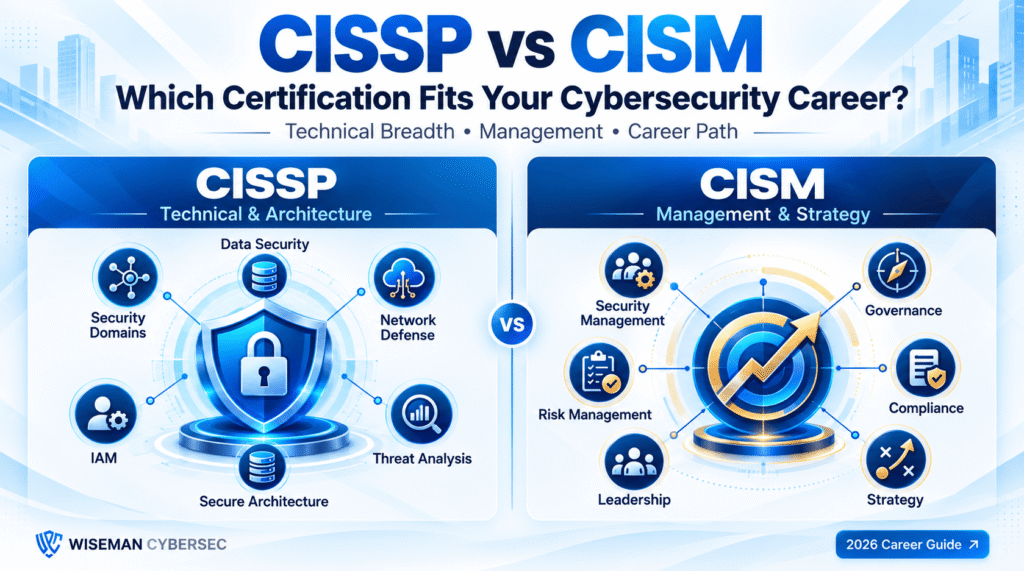
CISSP and CISM are both respected credentials for experienced cybersecurity professionals, but they validate different career strengths. CISSP is broader, covering security architecture, engineering, IAM, networking, operations, software security, risk, and governance, while CISM concentrates more heavily on managing security governance, risk, programs, and incidents. In 2026, CISSP is typically the stronger fit for security architects, senior engineers, consultants, and professionals who want broad security leadership credibility; CISM is especially relevant for security managers, GRC leaders, program owners, and professionals moving toward director or CISO responsibilities. Many experienced security leaders eventually earn both because the credentials are complementary rather than interchangeable.
CISSP vs CISM at a Glance
CISSP is administered by ISC2, while CISM—Certified Information Security Manager—is administered by ISACA. Neither is an entry-level certification: although you can take the exams before satisfying every certification requirement through the pathways permitted by each organization, both credentials are built around substantial professional experience.
| Category | CISSP | CISM |
| Certification body | ISC2 | ISACA |
| Primary focus | Broad cybersecurity leadership, architecture, engineering, operations and risk | Information security governance, risk, program management and incident management |
| Domains | 8 | 4 |
| Exam format | CAT, 100–150 items, up to 3 hours | 150 multiple-choice questions, up to 4 hours |
| Passing score | 700/1,000 | 450 on ISACA’s scaled scoring model |
| Experience | 5 years of cumulative paid experience in 2+ CISSP domains; qualifying waiver can reduce this by 1 year | 5 years of qualifying information security management experience across at least 3 CISM domains |
| Best aligned with | Security architect, security engineer, consultant, security manager, technical/security leader | Security manager, GRC/risk manager, security program manager, director, CISO-track professional |
| Maintenance | 120 CPE credits over 3 years; $135 annual maintenance fee | 120 CPE hours over 3 years, including at least 20 annually; $45/year for ISACA members or $85 for non-members |
| 2026 U.S. salary indicator | ISC2 reports a $150,000 North American median for CISSP holders | ISACA currently advertises $149K+ average annual salary for CISM; role-specific market data varies significantly |
ISC2 currently lists CISSP as a three-hour Computerized Adaptive Testing exam with 100–150 multiple-choice and advanced item types and a passing grade of 700 out of 1,000. CISM remains a 150-question examination; ISACA chapter exam guidance lists four hours, and ISACA’s own exam-preparation guidance uses a 240-minute limit.
Eligibility and Domain Comparison
CISSP Eligibility
To earn the CISSP certification, ISC2 requires five years of cumulative paid work experience in at least two of the eight CISSP domains. A relevant four-year degree or an approved credential can satisfy one year of that requirement. ISC2 revised its qualifying certification-waiver list effective April 1, 2026, so candidates relying on a credential for a waiver should check the current approved list rather than depending on older study guides.
Candidates who pass the CISSP exam without having enough experience can pursue the Associate of ISC2 pathway and have up to six years to obtain the experience required for CISSP certification.
The current CISSP examination weights are Security and Risk Management at 16%; Asset Security at 10%; Security Architecture and Engineering at 13%; Communication and Network Security at 13%; Identity and Access Management at 13%; Security Assessment and Testing at 12%; Security Operations at 13%; and Software Development Security at 10%.
That breadth is the defining characteristic of CISSP. You are expected to understand not just how an individual security control works, but how architecture, IAM, network design, software security, operations, governance, risk, testing, legal considerations, and business requirements fit together.
CISM Eligibility
ISACA allows interested professionals to take the CISM examination before meeting the full certification experience requirement. To actually become CISM-certified, however, candidates must document at least five years of professional information security management experience across at least three of the four CISM job-practice domains. Qualifying experience must fall within the required period defined by ISACA, and candidates have five years after passing the exam to apply for certification.
CISM has four domains: Information Security Governance, Information Security Risk Management, Information Security Program, and Incident Management.
There is an important 2026 timing issue for candidates. Through November 2, 2026, the established domain weighting is Governance 17%, Risk Management 20%, Information Security Program 33%, and Incident Management 30%. Beginning November 3, 2026, ISACA’s refreshed exam changes the weighting to 18%, 20%, 33%, and 29%, respectively, while also adding emphasis on information security strategy, enterprise architecture, and information security architecture. Candidates sitting on or after November 3 should therefore use the updated preparation materials ISACA released in September 2026.
That update also illustrates an important point: CISM is management-focused, but modern security managers still need enough architectural and technical understanding to make sound risk and program decisions.
Exam Format, Difficulty and Study Strategy
Which Exam Is Harder?
There is no universal answer, and neither ISC2 nor ISACA publishes a simple official pass-rate comparison.
CISSP is difficult primarily because of breadth and judgment. The CAT exam adapts as you answer questions and can end anywhere between 100 and 150 items within the three-hour limit. ISC2 also emphasizes that CISSP is experience-based: simply memorizing definitions is not enough because questions require candidates to apply security concepts to realistic situations.
CISM is difficult because of management-oriented decision making. Candidates frequently face situations where several answers appear technically reasonable, but the exam expects the answer most consistent with enterprise governance, risk ownership, business priorities, and security management responsibilities. ISACA specifically cautions candidates against answering every question solely through the lens of their own employer’s practices.
For study time, there is no single mandatory number. For CISSP, a practical planning estimate for an experienced professional is roughly 12–16 weeks of structured preparation, adjusting upward if several domains are unfamiliar. For CISM, planning around three months is sensible: ISACA exam-preparation guidance explicitly recommends starting at least three months before the exam, while an ISACA chapter’s 2026 CISM training guidance estimates roughly 20–100 additional study hours depending on existing knowledge.
CISSP Study Plan
- Download the current ISC2 CISSP Exam Outline and map your strongest and weakest domains before studying.
- Study all eight domains rather than concentrating only on technologies you use at work.
- Use current official ISC2 study materials, reputable CISSP reference books, or instructor-led training rather than outdated exam dumps.
- Build scenario-based understanding of risk, architecture, IAM, networking, security operations, testing, and secure software development.
- Complete practice questions regularly and analyze why incorrect choices are wrong instead of memorizing answers.
- Practice answering from an enterprise risk and leadership perspective: the best answer may be governance, assessment, or risk treatment rather than immediately deploying a technical control.
- Finish with timed mixed-domain exams and focus your final revision on weak concepts rather than rereading everything.
ISC2 confirms that official training is optional; candidates may prepare using self-study, books, practice exams, the exam outline, or formal training depending on their learning style.
CISM Study Plan
- Confirm whether your exam date falls before or after November 3, 2026, and use the correct CISM Exam Content Outline and study materials.
- Learn how governance, business objectives, risk appetite, security strategy, and accountability interact before drilling individual controls.
- Work systematically through all four domains, giving extra preparation time to Information Security Program because it carries the largest weighting in both the current and refreshed outlines.
- Use ISACA’s current CISM Review Manual and Questions, Answers & Explanations resources; ISACA also offers an Online Review Course and official question database.
- Review every practice-question explanation, including why apparently reasonable alternatives are not the best management response.
- Practice four-hour exam pacing and become comfortable with “best,” “first,” “most important,” and risk-based decision questions.
- In the final weeks, concentrate on weak domains and decision-making patterns rather than memorizing isolated terminology.
Certification Maintenance, Roles and Salary Outlook
Neither CISSP nor CISM is a certification you earn once and forget.
CISSP holders must earn 120 CPE credits during each three-year certification cycle. ISC2’s current policy suggests 40 per year and requires a $135 Annual Maintenance Fee for members holding certifications such as CISSP.
CISM holders must report at least 20 CPE hours annually and 120 over a three-year period. ISACA currently charges a CISM annual maintenance fee of $45 for members and $85 for non-members.
CISSP Career Roles
CISSP aligns particularly well with positions such as Security Architect, Senior Security Engineer, Cybersecurity Consultant, Security Manager, Security Program Lead, IAM or Cloud Security Architect, Security Director, and eventually CISO-level roles.
Salary should never be attributed to a certification alone. Geography, clearance level, industry, role scope, years of experience, technical specialization, leadership responsibility, and company size can matter more than the credential itself.
For a useful benchmark, ISC2’s latest published certification salary data reports a $127,000 global median and $150,000 North American median for CISSP holders. ZipRecruiter’s September 2026 data shows a broad U.S. CISSP market with most reported salaries around $95,000–$138,000, while more specialized CISSP security-engineering jobs can move well above that level. Current Indeed listings for CISSP-related remote security engineering roles also span roughly $94,000 to well above $175,000 depending on seniority.
A reasonable 2026 U.S. planning estimate is therefore approximately $100,000–$180,000+ for experienced CISSP-aligned professionals, with architects, senior engineering leaders, directors, cleared professionals, and executives potentially exceeding that range. This is a market estimate, not a guaranteed CISSP salary.
CISM Career Roles
CISM is especially relevant to Information Security Manager, Cybersecurity Manager, GRC Manager, Information Risk Manager, Security Program Manager, Security Governance Lead, Security Director, Head of Information Security, and CISO-track positions.
ISACA currently advertises $149K+ as an average annual salary indicator on its CISM certification page. Meanwhile, September 2026 ZipRecruiter data for U.S. Information Security Manager roles associated with CISM shows most salaries around $110,500–$160,500, with an average reported near $136,000.
For career planning, approximately $110,000–$170,000+ is a reasonable estimated U.S. range for many experienced CISM-aligned management positions in 2026, while directors and CISOs may earn substantially more. Again, that is an estimate rather than a salary guarantee.
The overall cybersecurity employment environment remains favorable: the U.S. Bureau of Labor Statistics projects information security analyst employment to grow 28.5% between 2024 and 2034, making it the fastest-growing computer occupation in its current projections.
CISSP or CISM: Which Should You Choose?
Choose CISSP first when your career still depends heavily on technical breadth. A senior security engineer moving toward architecture, an IAM architect expanding into enterprise security, a security consultant advising across several domains, or a technical lead moving toward security leadership will generally gain more immediate coverage from CISSP.
A sample path could be:
Security Analyst → Security Engineer → Senior Security Engineer → Security Architect → Security Manager/Director
CISSP fits particularly well around the senior-engineer-to-architect or architect-to-leadership transition because its eight domains connect technical security decisions with risk and business requirements.
Choose CISM first when your daily responsibilities already revolve around governance, risk ownership, security strategy, policy, program development, metrics, budgeting, incident management, executive communication, or managing security teams.
A typical path could be:
GRC Analyst → Security/GRC Manager → Information Security Manager → Security Director → CISO
CISM becomes especially valuable when the question is no longer simply “How do we implement this control?” but “Which risks matter to the business, who owns them, what security program should we fund, and how do we measure whether it works?”
When Does It Make Sense to Earn Both?
For many senior professionals, CISSP + CISM is a logical combination.
CISSP demonstrates broad cybersecurity knowledge across architecture, engineering, operations, IAM, software security, risk, and governance. CISM reinforces the management layer: governance, risk management, security-program leadership, and incident management. The overlap can also make preparation for the second credential more efficient, although candidates must still learn the exam philosophy and domain structure of each organization.
A strong long-term leadership path might therefore look like:
Security Engineer → CISSP → Security Architect → Security Manager → CISM → Director of Security → CISO
For a governance-focused professional, the order could be reversed:
Risk/GRC Analyst → Security Manager → CISM → Security Program Leader → CISSP → Security Director/CISO
The deciding factor should be your next role, not which certification sounds more prestigious.
CISSP is not simply the “technical certification,” because it contains substantial governance, risk, and leadership content. CISM is not simply a “non-technical management certification,” particularly as ISACA’s November 2026 refresh adds greater attention to enterprise and information security architecture. The better distinction is broad security leadership versus concentrated security-management leadership.
Professionals preparing for either credential can explore Wiseman CyberSec’s cybersecurity training programs, including CISSP and CISM preparation designed for experienced security professionals building toward senior technical, management, and leadership roles.
Frequently Asked Questions
Is CISSP better than CISM?
Neither is universally better. CISSP offers broader cybersecurity coverage, while CISM is more concentrated on governance, risk, security-program management, and incident management. Your target role should determine the better choice.
Should a security engineer choose CISSP or CISM?
For most experienced security engineers, CISSP is usually the more natural first choice because architecture, networking, IAM, operations, testing, risk, and software security are all directly represented in its eight domains.
Is CISM better for becoming a CISO?
CISM aligns strongly with CISO responsibilities because it focuses on governance, risk, security programs, and incident management. However, CISSP can add valuable technical and architectural breadth, so senior leaders often benefit from both.
Can I take CISSP or CISM without five years of experience?
Yes, but passing an exam is not the same as becoming fully certified. CISSP candidates without the required experience can pursue Associate of ISC2 status, while ISACA allows candidates to take CISM before satisfying the full experience requirement and apply after gaining the required experience.
How long should I study for CISSP or CISM?
A practical plan is around 12–16 weeks for CISSP and roughly three months for CISM, adjusted for experience and familiarity with the domains. ISACA itself recommends starting CISM preparation at least three months before the exam.
Is it worth earning both CISSP and CISM?
For professionals targeting security management, director, consulting, or CISO roles, the combination can be highly complementary: CISSP validates broad cybersecurity competence, while CISM strengthens the governance and program-management dimension required for enterprise security leadership.