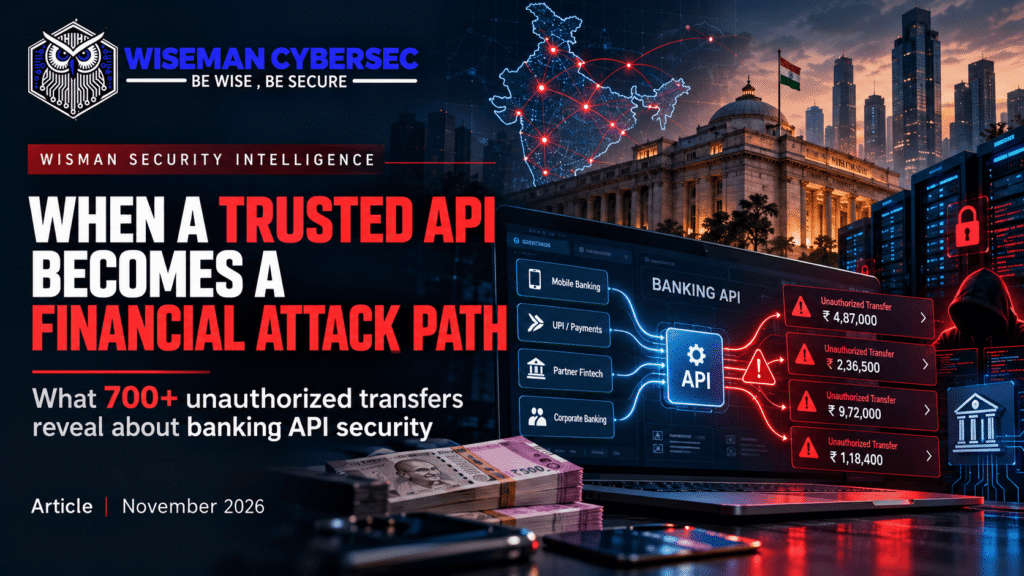
When trusted banking integrations become a gateway for financial fraud.
By Wiseman CyberSec | Security Intelligence | November 2026
A Banking Integration Became a Security Risk
More than 700 unauthorized fund transfers. Approximately $2 million in reported losses. And an alleged compromise involving a banking API used for loan disbursements.
On October 30, 2026, Reuters reported that India’s Reserve Bank of India (RBI) was intensifying cybersecurity scrutiny following a series of incidents affecting financial institutions.
One particularly concerning case involved two Mumbai-based non-banking financial companies (NBFCs) that reportedly lost approximately $2 million through more than 700 unauthorized instant transfers on October 8–9.
According to a police complaint reviewed by Reuters, attackers compromised an API connection used to send loan-disbursement instructions to ICICI Bank.
The incident highlights a critical security challenge:
What happens when an application trusted to initiate financial transactions becomes compromised?
The concern isn’t limited to banks. Any organization relying on APIs to connect applications, partners, payment systems, or critical infrastructure faces similar trust-boundary challenges.
How Can an API Become an Attack Path?
Application Programming Interfaces (APIs) allow systems to communicate and execute business operations automatically.
In financial services, these integrations support activities such as loan disbursements, payment processing, account verification, and transactions between institutions.
But APIs can also introduce significant risks when authentication credentials, authorization rules, or transaction controls are compromised.
Consider a simplified, illustrative scenario:
- A financial institution connects its lending application to a banking API.
- The API accepts authenticated requests to initiate approved loan disbursements.
- An attacker compromises an integration credential or another component in the transaction workflow.
- Unauthorized transaction instructions reach the payment-processing system.
- If additional validation and monitoring controls are inadequate, fraudulent transfers may be executed.
This example illustrates a potential failure path; it is not a confirmed technical reconstruction of the reported incident.
The security lesson is that successful API authentication alone does not establish whether a financial transaction is legitimate.
A request must also satisfy business authorization, beneficiary verification, transaction limits, and fraud-detection requirements.
Why Traditional API Security May Not Be Enough
Organizations commonly secure APIs using authentication tokens, encrypted communication, IP restrictions, and access-control policies.
These controls are important, but they do not eliminate every risk.
A stolen credential may allow an attacker to impersonate an authorized integration.
An overprivileged service account may permit operations beyond its intended business purpose.
A compromised application may generate requests that appear technically valid while violating transaction rules.
This creates a dangerous distinction between two questions:
Is the system authorized to connect?
And:
Is this specific transaction authorized to happen?
Financial institutions must be able to answer both.
What CERT-In Warned Financial Institutions About
On October 9, 2026, India’s cybersecurity agency CERT-In issued a warning about attacks targeting payment and disbursement APIs.
According to reporting on the advisory, attackers were compromising exposed applications and APIs to obtain credentials associated with financial integrations.
The warning described risks involving direct fund-transfer requests and the potential circumvention of important application-level checks, including loan validation, beneficiary verification, and transaction limits.
These findings reinforce why API security cannot be treated as a standalone authentication problem.
It must be integrated with fraud prevention, identity governance, application security, and continuous monitoring.
Five Security Priorities for Financial Institutions
1. Strengthen API Identity and Credential Security
Organizations should maintain an accurate inventory of API integrations and their associated identities.
Sensitive credentials must be protected using appropriate secrets-management systems, least-privilege permissions, restricted access, and well-defined rotation and revocation processes.
2. Enforce Transaction-Level Authorization
A trusted API connection should not automatically permit every requested financial operation.
Systems should independently validate transaction purpose, beneficiary details, financial limits, and applicable business rules.
3. Monitor for Unusual Transaction Behaviour
Security and fraud-monitoring teams should investigate suspicious activity such as abnormal transfer volumes, unusual beneficiaries, unexpected transaction timings, and sudden changes in API usage patterns.
Detection must connect technical events with financial behaviour.
4. Secure Third-Party Integrations
Banks, NBFCs, fintech platforms, payment providers, and external vendors frequently operate through interconnected technology ecosystems.
Organizations should regularly assess integration security, define accountability, review permissions, and test how quickly access can be revoked if a partner system is compromised.
5. Prepare for Credential and API Compromise
Incident response plans must account for the possibility that legitimate integration credentials have been stolen.
Teams should be able to suspend compromised connections, preserve forensic evidence, investigate transaction activity, coordinate with financial partners, and safely restore services.
The Bigger Picture: RBI’s Increasing Scrutiny
The reported incidents come amid growing concern over cybersecurity resilience across India’s financial sector.
Reuters reported that the RBI had asked banks to examine potential API vulnerabilities, demonstrate compliance with existing cybersecurity requirements, and explain their readiness for emerging AI-related risks.
The broader message is clear.
Cybersecurity compliance must translate into security controls that work under real attack conditions.
For financial institutions, the consequences of inadequate controls can extend beyond data exposure.
They may include direct monetary losses, service disruption, regulatory scrutiny, recovery expenses, and damage to customer trust.
The Wiseman CyberSec Perspective
The most important lesson from this incident isn’t simply that APIs can be compromised.
It’s that machine-to-machine trust must never become a substitute for transaction-level verification.
An API token may be valid.
A request may come from an expected integration.
A connection may use strong encryption.
Yet the transaction itself may still be unauthorized or fraudulent.
Modern cybersecurity requires organizations to connect identity security, application controls, business validation, monitoring, and incident response.
As banking becomes more automated and interconnected, protecting the systems that move money is just as critical as protecting the accounts that hold it.
Final Takeaway
An authenticated request is not automatically an authorized transaction.
For banks, fintech companies, and security professionals, that distinction could determine whether a compromised integration becomes a contained incident or a major financial loss.
One question worth asking your security team:If a trusted API integration began initiating fraudulent transfers today, would your controls detect the activity, stop the transactions, and identify the compromised access path quickly enough?