Identity and Access Management sits at the center of modern enterprise security.
Every organization needs to answer a few fundamental questions:
Who is requesting access? What should they be allowed to access? How should that access be granted? And when should it be removed?
IAM provides the technologies, processes and governance mechanisms used to answer those questions.
For cybersecurity professionals, this creates a career path that extends far beyond creating user accounts or resetting passwords. IAM professionals work with authentication, authorization, Single Sign-On (SSO), Multi-Factor Authentication (MFA), identity lifecycle management, federation, Identity Governance and Administration (IGA), Privileged Access Management (PAM), cloud identity and increasingly non-human identities.
But learning IAM can be confusing.
Should you start with Active Directory? Microsoft Entra ID? Okta? SAML? OAuth? SailPoint? CyberArk?
The answer is not to learn every product at once. A better approach is to build the underlying identity concepts first and then progressively add platforms, governance and architecture skills.
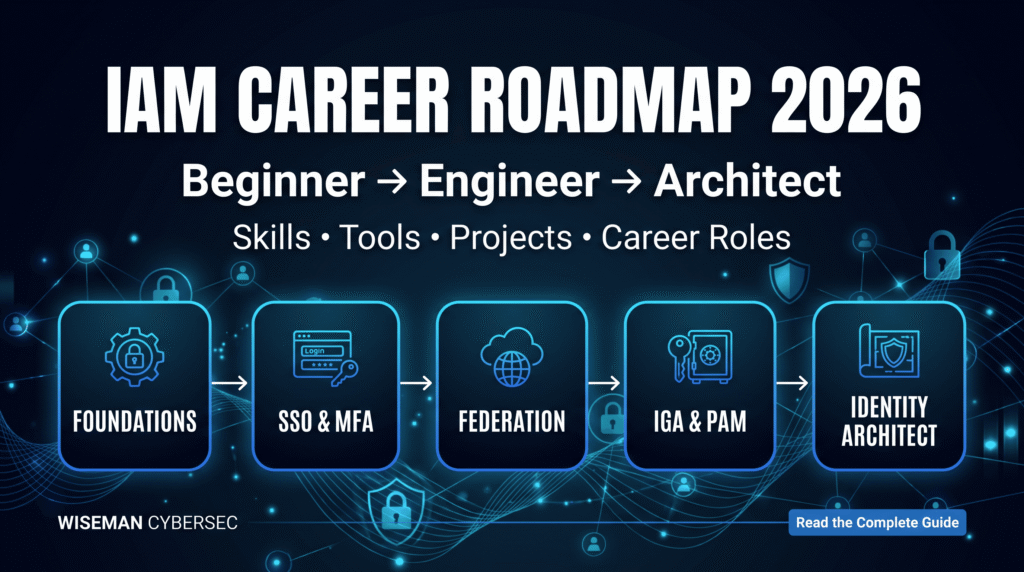
This IAM career roadmap explains that progression from beginner to advanced identity-security roles.
What Does an IAM Professional Actually Do?
IAM professionals design, implement, operate and govern the systems that control access to enterprise resources.
Depending on the organization and role, their responsibilities may include:
- Creating and managing digital identities
- Implementing SSO and MFA
- Configuring authentication policies
- Integrating applications with identity providers
- Automating user provisioning and deprovisioning
- Managing role-based access
- Conducting access reviews
- Implementing identity-governance processes
- Protecting privileged accounts
- Troubleshooting federation and authentication issues
- Managing cloud identities
- Monitoring identity-related security events
- Designing enterprise identity architecture
IAM therefore sits at the intersection of cybersecurity, infrastructure, cloud, governance and application security.
A useful way to think about IAM is:
Identity → Authentication → Authorization → Access → Governance → Monitoring
Each stage answers a different security question.
Identity asks who or what is requesting access?
Authentication asks can the identity prove who it claims to be?
Authorization asks what is that identity allowed to do?
Governance asks should that access still exist?
Monitoring asks is the identity behaving as expected?
Understanding these concepts is more important at the beginning of your career than memorizing the menus of a particular IAM product.
IAM Career Levels and Common Job Roles
IAM careers usually progress through several levels.
Entry-Level IAM Roles
Typical titles may include:
- IAM Analyst
- Identity Support Analyst
- Access Management Analyst
- IAM Operations Analyst
- Identity Administrator
- Junior IAM Engineer
At this level, you may work on account provisioning, access requests, password and MFA issues, user onboarding and offboarding, directory administration, basic application integrations and access-review activities.
The goal is to understand how identities move through an enterprise.
Intermediate IAM Roles
With more experience, roles may progress toward:
- IAM Engineer
- Identity Engineer
- IAM Consultant
- IGA Engineer
- PAM Engineer
- Federation Engineer
- Entra ID Engineer
- Okta Engineer
- SailPoint Engineer
- CyberArk Engineer
These positions generally require deeper technical implementation skills.
Instead of simply operating an existing IAM environment, you may integrate applications, configure federation, design provisioning workflows, build access models, automate lifecycle processes or deploy identity-security products.
Advanced IAM Roles
Advanced professionals may work as:
- Senior IAM Engineer
- IAM Architect
- Identity Security Architect
- IAM Lead
- IAM Program Manager
- Identity Governance Architect
- PAM Architect
- Cloud Identity Architect
At this level, the focus shifts from individual configurations toward enterprise architecture.
An IAM architect needs to understand how directories, identity providers, applications, APIs, governance platforms, PAM systems, cloud environments and security controls work together.
Skills You Need Before Learning IAM
You do not need to be an expert in every area of IT before starting IAM.
However, several foundational skills make IAM much easier to understand.
Networking Fundamentals
Learn concepts such as:
- IP addresses
- DNS
- HTTP and HTTPS
- TLS
- Ports
- Proxies
- Firewalls
- Client-server communication
Federated authentication often involves redirects, browser sessions, certificates and HTTP requests. Basic networking knowledge makes troubleshooting these flows much easier.
Operating-System Fundamentals
You should be comfortable with Windows and have at least basic familiarity with Linux.
Windows knowledge becomes especially useful when working with Active Directory and Microsoft identity environments.
Directory Concepts
Understand:
- Users
- Groups
- Organizational units
- Attributes
- Group membership
- LDAP
- Directory synchronization
Directories form an important foundation for enterprise identity.
Basic Security Concepts
Learn:
- Least privilege
- Authentication
- Authorization
- MFA
- Password security
- Session security
- Zero Trust concepts
- Logging and monitoring
Once these foundations are clear, you can move into IAM-specific technologies.
IAM Fundamentals: Identity, Authentication and Authorization
One of the most important early lessons in IAM is that identity, authentication and authorization are related but not interchangeable.
Imagine an employee called Priya trying to access a finance application.
The organization first needs a digital identity representing Priya.
When Priya signs in, the authentication system verifies her identity. That might involve a password, authenticator application, security key or another factor.
Once authenticated, the application must determine what Priya can actually do.
Can she view invoices?
Can she create payments?
Can she approve payments?
Those decisions are authorization.
A user can therefore be successfully authenticated while still being denied access to a particular resource.
IAM professionals must understand this distinction because many security problems are authorization problems rather than authentication problems.
Directory Services: Active Directory, LDAP and Microsoft Entra ID
After IAM fundamentals, directory services are a logical next step.
Active Directory
Microsoft Active Directory has historically been a major identity foundation in enterprise Windows environments.
Learn concepts such as:
- Domains
- Users and groups
- Organizational units
- Group Policy
- Kerberos
- LDAP
- Service accounts
You do not need to become an Active Directory architect before learning IAM, but understanding how enterprise identities are traditionally managed provides useful context.
LDAP
LDAP is a protocol used for accessing and managing directory information.
IAM professionals frequently encounter LDAP when integrating applications with enterprise directories.
Focus on understanding directory structures, distinguished names, attributes and queries rather than memorizing commands.
Microsoft Entra ID
Modern organizations increasingly operate across cloud and hybrid environments.
Microsoft Entra ID introduces important cloud-identity concepts such as:
- Cloud identities
- Enterprise applications
- App registrations
- MFA
- Conditional Access
- Identity federation
- Application permissions
- Service principals
Learning both traditional directory concepts and cloud identity gives you a stronger foundation for modern IAM work.
SSO and MFA
After directories, learn how organizations reduce authentication friction while strengthening security.
Single Sign-On
SSO allows a user to authenticate through a trusted identity provider and access multiple applications without independently signing in to every application.
A simplified architecture looks like this:
User → Identity Provider → Application
The identity provider authenticates the user and communicates information that the application can trust.
This introduces one of the most important areas of IAM: federation.
Multi-Factor Authentication
MFA requires more than one form of authentication.
For example:
Something you know + something you have
or
Something you have + something you are
IAM professionals need to understand not only how to enable MFA, but also where it should be enforced, how authentication policies affect users and what happens when authentication factors are lost or compromised.
Federation: SAML, OAuth 2.0 and OpenID Connect
Federation is where many IAM learners initially struggle.
Three technologies appear repeatedly:
SAML, OAuth 2.0 and OpenID Connect.
They solve related but different problems.
SAML is widely used for enterprise browser-based federation and SSO.
OAuth 2.0 is primarily an authorization framework that enables delegated access to resources.
OpenID Connect adds an identity layer on top of OAuth 2.0 and is commonly used for modern authentication.
Do not simply memorize definitions.
Learn the flows.
For example, in a federated SSO scenario:
User → Application → Identity Provider → Authentication → Assertion/Token → Application
Study which system performs each role, what information is exchanged and what the application trusts.
Being able to draw an authentication flow on a whiteboard is far more valuable than memorizing terminology.
Identity Lifecycle and Provisioning
Authentication is only part of IAM.
Organizations must also manage what happens to an identity throughout its lifecycle.
A common model is:
Joiner → Mover → Leaver
Joiner
When a person joins an organization:
- An identity is created.
- Required accounts are provisioned.
- Appropriate access is assigned.
- Authentication methods are registered.
Mover
When that person changes department or role:
- New access may be required.
- Old access may need removal.
- Group and role memberships may change.
Leaver
When the person leaves:
- Accounts should be disabled.
- Sessions may need termination.
- Access should be revoked.
- Privileged credentials may require rotation.
- Application accounts should be removed.
Poor lifecycle management can leave behind unnecessary or orphaned access.
That is why provisioning and deprovisioning are core IAM skills.
Identity Governance and Administration
As organizations grow, manually managing thousands of users and application entitlements becomes difficult.
Identity Governance and Administration helps answer questions such as:
- Who has access?
- Why do they have it?
- Who approved it?
- Does the user still need it?
- Does the access violate policy?
- Has the access been reviewed?
IGA commonly involves:
- Access requests
- Approval workflows
- Provisioning
- Access certifications
- Role management
- Segregation of duties
- Lifecycle automation
- Governance reporting
Platforms such as SailPoint are commonly associated with enterprise identity-governance implementations.
For an IAM career, IGA is a valuable specialization because it connects technical identity controls with governance and compliance requirements.
Privileged Access Management
Not all accounts have the same level of risk.
Administrative, root, database, cloud and other highly privileged accounts can cause significant damage if compromised.
Privileged Access Management focuses on protecting these identities and credentials.
Important PAM concepts include:
- Credential vaulting
- Password rotation
- Privileged session management
- Session recording
- Just-in-time access
- Least privilege
- Approval workflows
- Privileged account discovery
- Emergency access
CyberArk is one platform frequently encountered in enterprise PAM environments.
IAM professionals should understand PAM even if they do not intend to specialize in it because privileged identity is a critical part of enterprise identity security.
Cloud and Non-Human Identities
Modern IAM is no longer limited to employees signing into applications.
Organizations also need to manage identities belonging to:
- Applications
- APIs
- Services
- Containers
- Workloads
- Automation
- Bots
- Machine accounts
- AI agents
These are often described as machine identities or non-human identities.
This creates new identity-security questions.
Who owns the identity?
How is it authenticated?
Where are its credentials stored?
What permissions does it have?
How are those permissions reviewed?
How is the identity retired?
As enterprises adopt more cloud services, automation and autonomous systems, IAM professionals increasingly need to think about both human and non-human access.
IAM Tools to Learn
One of the biggest mistakes beginners make is trying to learn too many tools before understanding the concepts.
A better sequence is:
Concept → Protocol → Architecture → Product
Once the concepts are clear, useful platforms to explore include:
Microsoft Entra ID
Useful for cloud identity, authentication, application integration, MFA and Conditional Access.
Okta
Useful for learning identity-provider concepts, SSO, federation, lifecycle management and application integrations.
SailPoint
Useful for identity governance, lifecycle workflows, access certifications and enterprise provisioning.
CyberArk
Useful for privileged-access concepts including vaulting, credential management and privileged sessions.
The objective is not to collect product names.
It is to understand what problem each platform solves.
A strong IAM professional should eventually be able to look at a requirement and determine whether the problem concerns authentication, federation, governance, provisioning, privileged access or another identity function.
Hands-On Projects for an IAM Portfolio
IAM should not be learned entirely through theory.
Build small environments and document what you implement.
Project 1: Create a Basic Identity Environment
Create sample users, groups and roles.
Document:
- Identity attributes
- Group membership
- Role assignments
- Access rules
Project 2: Implement SSO
Integrate a test application with an identity provider.
Document:
- Identity provider
- Service provider/application
- Authentication flow
- Claims or assertions
- Common errors
Then draw the complete flow.
Project 3: Build an MFA Policy
Create different authentication requirements for different users or scenarios.
For example:
Normal employee → standard MFA
Administrator → stronger authentication requirement
Explain why the policies differ.
Project 4: Design a Joiner-Mover-Leaver Workflow
Create a hypothetical organization with HR, Finance and IT.
Document what happens when an employee:
- Joins Finance
- Transfers to IT
- Leaves the organization
Identify which access should be added and removed at each stage.
Project 5: Perform an Access Review
Create a sample list of users and entitlements.
Decide which access should be:
- Approved
- Revoked
- Investigated
Document your reasoning.
Project 6: Design Privileged Access
Take an administrator account and design controls around it.
Consider:
- Credential storage
- Approval
- MFA
- Time-limited access
- Session monitoring
- Logging
Projects like these demonstrate that you understand IAM as a security system rather than merely knowing product terminology.
IAM Skills Matrix
A useful learning progression looks like this:
| Level | Skills |
| Foundation | Networking, Windows/Linux, security fundamentals, directories |
| Beginner IAM | Identity, authentication, authorization, users, groups, MFA |
| Intermediate | SSO, federation, SAML, OAuth, OIDC, provisioning |
| Governance | JML, access requests, certifications, roles, IGA |
| Privileged Identity | PAM, vaulting, JIT, privileged sessions |
| Cloud Identity | Entra ID, cloud applications, Conditional Access |
| Advanced | Architecture, Zero Trust, machine identity, automation, identity threat detection |
Do not treat this as a checklist that must be completed before applying for a job.
Skills often develop in parallel.
Certification Options for IAM Professionals
Certifications can support an IAM career, but they should reinforce practical knowledge rather than replace it.
Depending on your career direction, relevant learning paths may cover:
- Identity administration
- Cloud identity
- Microsoft identity technologies
- Vendor-specific IAM platforms
- Privileged access
- Governance
- General cybersecurity architecture
Choose certifications based on the technologies and roles you want to work with.
For example, someone targeting Microsoft identity environments may choose a different path from someone planning to specialize in SailPoint implementation or CyberArk PAM.
The underlying IAM concepts remain transferable.
A Practical 90-Day IAM Learning Roadmap
Here is one way to structure your first three months.
Days 1–30: Build the Foundation
Focus on:
- IAM concepts
- Authentication vs authorization
- Active Directory fundamentals
- LDAP concepts
- Microsoft Entra ID fundamentals
- MFA
- Basic cloud identity
Build a small identity lab and create users, groups and access assignments.
Your objective at the end of the first month should be to explain how an enterprise represents and authenticates identities.
Days 31–60: Learn Federation and Lifecycle
Focus on:
- SSO
- SAML
- OAuth 2.0
- OpenID Connect
- Provisioning
- Joiner-Mover-Leaver
- Access requests
- Basic IGA
Build an SSO integration and draw the complete authentication flow.
Then create a sample lifecycle workflow.
Your objective should be to understand how identities receive access to applications and how that access changes over time.
Days 61–90: Add Governance and Privileged Access
Focus on:
- Access reviews
- Role models
- Segregation of duties
- IGA platforms
- PAM
- Just-in-time access
- Cloud identity
- Identity-security architecture
Build at least one governance project and one privileged-access design.
Finally, create an architecture diagram connecting:
Directory → Identity Provider → Applications → IGA → PAM → Logging/Security Monitoring
At this point, you should be able to discuss IAM as an enterprise security architecture rather than as a collection of independent products.
Common IAM Interview Expectations
IAM interviews vary considerably by role.
However, candidates are commonly expected to explain concepts rather than merely define acronyms.
Prepare to discuss scenarios such as:
- Authentication vs authorization
- How SSO works
- SAML authentication flow
- OAuth vs OpenID Connect
- MFA
- Provisioning and deprovisioning
- Joiner-Mover-Leaver
- RBAC
- Access reviews
- Privileged accounts
- Troubleshooting authentication
- Least privilege
- Identity governance
For implementation roles, expect deeper product-specific questions.
For architecture roles, expect questions about trade-offs, integrations, security controls and enterprise design.
Whenever possible, answer using a flow or practical example.
From IAM Beginner to IAM Architect
Becoming an IAM architect does not mean learning every identity product available.
It means developing layers of understanding.
Start with:
Identity → Authentication → Authorization
Then add:
Directories → MFA → SSO → Federation
Then:
Provisioning → Lifecycle → Governance
Then:
IGA → PAM → Cloud Identity
And eventually:
Architecture → Automation → Non-Human Identity → Enterprise Identity Security
Tools will change.
Products will change.
Identity protocols and implementation patterns will continue evolving.
But the central security problem remains remarkably consistent:
The right identity should receive the right access to the right resource, under the right conditions, for the right amount of time.
That is the problem IAM professionals are hired to solve.
Start Building Practical IAM Skills
Reading about IAM is useful, but identity becomes much easier to understand when you configure authentication flows, integrate applications, troubleshoot federation and build lifecycle workflows yourself.
Wiseman CyberSec’s IAM Foundation to Advance learning path is designed to help learners progress from IAM fundamentals into practical enterprise identity concepts and technologies.
Use the roadmap in this guide to identify where you are today, build the missing foundations and then develop hands-on experience across identity, federation, governance and privileged access.
Next step: Explore the IAM Foundation to Advance program and begin building an IAM portfolio around real identity workflows.
Frequently Asked Questions
Is IAM a good career path for beginners in cybersecurity?
IAM can be an entry point for people with foundations in IT, directories, cloud administration or cybersecurity. Beginners should first understand networking, operating systems, identity concepts, authentication and authorization before moving into specialized IAM platforms.
Do I need coding skills for IAM?
Not every IAM role requires advanced programming. However, scripting, APIs and automation become increasingly useful for engineering and advanced implementation roles.
Should I learn Okta or Entra ID first?
The best starting platform depends on the environment and roles you are targeting. More importantly, learn identity-provider concepts, authentication, federation and lifecycle management so your knowledge can transfer between products.
Is SailPoint the same as IAM?
No. IAM is the broader discipline. SailPoint is associated with identity governance and administration capabilities within the broader identity ecosystem.
Is CyberArk an IAM tool?
CyberArk is strongly associated with Privileged Access Management, which addresses the protection and governance of privileged identities and access. PAM forms part of the wider identity-security landscape.
What should I learn first in IAM?
Start with identity, authentication, authorization, directories and access-control fundamentals. Then progress into MFA, SSO, federation protocols, provisioning, lifecycle management, IGA and PAM.
How long does it take to learn IAM?
There is no single timeline. A focused 90-day learning plan can establish useful foundations and hands-on projects, while professional-level implementation and architecture skills develop through continued practical experience.
What projects should I put in an IAM portfolio?
Useful projects include an SSO integration, MFA policy design, Joiner-Mover-Leaver workflow, access-review exercise, RBAC design and privileged-access architecture. Document the architecture, security decisions and troubleshooting process rather than showing only screenshots.