You Don’t Need 10 Certifications to Get Into Cybersecurity—You Need These 5 Skills
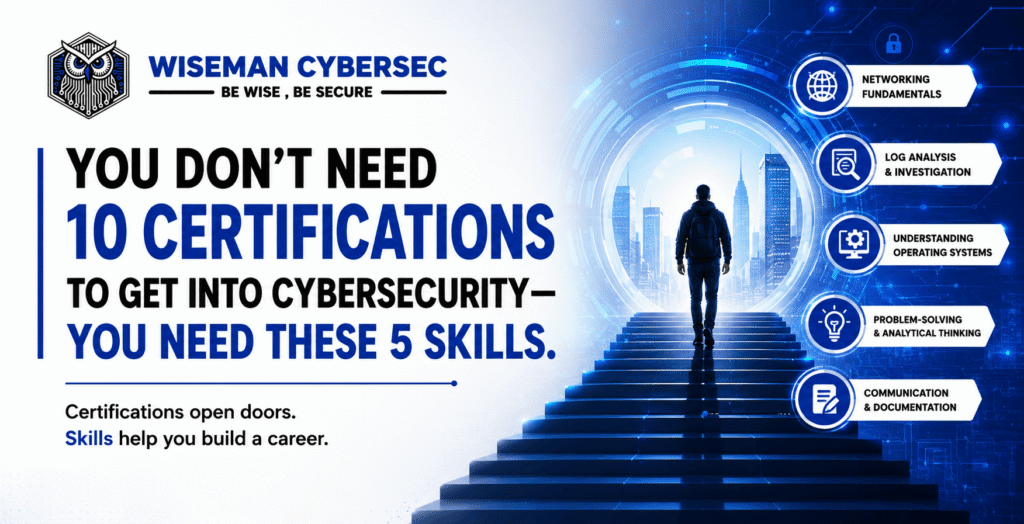
A cybersecurity beginner opens LinkedIn and sees the same advice everywhere. Get certified. Then get another certification. Then another one. Before long, the goal of building a cybersecurity career quietly turns into a race to collect certificates. CEH. Security+. CySA+. CISSP. CISM. ISO 27001. Maybe a few more just to make the resume look stronger. And yet, when the person finally sits in front of a recruiter or enters a real security environment, one simple question can expose the gap: “You have received an alert for multiple failed logins. How would you investigate it?”Suddenly, knowing the names of ten certifications does not help much. This is an uncomfortable truth about starting a cybersecurity career: Certifications can demonstrate that you studied something. They do not automatically prove that you can do the job. The cybersecurity industry does not need more people who can simply list security concepts. It needs people who can think, investigate, understand systems, and respond to problems. So, if you are trying to enter cybersecurity, stop asking yourself: “Which certification should I do next?”Start asking: “Which skills would make me useful in a real security team?” Here are five skills that matter far more than most beginners realise. 1. Networking Fundamentals: You Cannot Secure What You Do Not Understand Let’s start with the foundation. You do not need to become a network engineer to work in cybersecurity. But you absolutely need to understand how networks work. A surprising number of cybersecurity beginners try to learn advanced tools before understanding basic networking concepts. They know the name of a SIEM. They have seen an EDR dashboard. They can explain what a firewall does. But ask them to explain the difference between TCP and UDP, or what happens when a user visits a website, and the answer becomes uncertain. This creates a serious problem. Imagine an alert showing suspicious outbound traffic from an internal workstation. How do you determine whether it is malicious? You need to understand: Without this foundation, you are simply looking at an alert. You are not investigating it. Networking knowledge helps you understand the story behind the data. And cybersecurity is largely about understanding stories. What happened? Where did it start? What did it communicate with? What changed? A strong cybersecurity professional does not just say, “There is suspicious traffic.” They ask: “Why is this system communicating with that destination, over that port, at this time?” That is the beginning of real security thinking. 2. Log Analysis: Learn to Read What Systems Are Telling You Security teams generate an enormous amount of data. Login events. Firewall logs. Endpoint alerts. Authentication records. Cloud activity. Application events. The problem is not a lack of information. The problem is understanding what information actually matters. This is where log analysis becomes one of the most important skills in cybersecurity. Consider this: A user successfully logged in at 10:00 AM. On its own, this is completely normal. Now add a few more events: Suddenly, the individual events tell a very different story. The skill is not simply reading logs. The skill is connecting events. A good SOC analyst learns to identify patterns. They ask: This is why someone with strong analytical skills can sometimes outperform someone with more certifications. Because cybersecurity is not a multiple-choice exam. In the real world, the answer is often hidden across hundreds of events. You need to know how to find it. 3. Understanding Operating Systems: Know What Happens Behind the Interface Many cybersecurity learners focus heavily on tools. But tools are only as useful as your understanding of the systems they monitor. You should understand the basics of operating systems, particularly Windows and Linux. Why? Because attackers interact with operating systems. They create processes. They modify files. They use services. They create accounts. They execute commands. They manipulate permissions. If you do not understand normal system behaviour, malicious behaviour becomes much harder to recognise. For example, imagine an alert showing a suspicious PowerShell command. A beginner may simply see: “PowerShell detected.” An experienced analyst asks: The difference is knowledge. You do not need to memorise every command in Windows or Linux. But you need to understand how systems behave. You need to know what normal looks like. Because in cybersecurity, anomalies only make sense when you understand the baseline. 4. Problem-Solving: Cybersecurity Is Not a Checklist This may be the most underrated cybersecurity skill. Cybersecurity rarely gives you a perfectly labelled problem. You will not always receive an alert saying: “This is a phishing attack. Please follow steps 1 to 5.” Real incidents are messy. Information may be incomplete. The alert may be misleading. Multiple systems may be involved. And sometimes, the first assumption is completely wrong. This is why problem-solving matters. A strong cybersecurity professional is comfortable asking: “What else could explain this?” For example, a suspicious login could be: The job is not to immediately label everything as an attack. The job is to investigate. Good problem-solving means: This is also why cybersecurity professionals should not be afraid of saying: “I don’t know yet.” The important word is yet. The ability to investigate and find the answer is more valuable than pretending to know everything. 5. Communication and Documentation: The Skill Nobody Talks About Enough Cybersecurity is technical. But cybersecurity is also communication. You may investigate an incident perfectly. You may identify the root cause. You may even contain the threat. But if you cannot clearly explain what happened, your work loses value. A security analyst may need to communicate with: And each audience needs a different level of explanation. A CISO may not need to know every command executed on a system. But they need to know: What happened? What was affected? What is the business impact? What is being done about it? This is where clear documentation matters. A good incident report should help someone understand the incident even if they were not part of the investigation. Poor documentation creates confusion. It also makes future investigations harder. In cybersecurity, your
The Kudankulam Data Breach: What India’s Critical Infrastructure Can Teach Us About Third-Party Risk
The most dangerous assumption in cybersecurity is that your security ends at your firewall. On 15 July 2026, a report about India’s Kudankulam Nuclear Power Plant created a wave of concern across the cybersecurity and critical infrastructure community. A ransomware group reportedly published a large cache of files on the dark web that were allegedly linked to Reliance Group and related to infrastructure work at Kudankulam’s Units 3 and 4. According to reporting, the data was associated with a server hosted by Yotta, a third-party data centre provider. Reliance acknowledged a partial breach of its data and said the government had been informed. The reported files included purported blueprints, supplier details, inspection records and other project-related documents. The authenticity of the documents and the full extent of the exposure remain under investigation. Let us be precise about something. This is not a story about an attacker remotely taking control of a nuclear reactor. And that distinction matters. The Indian government had previously stated, in relation to the 2019 KKNPP malware incident, that the infection was limited to the administrative network and that the plant’s control and instrumentation systems were isolated from external and administrative networks. But here is the uncomfortable lesson: An organisation does not need to lose control of its most critical system for a cyber incident to become strategically dangerous. Sometimes, the breach happens somewhere else. With someone else. On infrastructure you do not directly operate. And yet the information exposed may still be connected to your most sensitive assets. That is the real third-party risk lesson emerging from the Kudankulam case. The breach did not have to start inside the nuclear plant When people hear “critical infrastructure cybersecurity,” they usually imagine the obvious attack scenario. An attacker finds a vulnerability in a plant network. They bypass a firewall. They gain access to an OT environment. They compromise an industrial control system. The story is easy to understand because the attack follows the traditional perimeter model. But modern attacks do not always work that way. The Kudankulam case, as currently reported, presents a different and much more uncomfortable model. The reported chain looks something like this: Critical infrastructure project → contractor → third-party data centre → stored project data → ransomware attack → public exposure The attacker may not need to breach the nuclear facility directly. They may not need access to a reactor control system. They may not even need to understand the entire plant architecture. They may only need to find a connected organisation holding sensitive information related to the project. This is the fundamental shift in third-party risk. Your attack surface is no longer defined by the systems you own. It is defined by the systems that hold your data, connect to your operations, support your projects, or are trusted by your people. The data may be “administrative”. The intelligence may not be. One of the most dangerous words in cybersecurity is administrative. An administrative system is often mentally categorised as less important than an operational system. That is understandable. An office network is not a reactor control system. A project document is not a PLC. A supplier database is not a safety system. But attackers do not always look at data through the same lens as defenders. A document that looks “administrative” to an organisation may provide an adversary with context. Supplier information can reveal dependencies. Inspection records can reveal equipment and maintenance patterns. Project documents can reveal how different organisations interact. Engineering documentation can reveal design assumptions or infrastructure relationships. Insurance documents can expose how an organisation categorises and financially models certain risks. Individually, each document may appear harmless. The problem is aggregation. A threat actor does not necessarily need one magical document. They may need thousands of small pieces of information that, when combined, create a much clearer picture of the target. This is why data classification cannot be based only on the question: “Can this file directly control a critical system?” The better question is:“What could an adversary understand if they collected enough of our data?” The vendor is not “just a vendor” anymore For years, many organisations have treated third-party risk as a procurement activity. A vendor is selected. A questionnaire is sent. A certificate is requested. A contract is signed. The vendor is onboarded. And the security team moves on to the next problem. This approach is increasingly inadequate. NIST describes cybersecurity supply chain risk management as the process of identifying, assessing and mitigating risks across the interconnected ICT and OT supply chain throughout the lifecycle of systems and services. That lifecycle includes design, development, deployment, maintenance and even destruction. That is a very different way of thinking about vendors. A vendor is not simply a company that provides a service. A vendor is a security dependency. And every security dependency creates a question: What happens to our risk when our data, access or operations move into their environment? In the Kudankulam case, the reported involvement of a third-party data centre provider is precisely what makes the story relevant to almost every modern organisation. Because most companies today rely on someone else. Cloud providers. Managed service providers. Data centres. SaaS platforms. Payroll systems. IT support vendors. Consultants. Engineering contractors. Software suppliers. And increasingly, AI platforms. The perimeter is no longer a wall. It is an ecosystem. The “weakest link” analogy is no longer enough Cybersecurity professionals often say: “Your security is only as strong as your weakest link.” It sounds correct. But it is incomplete. The problem is that third-party risk is not always about finding the weakest vendor. It is about understanding where trust has been transferred. A highly mature organisation may have excellent internal controls. Strong MFA. A capable SOC. Endpoint detection. Segmentation. Incident response. But if a critical supplier has access to sensitive project data and operates with weaker controls, the risk does not disappear simply because the primary organisation is mature. In fact, attackers may deliberately target the supplier. NIST has explicitly highlighted that
How Third-Party Vendor Breaches Become Enterprise Security Crises
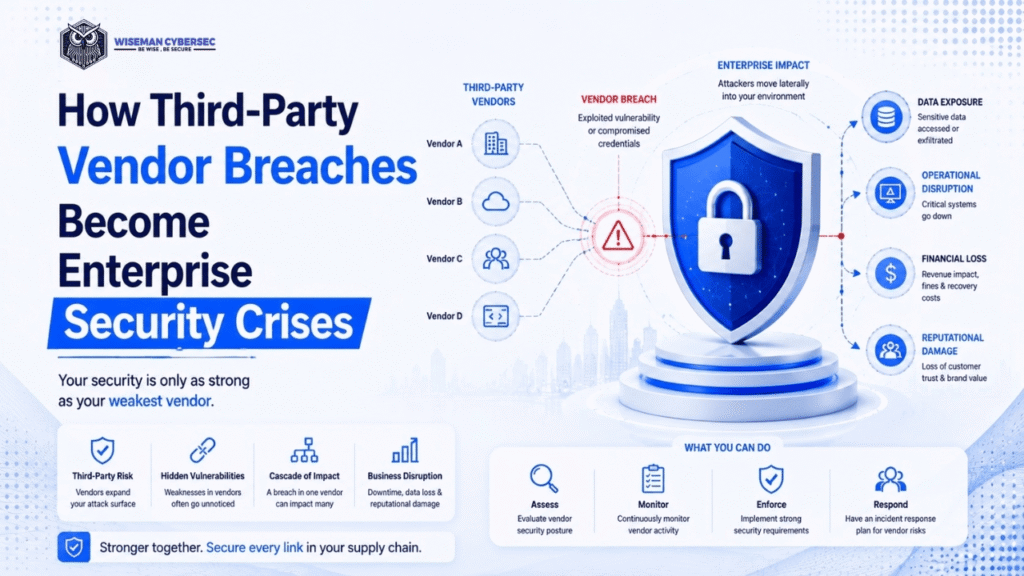
Introduction: In today’s interconnected digital ecosystem, cybersecurity extends far beyond an organization’s own network. Businesses increasingly rely on cloud platforms, SaaS applications, managed service providers (MSPs), consultants, payroll vendors, IT outsourcing firms, and numerous third-party partners to support critical operations. While these partnerships drive innovation and efficiency, they also introduce significant security risks. Every external vendor with access to your systems, applications, or sensitive data becomes part of your organization’s extended attack surface. If that vendor is compromised, the consequences can quickly escalate into a full-scale enterprise security crisis. Recent supply chain attacks have demonstrated that cybercriminals often target trusted third parties instead of attacking organizations directly. A single vulnerable supplier can become the gateway to data breaches, ransomware attacks, operational disruptions, regulatory penalties, and lasting reputational damage.Understanding and managing third-party risk is no longer optional—it’s a fundamental component of modern cybersecurity. Understanding Third-Party Risk: Third-party risk refers to the potential cybersecurity, operational, financial, and compliance risks introduced by external organizations that have access to your business assets. These vendors may include: Many organizations invest heavily in securing their own infrastructure while overlooking the security posture of their vendors. Unfortunately, attackers understand this weakness. A small supplier with privileged access can often become the easiest route into a much larger enterprise. This is why Third-Party Risk Management (TPRM) has evolved from a procurement requirement into a strategic cybersecurity function. How Vendor Breaches Become Enterprise Security Crises: A third-party breach becomes an enterprise-wide incident when attackers leverage the trust established between a vendor and the organization. Common attack vectors include: Once attackers gain access through a trusted vendor, they frequently: Because the traffic originates from trusted partners, malicious activity often goes undetected for extended periods, increasing the overall impact of the attack. Common Attack Paths: Third-party compromises generally follow predictable patterns. 1. Credential Theft: Attackers steal vendor usernames and passwords through phishing, malware, or credential leaks and use them to access customer environments. 2. Software Supply Chain Attacks: Cybercriminals compromise a vendor’s software development or update process, allowing malicious code to be distributed to thousands of customers simultaneously. 3. Remote Access Exploitation: Many IT vendors require administrative access to customer systems. Poorly secured remote access tools can become attractive entry points for attackers. 4. API Abuse: Insecure APIs between vendors and organizations may expose sensitive information or provide unauthorized system access. 5. Shared Infrastructure: Organizations that rely on shared cloud environments or integrated platforms may experience cascading compromise when a provider is breached. Business Impact of Third-Party Breaches: The consequences extend far beyond technical recovery. Data Exposure: Sensitive customer information, financial records, intellectual property, and confidential business data may be compromised. This often triggers: Operational Disruption: Critical business operations can come to a halt when vendors providing essential services become unavailable. Examples include: Financial Losses: Organizations frequently incur significant expenses, including: Reputational Damage: Customers rarely distinguish whether a breach originated internally or through a vendor. Loss of trust can result in: Why Traditional Vendor Assessments Fall Short: Many organizations still rely on annual questionnaires and compliance checklists to assess vendor security. While useful, these methods provide only a snapshot in time. Cyber threats evolve daily. A vendor that appeared secure during onboarding may experience a breach weeks later. Traditional assessments often fail because they: Effective Third-Party Risk Management requires ongoing visibility—not just periodic reviews. What Strong Vendor Security Looks Like: A mature vendor security program begins before a contract is signed. Organizations should: Security expectations should also be embedded into contracts, including: Vendor security should remain a continuous process throughout the business relationship. Practical Controls That Reduce Third-Party Risk: Organizations can significantly reduce exposure by implementing layered security controls. Recommended best practices include: Organizations should also maintain a complete inventory of vendors and identify which ones have access to critical systems or sensitive information. Evidence-based validation—such as independent security audits, penetration testing reports, and vulnerability management practices—is far more reliable than relying solely on vendor questionnaires. Governance Is the Key to Success: Third-party risk cannot be managed by cybersecurity teams alone. An effective TPRM program requires collaboration across multiple departments. Security Teams: Procurement: Legal Teams: Business Owners: Shared ownership reduces blind spots and enables faster decision-making during security incidents. Building a Mature Third-Party Risk Management Program: A comprehensive TPRM framework typically includes: Modern organizations increasingly use automation and continuous monitoring platforms to prioritize high-risk vendors and reduce assessment fatigue. The objective is not to eliminate every risk but to identify, prioritize, and effectively manage the risks that matter most. Final Thoughts: Third-party vendor breaches have become one of the most significant cybersecurity threats facing modern organizations. Attackers understand that trusted relationships often provide easier access than attacking well-defended enterprises directly. Without continuous oversight, strong governance, and enforceable security controls, a single vendor compromise can rapidly evolve into an enterprise-wide security crisis. Organizations that proactively invest in Third-Party Risk Management are better positioned to protect sensitive data, maintain business continuity, satisfy regulatory requirements, and preserve customer trust. In an era of increasingly interconnected digital ecosystems, cybersecurity is only as strong as the weakest link in your supply chain. Strengthening vendor security today is essential to protecting your organization tomorrow. – Wiseman CyberSec Secure Your Vendor Ecosystem Before Attackers Do– Third-party vendors shouldn’t become your biggest cybersecurity risk. Strengthen your supply chain security with expert-led Third-Party Risk Management, Vendor Risk Assessments, and Cybersecurity Training from Wiseman CyberSec.
Why Cybersecurity Is No Longer Just Technical: A Business Imperative for Every Organization
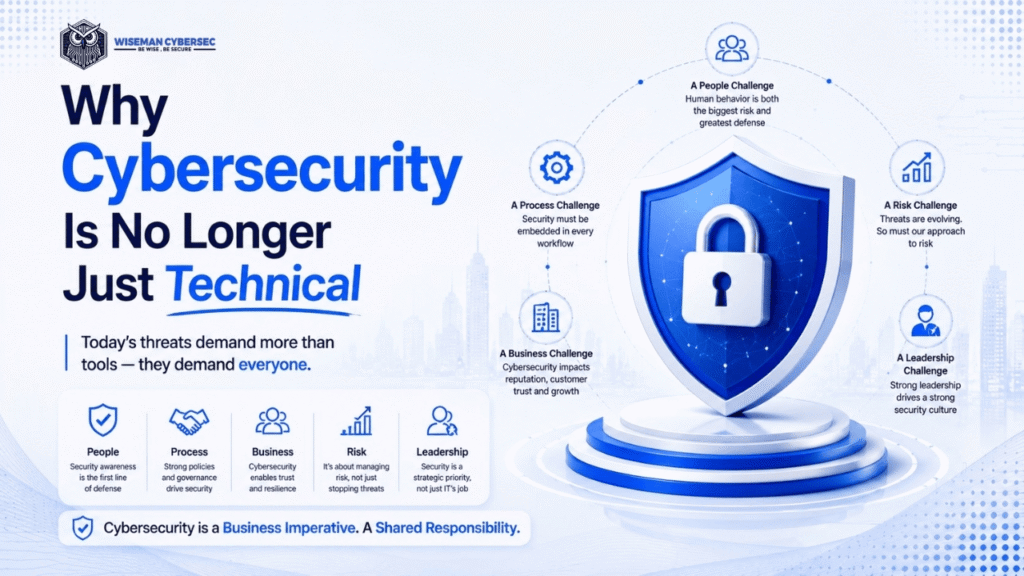
For many years, cybersecurity was treated as a narrow technical discipline owned by the IT department. Firewalls, antivirus tools, patching, and network defenses were seen as the primary answer to security threats. That approach is no longer enough. Today’s threat landscape is more complex, more human-driven, and more business-critical than ever before. Cybersecurity now affects reputation, customer trust, compliance, operations, revenue, and long-term resilience. The central message of this post is clear: cybersecurity must be embedded across the entire organization. It is not just about protecting systems; it is about protecting the business itself. When security is viewed only as a technical issue, organizations tend to react late, overlook human behavior, and create gaps between policy and practice. A modern security program must connect technology with governance, culture, leadership, and business strategy. The shift from technical to strategic: Cyber threats have evolved far beyond basic malware or unauthorized access attempts. Attackers now exploit people through phishing, social engineering, credential theft, business email compromise, and insider misuse. They target business processes, third-party relationships, cloud environments, and supply chains. This means that defending an organization requires more than technical controls alone. Security leaders must now think strategically. Cybersecurity decisions affect hiring, training, procurement, vendor selection, remote work policies, customer experience, and crisis management. In other words, security is not a separate layer added at the end; it is part of how the business operates from the beginning. The people challenge: Human behavior remains one of the biggest security risks. Employees can accidentally click malicious links, reuse weak passwords, mishandle sensitive data, or bypass procedures under pressure. At the same time, people are also the organization’s first and strongest line of defense when they are trained, informed, and empowered. This is why awareness programs alone are not enough. Organizations need a security culture where employees understand why controls exist and how their actions affect the company. That includes role-based training, leadership messaging, clear reporting channels, and practical guidance for everyday decisions. When people become part of the defense strategy, the organization becomes significantly harder to attack. The process challenge: Even the best security tools fail when processes are weak or ignored. Security must be embedded into workflows, not layered on as an afterthought. That means secure onboarding and offboarding, access reviews, change management, incident response procedures, backup testing, vendor risk checks, and documented approval paths. Strong processes create consistency. They reduce reliance on individual memory and ensure that security decisions are repeatable and measurable. In frameworks such as ISO 27001, this process-driven approach is essential because it ties security to governance, accountability, and continuous improvement. The goal is not just to prevent incidents, but to build an organization that can respond, recover, and adapt. The business challenge: Cybersecurity has direct business impact. A security incident can disrupt operations, delay services, damage client confidence, trigger legal exposure, and affect revenue. For customer-facing organizations, one breach can quickly become a reputation crisis. For regulated industries, the consequences may include fines, audits, and contractual loss. This is why business leaders must treat cybersecurity as a core business function. It is not merely a cost center or a technical overhead. It protects trust, preserves continuity, and supports growth. If the business depends on digital systems, customer data, and connected operations, then security is inseparable from business performance. The risk challenge: Risk is not static. Threats evolve, attackers adapt, and business environments change constantly. Remote work, cloud adoption, AI-enabled attacks, third-party dependencies, and shadow IT have expanded the attack surface. Security programs must therefore shift from a one-time control mindset to an ongoing risk management approach. A risk-based security strategy helps organizations prioritize what matters most. Not every asset carries the same level of exposure, and not every threat has the same business impact. Mature organizations assess likelihood and impact, apply controls where they matter most, and continuously review priorities as conditions change. This is what makes cybersecurity sustainable instead of reactive. The leadership challenge: Leadership determines whether cybersecurity becomes a real organizational priority or remains a technical checkbox. Strong leaders set the tone, allocate resources, demand accountability, and create a culture where security is taken seriously. Without leadership support, security teams often struggle to get buy-in for policy enforcement, training, investments, and process changes. Leaders do not need to be technical experts to support cybersecurity effectively. They do need to ask the right questions, understand business risk, and treat security as part of corporate governance. When executives visibly support security, teams across the organization are more likely to follow. That top-down commitment is often what separates mature organizations from vulnerable ones. Why shared responsibility matters: The post correctly frames cybersecurity as a shared responsibility. IT teams, security professionals, executives, managers, employees, vendors, and even customers all play a role in protecting the organization. No single team can stop every threat alone. Shared responsibility means that everyone has a part to play. Employees must follow secure practices, managers must enforce policies, executives must sponsor the program, and security teams must design practical controls that support business goals. When responsibility is distributed clearly, security becomes more resilient and far more effective. Building a modern security culture: A strong cybersecurity culture does not happen by chance. It is built through consistent communication, leadership commitment, process discipline, and ongoing education. Organizations should make security visible, understandable, and relevant to daily work. Practical steps include: These practices help move security from theory into daily behavior. Over time, they create an environment where secure choices become normal choices. Conclusion: Cybersecurity is no longer just a technical function because modern threats do not stay within technical boundaries. They affect people, processes, business operations, leadership decisions, and organizational risk. The most resilient organizations are the ones that treat security as a business imperative and a shared responsibility. – Wiseman CyberSec Ready to build a cybersecurity culture that protects your business? Explore Wiseman CyberSec’s cybersecurity, risk management, and governance training programs to empower your teams, strengthen resilience, and stay ahead of evolving threats.