Introduction:
In today’s interconnected digital ecosystem, cybersecurity extends far beyond an organization’s own network. Businesses increasingly rely on cloud platforms, SaaS applications, managed service providers (MSPs), consultants, payroll vendors, IT outsourcing firms, and numerous third-party partners to support critical operations.
While these partnerships drive innovation and efficiency, they also introduce significant security risks. Every external vendor with access to your systems, applications, or sensitive data becomes part of your organization’s extended attack surface. If that vendor is compromised, the consequences can quickly escalate into a full-scale enterprise security crisis.
Recent supply chain attacks have demonstrated that cybercriminals often target trusted third parties instead of attacking organizations directly. A single vulnerable supplier can become the gateway to data breaches, ransomware attacks, operational disruptions, regulatory penalties, and lasting reputational damage.Understanding and managing third-party risk is no longer optional—it’s a fundamental component of modern cybersecurity.
Understanding Third-Party Risk:
Third-party risk refers to the potential cybersecurity, operational, financial, and compliance risks introduced by external organizations that have access to your business assets.
These vendors may include:
- Cloud service providers
- Software vendors
- Managed Security Service Providers (MSSPs)
- Payroll and HR platforms
- IT support companies
- Consultants and contractors
- Data processing partners
- Payment processors
Many organizations invest heavily in securing their own infrastructure while overlooking the security posture of their vendors. Unfortunately, attackers understand this weakness.
A small supplier with privileged access can often become the easiest route into a much larger enterprise.
This is why Third-Party Risk Management (TPRM) has evolved from a procurement requirement into a strategic cybersecurity function.
How Vendor Breaches Become Enterprise Security Crises:
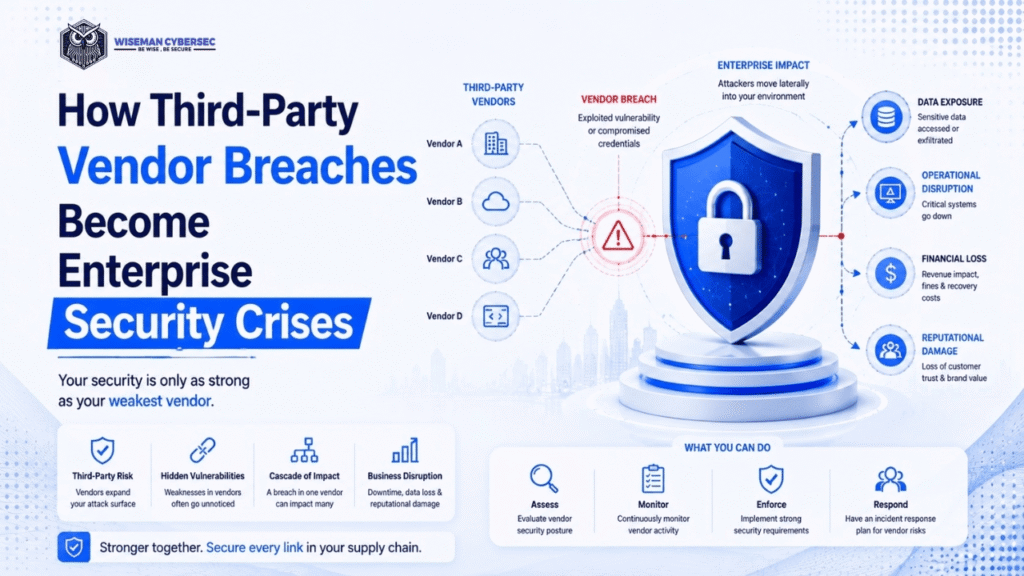
A third-party breach becomes an enterprise-wide incident when attackers leverage the trust established between a vendor and the organization.
Common attack vectors include:
- Stolen vendor credentials
- Exploited software vulnerabilities
- Insecure APIs
- Compromised software updates
- Weak remote access controls
- Shared authentication systems
- Excessive vendor privileges
Once attackers gain access through a trusted vendor, they frequently:
- Move laterally across networks
- Escalate privileges
- Access sensitive customer or employee data
- Deploy ransomware
- Disrupt critical business services
- Establish long-term persistence
Because the traffic originates from trusted partners, malicious activity often goes undetected for extended periods, increasing the overall impact of the attack.
Common Attack Paths:
Third-party compromises generally follow predictable patterns.
1. Credential Theft:
Attackers steal vendor usernames and passwords through phishing, malware, or credential leaks and use them to access customer environments.
2. Software Supply Chain Attacks:
Cybercriminals compromise a vendor’s software development or update process, allowing malicious code to be distributed to thousands of customers simultaneously.
3. Remote Access Exploitation:
Many IT vendors require administrative access to customer systems. Poorly secured remote access tools can become attractive entry points for attackers.
4. API Abuse:
Insecure APIs between vendors and organizations may expose sensitive information or provide unauthorized system access.
5. Shared Infrastructure:
Organizations that rely on shared cloud environments or integrated platforms may experience cascading compromise when a provider is breached.
Business Impact of Third-Party Breaches:
The consequences extend far beyond technical recovery.
Data Exposure:
Sensitive customer information, financial records, intellectual property, and confidential business data may be compromised.
This often triggers:
- Regulatory investigations
- Mandatory breach notifications
- Legal liabilities
- Customer lawsuits
Operational Disruption:
Critical business operations can come to a halt when vendors providing essential services become unavailable.
Examples include:
- Payroll delays
- Manufacturing interruptions
- Website downtime
- Customer support outages
- Cloud service disruptions
Financial Losses:
Organizations frequently incur significant expenses, including:
- Incident response costs
- Digital forensics
- Legal services
- Regulatory fines
- Business interruption losses
- Recovery and remediation expenses
- Increased cyber insurance premiums
Reputational Damage:
Customers rarely distinguish whether a breach originated internally or through a vendor.
Loss of trust can result in:
- Customer attrition
- Reduced investor confidence
- Damaged brand reputation
- Lost business opportunities
- Rebuilding trust often takes years.
Why Traditional Vendor Assessments Fall Short:
Many organizations still rely on annual questionnaires and compliance checklists to assess vendor security.
While useful, these methods provide only a snapshot in time.
Cyber threats evolve daily.
A vendor that appeared secure during onboarding may experience a breach weeks later.
Traditional assessments often fail because they:
- Are conducted only once
- Depend heavily on self-attestation
- Lack continuous monitoring
- Ignore evolving threat intelligence
- Fail to reassess high-risk vendors regularly
Effective Third-Party Risk Management requires ongoing visibility—not just periodic reviews.
What Strong Vendor Security Looks Like:
A mature vendor security program begins before a contract is signed.
Organizations should:
- Assess vendor security posture before onboarding
- Classify vendors based on risk level
- Verify security certifications and audit reports
- Review access requirements
- Evaluate incident response capabilities
- Validate compliance obligations
Security expectations should also be embedded into contracts, including:
- Breach notification timelines
- Audit rights
- Data handling requirements
- Access restrictions
- Security control obligations
- Right-to-assess clauses
Vendor security should remain a continuous process throughout the business relationship.
Practical Controls That Reduce Third-Party Risk:
Organizations can significantly reduce exposure by implementing layered security controls.
Recommended best practices include:
- Principle of Least Privilege (PoLP)
- Multi-Factor Authentication (MFA)
- Network segmentation
- Continuous security monitoring
- Vendor risk reassessments
- Endpoint detection and response
- Privileged Access Management (PAM)
- Security logging and alerting
- Secure vendor offboarding
- Regular access reviews
Organizations should also maintain a complete inventory of vendors and identify which ones have access to critical systems or sensitive information.
Evidence-based validation—such as independent security audits, penetration testing reports, and vulnerability management practices—is far more reliable than relying solely on vendor questionnaires.
Governance Is the Key to Success:
Third-party risk cannot be managed by cybersecurity teams alone.
An effective TPRM program requires collaboration across multiple departments.
Security Teams:
- Define technical security requirements
- Monitor vendor risks
- Validate controls
Procurement:
- Assess vendor risk during sourcing
- Ensure security reviews before purchase
Legal Teams:
- Include enforceable security clauses in contracts
- Define liability and notification requirements
Business Owners:
- Understand operational risks
- Ensure vendors meet business resilience expectations
Shared ownership reduces blind spots and enables faster decision-making during security incidents.
Building a Mature Third-Party Risk Management Program:
A comprehensive TPRM framework typically includes:
- Vendor inventory management
- Risk classification
- Security due diligence
- Continuous monitoring
- Compliance verification
- Remediation tracking
- Incident response coordination
- Periodic reassessments
- Executive reporting
- Threat intelligence integration
Modern organizations increasingly use automation and continuous monitoring platforms to prioritize high-risk vendors and reduce assessment fatigue.
The objective is not to eliminate every risk but to identify, prioritize, and effectively manage the risks that matter most.
Final Thoughts:
Third-party vendor breaches have become one of the most significant cybersecurity threats facing modern organizations.
Attackers understand that trusted relationships often provide easier access than attacking well-defended enterprises directly. Without continuous oversight, strong governance, and enforceable security controls, a single vendor compromise can rapidly evolve into an enterprise-wide security crisis.
Organizations that proactively invest in Third-Party Risk Management are better positioned to protect sensitive data, maintain business continuity, satisfy regulatory requirements, and preserve customer trust.
In an era of increasingly interconnected digital ecosystems, cybersecurity is only as strong as the weakest link in your supply chain. Strengthening vendor security today is essential to protecting your organization tomorrow.
– Wiseman CyberSec
Secure Your Vendor Ecosystem Before Attackers Do–
Third-party vendors shouldn’t become your biggest cybersecurity risk. Strengthen your supply chain security with expert-led Third-Party Risk Management, Vendor Risk Assessments, and Cybersecurity Training from Wiseman CyberSec.