Introduction:
As cyber threats become more sophisticated, organizations need specialized cybersecurity professionals to protect their environments at every stage of an attack. While the terms SOC Analyst, DFIR Analyst, and Threat Hunter are often used together, each role serves a distinct purpose within a mature Security Operations Center (SOC).
Think of cybersecurity as a continuous defense cycle. One professional monitors for suspicious activity, another investigates and responds to confirmed incidents, while a third proactively searches for threats that traditional security tools may have missed.
Although these roles work closely together, understanding their responsibilities, skill sets, and objectives is essential for organizations building security teams and for professionals planning a career in cybersecurity.
The Cybersecurity Defense Lifecycle:
A successful Security Operations Center follows a layered approach to cyber defense:
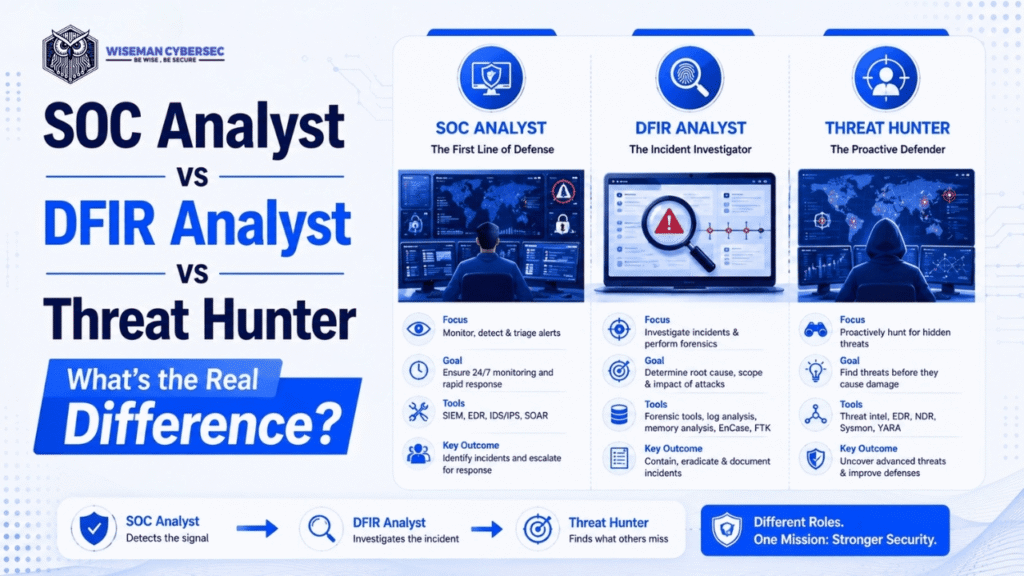
- SOC Analyst detects suspicious activity and responds to alerts.
- DFIR Analyst investigates confirmed incidents to determine what happened and how to recover.
- Threat Hunter proactively searches for hidden threats before they cause damage.
Together, they create a comprehensive security strategy that helps organizations detect, respond to, and prevent cyberattacks.
SOC Analyst – The First Line of Defense:
A Security Operations Center (SOC) Analyst is responsible for continuously monitoring an organization’s network, systems, endpoints, and security tools for signs of malicious activity.
Their primary objective is to identify, validate, and triage security alerts before they escalate into major incidents.
Primary Responsibilities:
- Monitor security alerts 24/7
- Analyze logs and security events
- Investigate suspicious activities
- Validate potential threats
- Escalate confirmed incidents
- Follow incident response playbooks
- Maintain continuous security monitoring
Common Tools:
SOC Analysts typically work with:
- Security Information and Event Management (SIEM)
- Endpoint Detection & Response (EDR)
- Intrusion Detection/Prevention Systems (IDS/IPS)
- Security Orchestration, Automation & Response (SOAR)
Key Skills:
- Log analysis
- Network security fundamentals
- Windows & Linux administration
- Threat detection
- Security monitoring
- Incident triage
Goal:
Identify threats as quickly as possible and ensure rapid escalation to minimize business impact.
DFIR Analyst – The Incident Investigator:
Digital Forensics and Incident Response (DFIR) Analysts take over once a security incident has been confirmed.
Rather than focusing on detection, they investigate exactly how the attack occurred, what systems were affected, how attackers gained access, and what evidence can be preserved.
Their work combines technical investigation with structured incident response.
Primary Responsibilities:
- Investigate security incidents
- Perform digital forensic analysis
- Identify root cause
- Determine attack timeline
- Analyze malware
- Preserve forensic evidence
- Support legal and compliance investigations
- Coordinate recovery activitiesPrepare an annual internal audit plan.
Common Tools:
DFIR professionals commonly use:
- EnCase
- FTK
- Volatility
- Autopsy
- Memory analysis tools
- Disk forensic tools
- Log analysis platforms
Key Skills:
- Digital forensics
- Malware analysis
- Memory forensics
- Incident response
- Evidence preservation
- Root cause analysis
Goal:
Contain the incident, eradicate the threat, recover affected systems, and prevent similar attacks in the future.
Threat Hunter – The Proactive Defender:
Unlike SOC Analysts who respond to alerts, Threat Hunters actively search for threats that have not yet triggered security controls.
Threat Hunting is hypothesis-driven and intelligence-led. Instead of waiting for alerts, Threat Hunters assume attackers may already be inside the environment and proactively look for indicators of compromise.
This role requires strong analytical thinking and deep knowledge of attacker techniques.
Primary Responsibilities:
- Search for hidden threats
- Analyze attacker behavior
- Investigate unusual activities
- Hunt advanced persistent threats (APTs)
- Improve detection rules
- Validate threat intelligence
- Identify gaps in existing defenses
Common Tools:
Threat Hunters frequently use:
- Threat Intelligence Platforms
- EDR solutions
- Network Detection & Response (NDR)
- Sysmon
- YARA
- MITRE ATT&CK Framework
- Threat hunting platforms
Key Skills:
- Threat intelligence
- Advanced log analysis
- Behavioral analytics
- MITRE ATT&CK mapping
- Adversary emulation
- Detection engineering
Goal:
Discover threats before they become active security incidents and continuously strengthen the organization’s defensive posture.
Comparing the Three Roles:
SOC Analyst
- Monitors security alerts
- First responder
- Focuses on detection
- Works with SIEM, EDR, IDS/IPS
- Escalates incidents
DFIR Analyst
- Investigates confirmed incidents
- Incident investigator
- Focuses on response and recovery
- Uses forensic and investigation tools
- Determines root cause
Threat Hunter
- Proactively searches for hidden threats
- Advanced threat seeker
- Focuses on prevention and early discovery
- Uses threat intelligence and hunting tools
- Improves future detection capabilities
How These Roles Work Together:
These roles are not competitors—they complement each other as part of a unified cybersecurity defense strategy.
A typical workflow looks like this:
- SOC Analyst detects unusual activity and validates the alert.
- The incident is escalated to the DFIR Analyst, who investigates, contains, and remediates the attack.
- Threat Hunters use insights from the investigation to search for similar attacker behavior across the environment and improve future detection mechanisms.
This collaborative approach enables organizations to respond faster, reduce attacker dwell time, and continuously strengthen their overall security posture.
Which Career Path Should You Choose?
Choosing between these roles depends on your interests and career goals.
Choose SOC Analyst if you enjoy:
- Continuous monitoring
- Security operations
- Log analysis
- Real-time alert handling
- Learning the fundamentals of cybersecurity
Choose DFIR Analyst if you enjoy:
- Digital investigations
- Malware analysis
- Incident response
- Root cause analysis
- Computer forensics
Choose Threat Hunter if you enjoy:
- Advanced cybersecurity
- Research and analysis
- Thinking like an attacker
- Threat intelligence
- Proactive security operations
Many cybersecurity professionals begin as SOC Analysts before progressing into DFIR, Threat Hunting, Detection Engineering, or Security Architecture roles.
Final Thoughts:
Cybersecurity is no longer about a single role protecting an organization. Modern defense requires a coordinated team where each specialist contributes at a different stage of the attack lifecycle.
SOC Analysts detect the signals, DFIR Analysts investigate and contain incidents, and Threat Hunters proactively uncover threats that traditional security controls may miss.
Together, these professionals help organizations reduce risk, respond effectively to incidents, and build resilient security operations.
Whether you’re starting your cybersecurity journey or expanding your Security Operations Center, understanding these distinct roles is essential for building a stronger, more proactive cyber defense strategy.
– Wiseman CyberSec
Advance Your Career in Cybersecurity
Master the skills required for roles like SOC Analyst, DFIR Analyst, Threat Hunter, Security Analyst, and Incident Responder with Wiseman CyberSec’s hands-on cybersecurity training programs.
Explore Our Cybersecurity & AI Security Courses and take the next step toward a successful career in cyber defense.