5 Common ISO 27001 Audit Mistakes Organizations Still Make
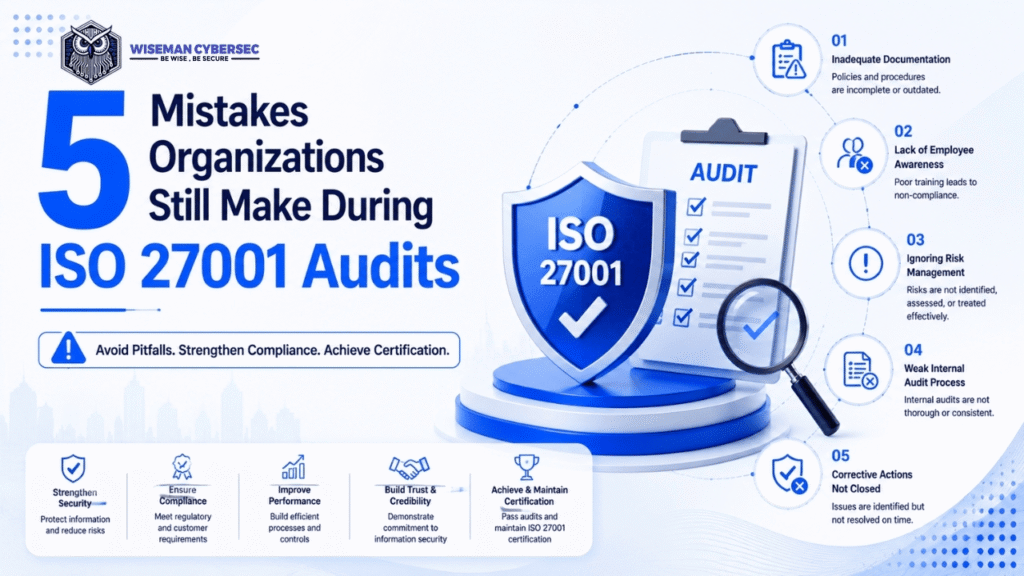
ISO 27001 certification is one of the most effective ways to demonstrate a strong information security management system. It helps organizations protect sensitive data, build customer trust, and show that security is managed through a structured and repeatable process. However, many organizations still struggle during audits because of avoidable mistakes that weaken compliance and create unnecessary findings. The good news is that most ISO 27001 audit issues are preventable. With the right documentation, employee awareness, risk management, internal audit discipline, and corrective action process, organizations can significantly improve their audit readiness and certification success. Why ISO 27001 audits matter: An ISO 27001 audit is not just a formal review of documents. It evaluates whether your organization’s information security management system is working in practice, not just on paper. Auditors want to see evidence that policies are implemented, risks are managed, employees are aware of their responsibilities, and corrective actions are tracked properly. For leadership, a successful audit reflects maturity, accountability, and resilience. For teams, it creates clarity around responsibilities and helps build a culture of security. That is why audit preparation should be treated as an ongoing business activity rather than a last-minute project. 1. Inadequate documentation: One of the most common reasons organizations struggle during an ISO 27001 audit is poor documentation. Policies may be incomplete, outdated, or not aligned with actual business processes. In some cases, documents exist only to satisfy the standard, but they are not actively used or reviewed. Auditors look for consistency between written policies and real-world practices. If the documentation says one thing and the organization does another, that inconsistency can lead to nonconformities. Strong documentation should be current, approved, version-controlled, and easy for relevant staff to access. How to avoid it: 2. Lack of employee awareness: Even the best policies fail if employees do not understand them. A common audit issue is weak security awareness across the workforce, especially when people cannot explain basic responsibilities such as incident reporting, password hygiene, access control, or data handling practices. ISO 27001 expects organizations to show that security awareness is part of daily operations. Training records alone are not enough if employees cannot apply what they learned. Auditors often ask staff how they would respond to phishing emails, suspicious activity, or unauthorized access attempts. How to avoid it: 3. Ignoring risk management: Risk management is the foundation of ISO 27001, yet many organizations treat it like a one-time compliance exercise. They complete a risk assessment during implementation but fail to update it when systems, vendors, regulations, or business processes change. This creates a disconnect between the ISMS and the actual risk environment. Auditors expect risk assessment and treatment to be active, not static. Risks should be identified, evaluated, assigned, treated, and reviewed on a regular basis. If the risk register is outdated, it suggests that the organization is not managing information security in a structured way. How to avoid it: 4. Weak internal audit process: Many organizations treat internal audits as a formality before the certification audit. That approach is risky because internal audits are meant to identify weaknesses early and help the organization improve before external auditors arrive. A weak internal audit process often means gaps are discovered too late or not at all. A good internal audit should be independent, risk-based, and thorough. It should cover applicable clauses, controls, and operational evidence. If internal audits are rushed or performed without proper expertise, the organization loses one of its most valuable tools for maintaining audit readiness. How to avoid it: 5. Corrective actions not closed: Another major audit mistake is failing to close corrective actions properly. Organizations may identify a nonconformity but then delay root cause analysis, correction, or follow-up. This creates repeat issues and weakens confidence in the management system. ISO 27001 auditors expect a complete corrective action cycle: identify the issue, determine the root cause, implement a fix, verify effectiveness, and document closure. If this process is inconsistent, the organization may appear reactive rather than mature and controlled. How to avoid it: What auditors look for : Auditors are not only checking whether you have documents in place. They are looking for evidence of discipline, consistency, and continuous improvement. They want to see that leadership is involved, employees understand their roles, risks are actively managed, and corrective actions are tracked effectively. A well-prepared organization usually demonstrates: How to improve audit readiness: The best way to prepare for an ISO 27001 audit is to make readiness part of everyday operations. Organizations that wait until the audit date is near often struggle with missing evidence, untrained staff, and unresolved actions. In contrast, organizations that build regular reviews into their ISMS are far more likely to succeed. A practical preparation cycle includes reviewing documentation, checking risk assessments, testing staff awareness, running internal audits, and closing any open findings. This creates a stronger system and reduces stress when the external audit begins. Final thoughts: ISO 27001 audits do not have to be stressful. Most problems come from preventable weaknesses rather than complex technical failures. By improving documentation, awareness, risk management, internal audits, and corrective action closure, organizations can build a more reliable and audit-ready ISMS. If your goal is certification, focus on consistency over speed and evidence over assumptions. A well-managed ISMS not only helps you pass the audit but also strengthens your long-term security posture. – Wiseman CyberSec Ready to simplify your ISO 27001 audit journey? Avoid common audit pitfalls with expert guidance from WisemanCyberSec. Whether you’re preparing for certification, conducting internal audits, or strengthening your ISMS, our cybersecurity professionals can help you achieve compliance with confidence. Contact WisemanCyberSec today to schedule an ISO 27001 consultation and assess your audit readiness.
Why Cybersecurity Is No Longer Just Technical: A Business Imperative for Every Organization
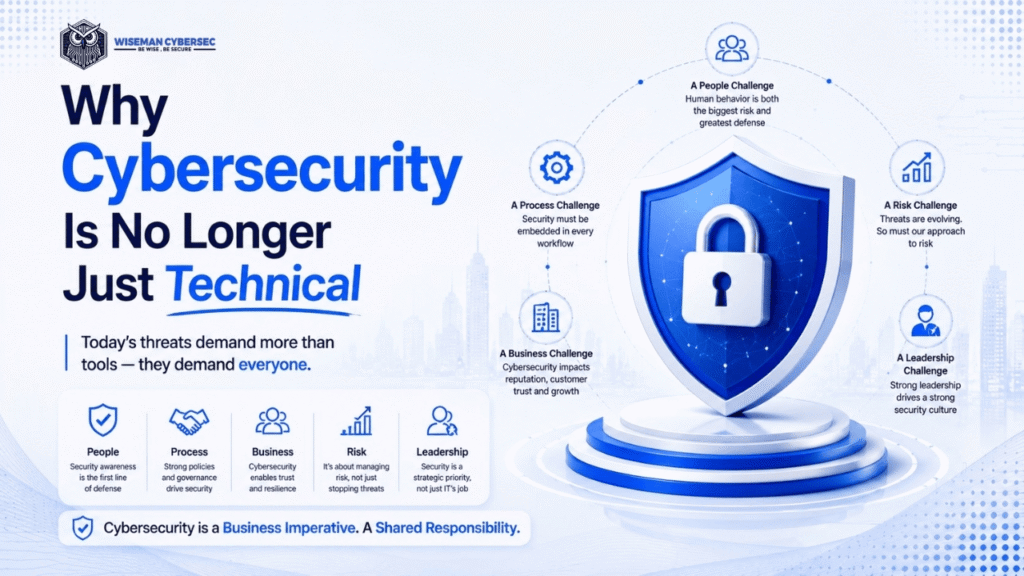
For many years, cybersecurity was treated as a narrow technical discipline owned by the IT department. Firewalls, antivirus tools, patching, and network defenses were seen as the primary answer to security threats. That approach is no longer enough. Today’s threat landscape is more complex, more human-driven, and more business-critical than ever before. Cybersecurity now affects reputation, customer trust, compliance, operations, revenue, and long-term resilience. The central message of this post is clear: cybersecurity must be embedded across the entire organization. It is not just about protecting systems; it is about protecting the business itself. When security is viewed only as a technical issue, organizations tend to react late, overlook human behavior, and create gaps between policy and practice. A modern security program must connect technology with governance, culture, leadership, and business strategy. The shift from technical to strategic: Cyber threats have evolved far beyond basic malware or unauthorized access attempts. Attackers now exploit people through phishing, social engineering, credential theft, business email compromise, and insider misuse. They target business processes, third-party relationships, cloud environments, and supply chains. This means that defending an organization requires more than technical controls alone. Security leaders must now think strategically. Cybersecurity decisions affect hiring, training, procurement, vendor selection, remote work policies, customer experience, and crisis management. In other words, security is not a separate layer added at the end; it is part of how the business operates from the beginning. The people challenge: Human behavior remains one of the biggest security risks. Employees can accidentally click malicious links, reuse weak passwords, mishandle sensitive data, or bypass procedures under pressure. At the same time, people are also the organization’s first and strongest line of defense when they are trained, informed, and empowered. This is why awareness programs alone are not enough. Organizations need a security culture where employees understand why controls exist and how their actions affect the company. That includes role-based training, leadership messaging, clear reporting channels, and practical guidance for everyday decisions. When people become part of the defense strategy, the organization becomes significantly harder to attack. The process challenge: Even the best security tools fail when processes are weak or ignored. Security must be embedded into workflows, not layered on as an afterthought. That means secure onboarding and offboarding, access reviews, change management, incident response procedures, backup testing, vendor risk checks, and documented approval paths. Strong processes create consistency. They reduce reliance on individual memory and ensure that security decisions are repeatable and measurable. In frameworks such as ISO 27001, this process-driven approach is essential because it ties security to governance, accountability, and continuous improvement. The goal is not just to prevent incidents, but to build an organization that can respond, recover, and adapt. The business challenge: Cybersecurity has direct business impact. A security incident can disrupt operations, delay services, damage client confidence, trigger legal exposure, and affect revenue. For customer-facing organizations, one breach can quickly become a reputation crisis. For regulated industries, the consequences may include fines, audits, and contractual loss. This is why business leaders must treat cybersecurity as a core business function. It is not merely a cost center or a technical overhead. It protects trust, preserves continuity, and supports growth. If the business depends on digital systems, customer data, and connected operations, then security is inseparable from business performance. The risk challenge: Risk is not static. Threats evolve, attackers adapt, and business environments change constantly. Remote work, cloud adoption, AI-enabled attacks, third-party dependencies, and shadow IT have expanded the attack surface. Security programs must therefore shift from a one-time control mindset to an ongoing risk management approach. A risk-based security strategy helps organizations prioritize what matters most. Not every asset carries the same level of exposure, and not every threat has the same business impact. Mature organizations assess likelihood and impact, apply controls where they matter most, and continuously review priorities as conditions change. This is what makes cybersecurity sustainable instead of reactive. The leadership challenge: Leadership determines whether cybersecurity becomes a real organizational priority or remains a technical checkbox. Strong leaders set the tone, allocate resources, demand accountability, and create a culture where security is taken seriously. Without leadership support, security teams often struggle to get buy-in for policy enforcement, training, investments, and process changes. Leaders do not need to be technical experts to support cybersecurity effectively. They do need to ask the right questions, understand business risk, and treat security as part of corporate governance. When executives visibly support security, teams across the organization are more likely to follow. That top-down commitment is often what separates mature organizations from vulnerable ones. Why shared responsibility matters: The post correctly frames cybersecurity as a shared responsibility. IT teams, security professionals, executives, managers, employees, vendors, and even customers all play a role in protecting the organization. No single team can stop every threat alone. Shared responsibility means that everyone has a part to play. Employees must follow secure practices, managers must enforce policies, executives must sponsor the program, and security teams must design practical controls that support business goals. When responsibility is distributed clearly, security becomes more resilient and far more effective. Building a modern security culture: A strong cybersecurity culture does not happen by chance. It is built through consistent communication, leadership commitment, process discipline, and ongoing education. Organizations should make security visible, understandable, and relevant to daily work. Practical steps include: These practices help move security from theory into daily behavior. Over time, they create an environment where secure choices become normal choices. Conclusion: Cybersecurity is no longer just a technical function because modern threats do not stay within technical boundaries. They affect people, processes, business operations, leadership decisions, and organizational risk. The most resilient organizations are the ones that treat security as a business imperative and a shared responsibility. – Wiseman CyberSec Ready to build a cybersecurity culture that protects your business? Explore Wiseman CyberSec’s cybersecurity, risk management, and governance training programs to empower your teams, strengthen resilience, and stay ahead of evolving threats.