A Complete Guide to Managing Vendor Risk
Modern organizations rarely operate alone. From cloud service providers and software vendors to consultants, payment processors, managed service providers, and outsourcing partners, businesses increasingly depend on third parties to run critical operations.
While these relationships can improve efficiency and scalability, they also introduce risk.
A security weakness, compliance failure, service disruption, or data breach at a third-party organization can directly affect your own business.
This is where Third-Party Risk Management (TPRM) becomes essential.
TPRM provides a structured approach for identifying, assessing, monitoring, and managing risks associated with vendors, suppliers, service providers, and other external organizations throughout the entire relationship lifecycle.
What is Third-Party Risk Management?
Third-Party Risk Management (TPRM) is the process of identifying and managing risks introduced by external organizations that provide products, services, technology, data processing, infrastructure, or other business functions.
These third parties may include:
- Cloud service providers
- Software-as-a-Service (SaaS) vendors
- IT service providers
- Consultants and contractors
- Payment processors
- Data processors
- Outsourcing partners
- Suppliers and manufacturers
- Managed security service providers
- Professional service organizations
The objective of TPRM is not simply to approve or reject vendors. It is to understand the level of risk associated with each relationship and ensure appropriate controls are implemented throughout the lifecycle.
Why Third-Party Risk Management Matters
Organizations may have strong internal cybersecurity controls, but their security posture can still be affected by their vendors.
If a third party has access to sensitive data, privileged systems, production environments, customer information, or critical business operations, weaknesses within that organization can become weaknesses for your business as well.
Cybersecurity Risk
A vendor may suffer a cyberattack, ransomware incident, credential compromise, or security breach that impacts your organization.
Data Privacy Risk
Third parties may process personal, financial, health, employee, or customer information on behalf of an organization. Improper handling of this data can lead to privacy violations and regulatory consequences.
Compliance Risk
Organizations are often responsible for ensuring that their vendors meet relevant regulatory, contractual, and industry requirements.
Operational Risk
If a critical vendor experiences an outage or operational disruption, essential business services may become unavailable.
Financial Risk
A financially unstable vendor may unexpectedly stop providing services or fail to meet contractual commitments.
Reputational Risk
Customers rarely distinguish between an organization and its vendors when something goes wrong. A major third-party incident can therefore damage trust and brand reputation.
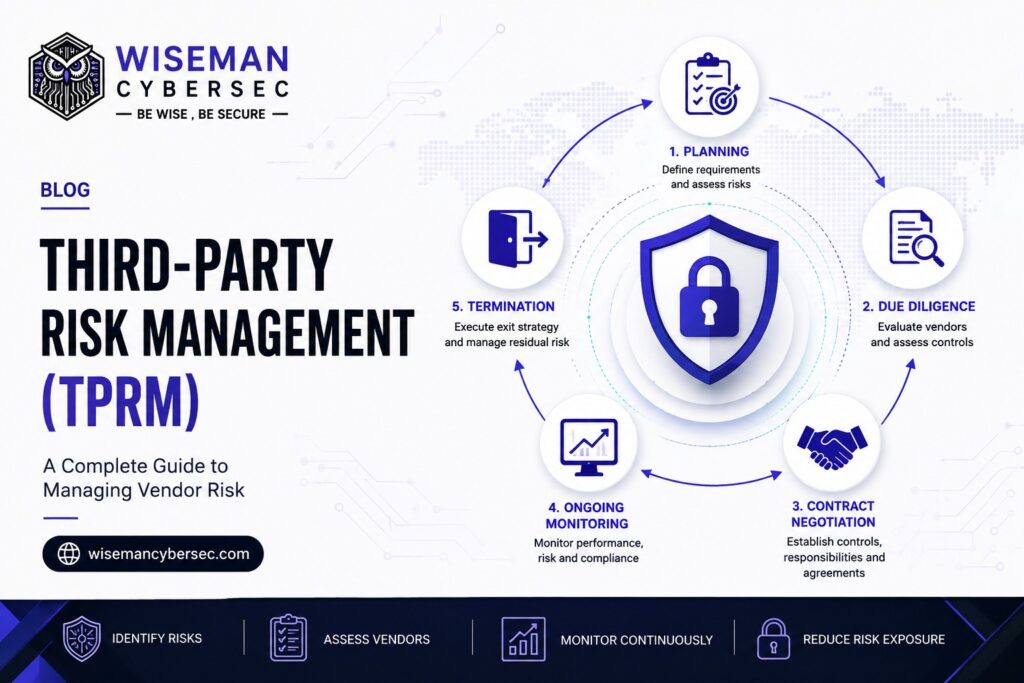
The Third-Party Risk Management Lifecycle
An effective TPRM program should manage third-party relationships from the moment a vendor is considered until the relationship is completely terminated.
The lifecycle can generally be divided into five major stages:
- Planning
- Due Diligence
- Contract Negotiation
- Ongoing Monitoring
- Termination
1. Planning
The first stage begins before a vendor is selected. Organizations should clearly define:
- Why the third party is required
- What service will be provided
- What information the vendor will access
- Whether sensitive or regulated data will be involved
- Which systems the vendor may connect to
- How critical the service is to business operations
- What risks could arise from the relationship
Not every third party carries the same level of risk. For example, a vendor supplying office furniture does not normally require the same level of cybersecurity assessment as a cloud provider storing customer data.
This is why organizations should classify vendors based on factors such as:
- Business criticality
- Data sensitivity
- System access
- Regulatory impact
- Operational dependency
- Financial dependency
A risk-based classification allows organizations to focus greater attention on higher-risk third parties.
2. Due Diligence
Once a potential vendor has been identified, organizations should perform appropriate due diligence. The purpose of due diligence is to determine whether the vendor has sufficient controls, capabilities, processes, and governance mechanisms to manage the risks associated with the relationship.
Security Assessment
Organizations may review areas such as:
- Information security policies
- Access control mechanisms
- Identity and authentication controls
- Encryption practices
- Vulnerability management
- Patch management
- Incident response capabilities
- Network security
- Backup and recovery
- Secure software development practices
- Employee security awareness
Depending on the nature of the relationship, organizations may also request security questionnaires, audit reports, certifications, penetration-testing reports, or other supporting documentation.
Compliance Review
Relevant compliance requirements may include standards, laws, frameworks, and contractual obligations. Organizations should assess whether the vendor can meet the compliance requirements applicable to the service being provided.
Privacy Assessment
If the vendor processes personal information, organizations should understand:
- What data is collected
- Why the vendor needs the data
- Where the information is stored
- Who can access the information
- How long the data is retained
- Whether subcontractors or sub-processors are involved
- How data will be deleted after termination
Business Continuity Assessment
Critical vendors should also be evaluated for operational resilience. This may include reviewing:
- Business continuity plans
- Disaster recovery procedures
- Backup arrangements
- Recovery objectives
- Dependency on subcontractors
- Geographic concentration
- Contingency plans
Due diligence should be proportionate to the risk presented by the vendor.
3. Contract Negotiation
Identifying risk is not enough. The contractual agreement should clearly establish how those risks will be managed.
Security Requirements
The contract should clearly define the security controls the third party is expected to maintain.
Confidentiality
Requirements regarding confidential and sensitive information should be clearly documented.
Data Protection
Where personal data is processed, responsibilities relating to privacy, data processing, retention, deletion, and breach notification should be defined.
Incident Notification
The organization should establish how quickly the vendor must notify it about security incidents or breaches.
Audit Rights
Organizations may require contractual rights to assess or audit relevant vendor controls.
Service-Level Agreements
Performance expectations should be clearly documented through appropriate service-level agreements.
Subcontractor Requirements
Organizations should understand whether vendors can use subcontractors and what security requirements apply to those organizations.
Liability and Indemnification
Contracts should clearly establish responsibilities where failures, breaches, or service disruptions occur.
Termination Requirements
Exit obligations should be defined before the relationship begins. Waiting until the end of the relationship to plan vendor termination can create unnecessary security and operational risks.
4. Ongoing Monitoring
A common mistake in third-party risk management is treating vendor assessment as a one-time exercise. Risk changes continuously.
A vendor that was considered secure two years ago may have experienced major changes in its infrastructure, leadership, ownership, financial condition, or cybersecurity posture.
Organizations should therefore monitor relevant third parties throughout the relationship. Ongoing monitoring can include:
- Periodic security assessments
- Review of audit reports
- Compliance certification reviews
- Performance monitoring
- Service-level monitoring
- Security rating changes
- Breach and incident monitoring
- Financial stability checks
- Regulatory developments
- Changes in ownership
- Changes in subcontractors
- Changes in technology or service delivery
The frequency and depth of monitoring should depend on the vendor’s level of risk. Critical vendors may require more frequent reviews than low-risk suppliers.
Third-Party Contingency Planning
Organizations should also consider what happens if a critical vendor becomes unavailable. Questions to consider include:
- What happens if the vendor suffers a ransomware attack?
- What happens if the service is unavailable for several days?
- What happens if the vendor becomes financially insolvent?
- Can another provider replace the service?
- Can the organization temporarily operate without the vendor?
- How quickly can data and systems be migrated elsewhere?
Organizations should avoid becoming so dependent on a third party that the vendor effectively becomes a single point of failure. Proper contingency planning can significantly reduce this risk.
5. Third-Party Termination and Exit Management
The final stage of the TPRM lifecycle is vendor termination. This stage is often underestimated, but poorly managed vendor exits can create serious security risks.
When a relationship ends, organizations should ensure that:
- Vendor user accounts are disabled
- Privileged access is revoked
- Remote access is removed
- API keys and credentials are rotated
- Physical access is terminated
- Company assets are returned
- Sensitive information is returned or securely deleted
- Data deletion requirements are verified
- Software integrations are disconnected
- Responsibilities are transferred appropriately
- Outstanding security issues are resolved
Organizations should also verify whether the third party has retained copies of sensitive information. Where appropriate, evidence of secure deletion may be requested.
A structured exit process helps ensure that vendor access and data do not remain active after the business relationship has ended.
Building a Risk-Based TPRM Program
An effective TPRM program does not need to perform the same level of assessment for every vendor. Instead, organizations should adopt a risk-based approach.
Low-Risk Vendor
A supplier with no access to sensitive data, systems, or critical infrastructure may require only basic onboarding checks.
Medium-Risk Vendor
A provider with limited access to internal information or non-critical systems may require additional security and compliance assessment.
High-Risk Vendor
A cloud platform, payment provider, managed service provider, or vendor processing sensitive customer information may require extensive due diligence, contractual controls, continuous monitoring, and executive oversight.
This approach helps organizations allocate resources efficiently while maintaining appropriate levels of risk management.
TPRM is a Continuous Process
Third-Party Risk Management should never be viewed simply as a vendor questionnaire or annual compliance exercise. It is an ongoing lifecycle.
Organizations must continuously understand:
- Who their third parties are.
- What information and systems those third parties can access.
- What risks they introduce.
- What controls are being used to manage those risks.
- How those risks change over time.
- What happens when something goes wrong.
As organizations continue adopting cloud platforms, outsourcing business processes, integrating external applications, and relying on complex digital supply chains, third-party risk management will only become more important.
Skills in Third-Party Risk Management
For cybersecurity and GRC professionals, TPRM is also becoming an increasingly valuable professional skill.
Understanding vendor risk can benefit professionals working in areas such as:
- Governance, Risk and Compliance
- Cybersecurity
- Information Security
- IT Risk
- Internal Audit
- Vendor Risk Management
- Data Privacy
- Information Security Governance
- Compliance
- Cybersecurity Consulting
Professionals who understand both cybersecurity controls and business risk are particularly well positioned to work in third-party risk management roles.
Final Thoughts
Organizations cannot eliminate third-party risk simply by avoiding vendors. Modern businesses depend on complex networks of service providers, technology platforms, contractors, suppliers, and partners.
The goal of TPRM is therefore not to eliminate every possible risk. It is to identify, understand, prioritize, manage, and continuously monitor third-party risks so that organizations can make informed business decisions.
A mature Third-Party Risk Management program brings together cybersecurity, risk management, compliance, procurement, legal, privacy, and business teams to ensure that third-party relationships remain secure throughout their complete lifecycle.