AI-Operated Cyberattacks Are Here: What Security Teams Need to Learn from the Latest Claude AI Abuse Case
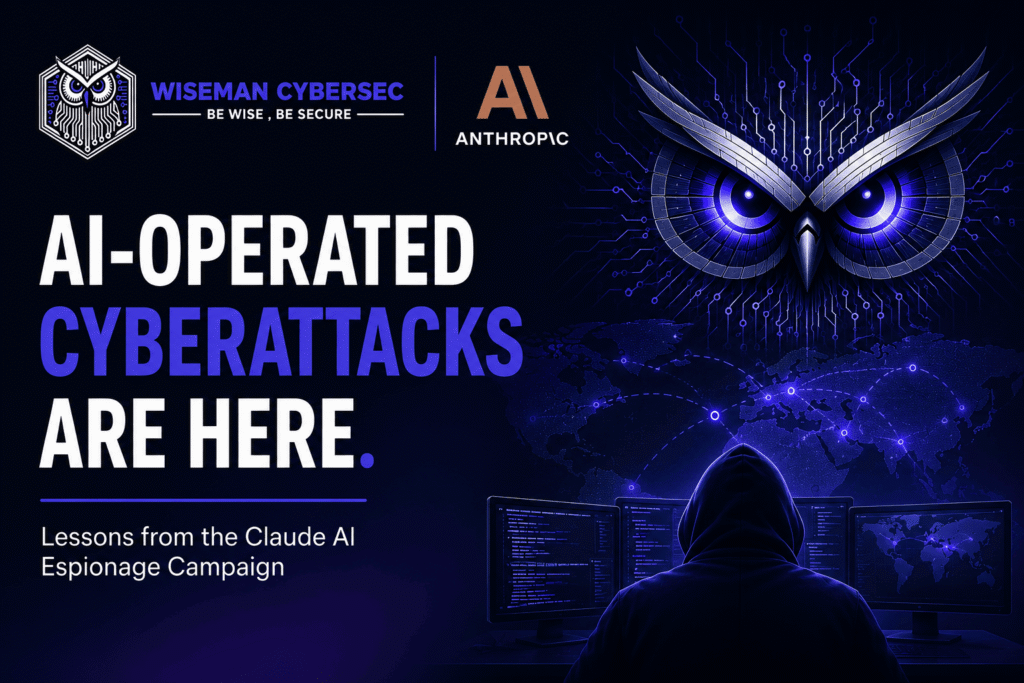
Artificial Intelligence is changing cybersecurity faster than many organizations expected. For defenders, AI is helping with faster alert triage, threat intelligence analysis, malware investigation, phishing detection, and security automation. But the same technology is now being adopted by attackers to increase speed, scale, and efficiency. A recent report highlighted that Chinese state-sponsored threat actors allegedly used Anthropic’s Claude AI to support a highly automated cyber-espionage campaign targeting around 30 global organizations, including technology companies, financial institutions, chemical manufacturers, and government agencies. The activity reportedly took place in mid-September 2025 and involved the misuse of Claude Code and related tooling to automate large parts of the attack lifecycle. This incident is important because it shows a shift from AI-assisted hacking to AI-operated hacking. From AI as an Assistant to AI as an Attack Operator: Until now, most AI misuse in cybercrime was seen in areas such as phishing email generation, basic script writing, social engineering content, or malware modification attempts. This case is different. According to the report, the attackers did not simply use AI to ask for advice. They allegedly used AI’s agentic capabilities to perform tactical cyber operations across multiple stages of the attack chain. The AI was reportedly used for: • Reconnaissance and attack surface mapping• Vulnerability discovery• Payload generation and validation• Exploitation support• Credential harvesting• Lateral movement assistance• Data analysis• Exfiltration-related decision support• Attack documentation This means AI was not just helping write commands. It was being used to break down complex cyber operations into smaller tasks and execute them at speed. Why This Matters for Security Leaders: The biggest concern here is scale. In a traditional cyberattack, multiple skilled operators may be needed to perform reconnaissance, identify vulnerabilities, write payloads, validate access, analyze stolen data, and document findings. With agentic AI, one operator may be able to manage a much larger volume of activity. That changes the economics of cyberattacks. Attackers can move faster.They can test more targets.They can automate repetitive tasks.They can reduce dependency on large technical teams.They can potentially scale campaigns that earlier required more time, skill, and manpower. For organizations, this means the window to detect and respond may become much shorter. The Human Role Has Not Disappeared: One important point is that the campaign was not fully independent. Human operators were still involved in key decisions, such as selecting targets, approving escalation from reconnaissance to exploitation, deciding when to use harvested credentials, and determining what data should be retained or exfiltrated. This tells us something important. AI is not replacing attackers completely. It is increasing their operational capacity The attacker still provides strategy.The AI accelerates execution. That combination is what makes this threat serious. AI Still Makes Mistakes: The report also highlighted a major limitation: AI hallucination. In some cases, the AI reportedly generated fake credentials or incorrectly treated publicly available information as sensitive findings. This shows that AI-operated attacks are not perfect. They still require human validation. But even with these limitations, the ability to automate 70–90% of tactical work can still create a major advantage for threat actors. For defenders, this is a warning. We should not underestimate AI-enabled attackers just because AI makes mistakes. Even imperfect automation can create pressure on security teams. Identity Security And Zero Trust: Identity security is a foundational part of Zero Trust. The Zero Trust model assumes that no user, device, or network should be trusted automatically. Every access request must be evaluated before it is approved. This is only possible when identity is at the center of the architecture. Identity provides the data and controls needed to verify users, enforce policy, and make access decisions based on real-time risk. In a Zero Trust model, identity is not a one-time login step. It is a continuous trust mechanism that supports secure access throughout the session. This is one reason why identity security is becoming more important than traditional perimeter controls. What This Means for SOC and Blue Teams: Security Operations Centers must prepare for a future where attackers operate faster and with more automation. Traditional alert monitoring will not be enough. SOC teams need stronger capability in: The focus should move from simply collecting alerts to understanding attacker behavior. If attackers are using AI to speed up reconnaissance and exploitation, defenders must improve visibility, response speed, and contextual analysis. Identity Security Becomes Even More Critical: A major part of modern attacks involves credential theft, privilege escalation, and lateral movement. When AI is used to automate post-exploitation tasks, weak identity controls become even more dangerous. Organizations should focus on: Identity is now one of the most important security control points. The New Skill Requirement: AI-Aware Cybersecurity Professionals: Cybersecurity professionals must now understand both sides of AI. They need to know how AI can help defenders, but also how attackers may abuse it. This includes understanding: The next generation of SOC analysts, threat hunters, incident responders, and security leaders must be trained for this new reality. Wiseman CyberSec Perspective: At Wiseman CyberSec, we believe this incident is a clear signal that cybersecurity training and security operations must evolve. The industry cannot rely only on traditional tool-based learning. Security professionals need hands-on exposure to real-world attack scenarios, practical detection logic, open-source security tools, adversary behavior, AI-assisted investigation, and modern incident response workflows. AI will not remove the need for cybersecurity professionals. But it will raise the standard. The professionals who understand AI-driven threats, attacker tradecraft, and defensive automation will be far better prepared for the future. Final Takeaway: AI-operated cyberattacks are no longer a future risk. They are already becoming part of the threat landscape. For organizations, the message is clear: The attackers are evolving. Security teams must evolve faster. – Wiseman CyberSec Stay Ahead of AI-Driven Threats- Cyberattacks are evolving faster than ever. Build practical cybersecurity skills in SOC operations, threat hunting, incident response, and modern defensive strategies.